THE CLASSIC COLLECTION✦An outlaw’s diary: the CommuneCLASSIC FREE BOOKS
An outlaw’s diary: the Commune
Cécile Tormay
THE CLASSIC COLLECTION · 1916
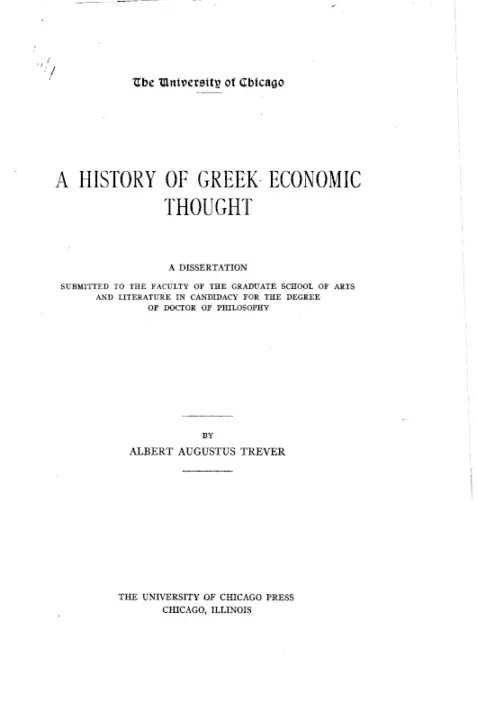
"A History of Greek Economic Thought" by Albert Augustus Trever is a scholarly dissertation composed in the early 20th century. This work explores the evolution of economic theories as conceptualized by ancient Greek philosophers, placing their ideas within the context of both their time and the present humanitarian economic discourse. The book aims to not just chronicle, but also reinterpret Greek economic thought, connecting ancient ideas with modern economic principles. The opening of the work sets forth the author's intention to fulfill a scholarly gap in the discourse of Greek economic theory. It discusses the existing literature on the subject, noting that previous works often failed to approach the topic from the perspective of a classicist infused with a modern economic view. Trever emphasizes that the Greeks, despite their simpler economic environment, fostered significant ethical and humanistic considerations in their economic theories that resonate with contemporary thought. By establishing a chronological format, he intends to analyze the ideas of prominent Greek thinkers, such as Plato and Aristotle, in relation to the economic conditions of their epoch.
Introduction adapted from the source catalogue; source summaries may be automatically generated.
Free to read · English · 58,276 words · No account needed
MAKE TIME FOR A GOOD BOOK
On by default. Untick to stop anonymous reading totals. Each page counts after 10 seconds in view. How this works.
Anonymous counting is on unless you have switched it off.
Laws 740D; but his specific methods for carrying out his difficult suggestion, if he had any to offer, were probably impracticable, judging by his discussion of women and children in the Republic. Ruskin’s suggestions for meeting the problem are colonization, reclamation of waste lands, and discouragement of marriage (Unto This Last, IV, 80 [Vol. XVII, 108]).
Footnote 248:
Laws 740E; Ar. (Pol. 1265b6-12) unfairly criticizes him for limiting the amount of property, and making it indivisible, while failing to provide against a too high birth-rate.
Footnote 249:
Footnote 250:
Cf. Ruskin, cited above, p. 27.
Footnote 251:
For the Greek term, cf. infra on Aristotle.
Footnote 252:
Cf., however, Xen. Mem. ii. 7. 12-14, discussed infra, which may be a suggestion of a theory of profits.
Footnote 253:
Laws 921A-D, discussed on p. 39, n. 8; cf. also 847B.
Footnote 254:
The passages above cited, n. 1 above, need not imply labor for capitalists. It does not appear that there was ever a considerable body of free citizen laborers at Athens, who worked for capitalists, though the number of free workers, aside from labor on the farms, was fairly large. Cf. C.I.A. for records of such labor on the buildings of the acropolis; Boeckh, op. cit., I, 58: “Der geringere war durch seine Umstände so gut als der arme Schutzverwandte oder Sklave zur Handarbeit genöthigt.” On the favorable attitude toward free labor at Athens, cf. above, p. 29, n. 4. Poehlmann (op. cit., in loc.) takes the opposite view as to the number of free laborers for capitalists.
Footnote 255:
Rep. 552B-D, a characteristic passage; Gorg. 507E; Laws 757B.
Footnote 256:
Footnote 257:
740B ff., 923; but his purpose is to keep the allotments intact.
Footnote 258:
847B: μισθῶν δὲ αὐτοῖς περὶ καὶ τῶν ἀναιρέσεων τῶν ἔργων, καὶ ἐάν τις αὐτοὺς ἕτερος ἢ κεῖνοί τινα ἄλλον ἀδικῶσι, μέχρι δραχμῶν πεντήκοντα ἀστυνόμοι διαδικαζόντων, etc.; perhaps a strained interpretation.
Footnote 259:
On his attitude to industry, cf. pp. 32 ff.
Footnote 260:
Bonar, op. cit., p. 29.
Footnote 261:
Bussy, Histoire et Réfutation du Socialisme (1859), p. 119.
Footnote 262:
Oncken, op. cit., p. 34.
Footnote 263:
Haney, op. cit., p. 16.
Footnote 264:
Zeller, Phil. Gr., II, 1 (1889), 907; cf. also above, pp. 32 f. Historians of economic thought generally state the case extremely; e.g., Kautz, op. cit., p. 59; Blanqui, op. cit., p. 45; Souchon also, to some extent. Poehlmann (op. cit., II, 36-108) errs in the opposite way.
Footnote 265:
Pol. ii. 5. 1264a11-17, 36-38; 1264b11-13.
Footnote 266:
423D: ὡς δόξειεν ἄντις; also 425D, both cited by Poehlmann.
Footnote 267:
415E-417B, 420A-421C admit of no other interpretation. Cf. 421C, how he turns to the next related point (τοῦ τούτου ἀδελφόν) the question of the effect of wealth or poverty on the artisans (τοὺς ἄλλους δημιουργούς). Cf. also infra for other citations.
Footnote 268:
Pol. 1264a36-38, repeated by many moderns.
Footnote 269:
Rep. 415B-C.
Footnote 270:
Your reading position is saved on this browser. Take it to another device with a library code. Reading pages adapt to text, rather than matching a printed edition.
BEHIND THE BOOK
This eBook is for the use of anyone anywhere in the United States and most other parts of the world at no cost and with almost no restrictions whatsoever. You may copy it, give it away or re-use it under the terms of the Project Gutenberg License included with this eBook or online at www.gutenberg.org. If you are not located in the United States, you will have to check the laws of the country where you are located before using this eBook. Read the source licence.
The original source file, including credits and licence, is retained by this library. Request an original-format copy at no charge. Please include the book title and Project Gutenberg identifier #58204.
KEEP YOUR CURIOSITY GOING
Cécile Tormay

Moritz Busch
John L. Ransom
Frances Wright
Cécile Tormay

Mabel Potter Daggett