THE CLASSIC COLLECTION✦An outlaw’s diary: the CommuneCLASSIC FREE BOOKS
An outlaw’s diary: the Commune
Cécile Tormay
THE CLASSIC COLLECTION · 1916
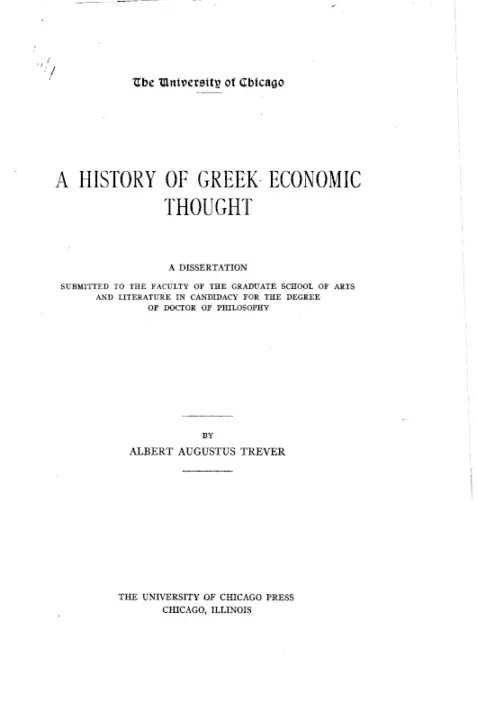
"A History of Greek Economic Thought" by Albert Augustus Trever is a scholarly dissertation composed in the early 20th century. This work explores the evolution of economic theories as conceptualized by ancient Greek philosophers, placing their ideas within the context of both their time and the present humanitarian economic discourse. The book aims to not just chronicle, but also reinterpret Greek economic thought, connecting ancient ideas with modern economic principles. The opening of the work sets forth the author's intention to fulfill a scholarly gap in the discourse of Greek economic theory. It discusses the existing literature on the subject, noting that previous works often failed to approach the topic from the perspective of a classicist infused with a modern economic view. Trever emphasizes that the Greeks, despite their simpler economic environment, fostered significant ethical and humanistic considerations in their economic theories that resonate with contemporary thought. By establishing a chronological format, he intends to analyze the ideas of prominent Greek thinkers, such as Plato and Aristotle, in relation to the economic conditions of their epoch.
Introduction adapted from the source catalogue; source summaries may be automatically generated.
Free to read · English · 58,276 words · No account needed
MAKE TIME FOR A GOOD BOOK
On by default. Untick to stop anonymous reading totals. Each page counts after 10 seconds in view. How this works.
Anonymous counting is on unless you have switched it off.
Footnote 577:
Cf. especially 1258a34 ff.: μάλιστα δὲ, καθάπερ εἴρεται πρότερον, δεῖ φύσει τοῦτο ὑπάρχειν. Cf. Susemihi and Hicks, Pol. of Ar., I (1894), Intro., p. 30.
Footnote 578:
1256a40 ff., αὐτόφυτος, “self-existent,” with ἔργασία, as here, equals αὐτουργία, “agriculture.”
Footnote 579:
1258b9-27.
Footnote 580:
Op. cit., pp. 96, 98 f., n. 1; cf. Haney, op. cit., p. 47; Kautz, op. cit., p.138; Ingram, op. cit., p. 18. The physiocrats thought that commerce and industry increased the value of raw materials only enough to pay for labor and capital expended. Commerce was an expensive necessity, a tax on agriculture. For a good summary, cf. Haney, pp. 138 ff. Quesnay (Tableau Econ. [1776]) followed Xenophon (Econ. v. 17) as his motto. But the motive of the physiocrats was economic, not moral and political, as was that of Aristotle.
Footnote 581:
Pol. 1258b21 ff.; probably implied also in 1256a40 ff.; but cf. vi (iv). 4. 1291a1 ff., where the mechanic and hired laborer are counted among the necessary parts of the state.
Footnote 582:
1256 ff.; 1256b23 f. To him, production is a branch of acquisition. Cf. p. 28, on Plato’s use of the terms.
Footnote 583:
1258a19-38; 1254a7, cited on p. 88, n. 10.
Footnote 584:
Op. cit., pp. 358, 375 f.
Footnote 585:
Op. cit., p. 39, on the basis of Pol. 1258b34 f.: τὸ δὲ κατὰ μέρος ἀκριβολογεῖσθαι χρήσιμον μὲν πρὸς τὰς ἐργασίας, φορτικὸν δὲ τὸ ἐνδιατρίβειν. φορτικόν may mean merely “tiresome,” not “vulgar.”
Footnote 586:
Cf. Zmavc, Archiv., etc., p. 431; cf. passages cited infra, on the attitude of Aristotle to labor; cf. vi (iv). 4. 1291a1 ff., especially ἔστι δὲ τοῦτο τὸ περὶ τὰς τέχνας ὧν ἄνευ πόλιν ἀδύνατον οἰκεῖσθαι.
Footnote 587:
Pol. 1258a34-38, cited on p. 89, n. 2.
Footnote 588:
1258b9-21.
Footnote 589:
Ibid. 40 ff.; cf. Newman, op. cit., II, 204, on the statements of Varro De re rustica i. 1. 8 and Columella i. 1. 7 that Aristotle and Theophrastus wrote on agriculture. Cf. also (Plato) Axiochus 368C.
Footnote 590:
Pol. iv (vii). 9. 1329a1 f.
Footnote 591:
1254a1 ff.; cf. pp. 68 and 88 for Greek terms.
Footnote 592:
1254a2-4.
Footnote 593:
Op. cit., ii, chap. i.
Footnote 594:
Pol. 1254a7; cf. p. 88, n. 10.
Footnote 595:
Pol. 1254a8 ff. He thinks chiefly of the domestic slave.
Footnote 596:
Unto This Last, p. 61, an unjust criticism of Mill; ibid., IV, 78: “Production is primarily for the mouth, not for the granary.”
Footnote 597:
Op. cit., IV, chap. viii: “Consumption is the sole end and purpose of all production; ... and the interest of the producer ought to be attended to only so far as it may be necessary for promoting that of the consumer.”
Footnote 598:
For reference and Greek terms, cf. p. 68.
Footnote 599:
For his term ἀφορμή cf. p. 68, n. 8, and infra. It probably was a mere business word to him. DuBois (op. cit., p. 38) thinks that he had a very clear idea of its significance.
Footnote 600:
Pol. 1258b12-21; cf. 1258a37 f.
Footnote 601:
Ibid. 21-27, and entire chaps., 8-11. For terms, cf. infra.
Footnote 602:
iv. 1121a29; 1122a14 f.; cf. the stress on δόσις and χρῆσις rather than on κτῆσις and λῆψις, 1120a8-13; b14-16, and Stewart’s notes, I, 323.
Footnote 603:
Your reading position is saved on this browser. Take it to another device with a library code. Reading pages adapt to text, rather than matching a printed edition.
BEHIND THE BOOK
This eBook is for the use of anyone anywhere in the United States and most other parts of the world at no cost and with almost no restrictions whatsoever. You may copy it, give it away or re-use it under the terms of the Project Gutenberg License included with this eBook or online at www.gutenberg.org. If you are not located in the United States, you will have to check the laws of the country where you are located before using this eBook. Read the source licence.
The original source file, including credits and licence, is retained by this library. Request an original-format copy at no charge. Please include the book title and Project Gutenberg identifier #58204.
KEEP YOUR CURIOSITY GOING
Cécile Tormay

Moritz Busch
John L. Ransom
Frances Wright
Cécile Tormay

Mabel Potter Daggett