THE CLASSIC COLLECTION✦An outlaw’s diary: the CommuneCLASSIC FREE BOOKS
An outlaw’s diary: the Commune
Cécile Tormay
THE CLASSIC COLLECTION · 1916
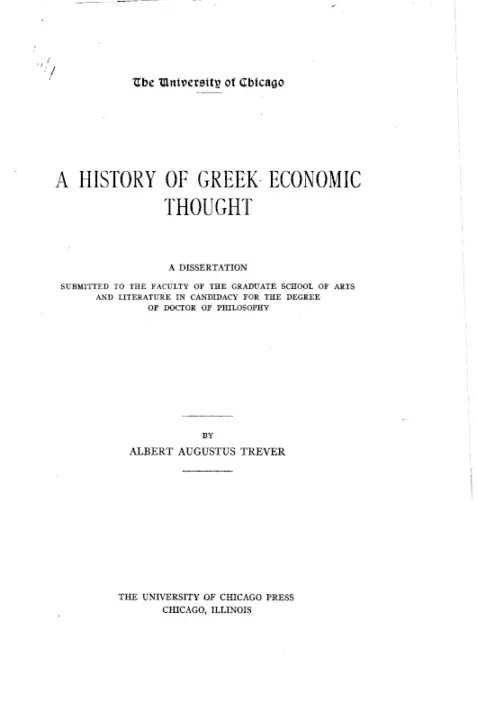
"A History of Greek Economic Thought" by Albert Augustus Trever is a scholarly dissertation composed in the early 20th century. This work explores the evolution of economic theories as conceptualized by ancient Greek philosophers, placing their ideas within the context of both their time and the present humanitarian economic discourse. The book aims to not just chronicle, but also reinterpret Greek economic thought, connecting ancient ideas with modern economic principles. The opening of the work sets forth the author's intention to fulfill a scholarly gap in the discourse of Greek economic theory. It discusses the existing literature on the subject, noting that previous works often failed to approach the topic from the perspective of a classicist infused with a modern economic view. Trever emphasizes that the Greeks, despite their simpler economic environment, fostered significant ethical and humanistic considerations in their economic theories that resonate with contemporary thought. By establishing a chronological format, he intends to analyze the ideas of prominent Greek thinkers, such as Plato and Aristotle, in relation to the economic conditions of their epoch.
Introduction adapted from the source catalogue; source summaries may be automatically generated.
Free to read · English · 58,276 words · No account needed
MAKE TIME FOR A GOOD BOOK
On by default. Untick to stop anonymous reading totals. Each page counts after 10 seconds in view. How this works.
Anonymous counting is on unless you have switched it off.
Footnote 224:
Cf. 415E, χρηματιστικάς in contrast to στρατιωτικάς.
Footnote 225:
Footnote 226:
Footnote 227:
Footnote 228:
915A-B, though it applies especially to freedmen.
Footnote 229:
850B-C, and n. 1, above.
Footnote 230:
Footnote 231:
849D-E, 850A, 915D; cf. infra on this and the other regulations in their application to modern economics.
Footnote 232:
916D-E; cf. 917.
Footnote 233:
Footnote 234:
920B-C. Plato’s market regulations would exclude all selfish competition and all gain, beyond mere return for labor expended, from exchange, and would base it upon a mutual spirit of reciprocity. Thus here, as often, he is the model for Aristotle, who usually fails to recognize his debt. Espinas (Revue des Etudes Grecques, XXVII [1914], 246) is hardly in accord with the modern spirit in declaring that competition is the social bond, and that Plato misconceives the nature of this bond.
Footnote 235:
Footnote 236:
Laws 920C.
Footnote 237:
Zimmern (op. cit., p. 280, n. 1) calls it “grandfatherly.”
Footnote 238:
But cf. Robin, op. cit., p. 212, n. 1, who argues that many of his suggestions are based on actual legislation in Athens or elsewhere in Greece. Cf. also Hermann, Ges. Abh. (1849), pp. 141, 153, 159, whom he cites; J. Schulte, Quomodo Plato in legibus publica Atheniensium instituta respexerit (1907, dissertation), and the bibliography cited there. But he deals very little with Plato’s economic and social laws.
Footnote 239:
Plato saw that it might add a time and place value (p. 41, and notes).
Footnote 240:
Cf. above, p. 42, n. 7; also Fors Clav., Letters 45, 82; Crown of Wild Olive, II, 75 f. (Vol. XVIII, 450 f.). He argues that there should be no profit in exchange, beyond merely the payment for the labor involved in it. He insists that “for every plus in exchange there is a precisely equal minus.” Cf. infra on Aristotle for a similar idea, pp. 107 ff.
Footnote 241:
Op. cit., p. 278, n. 2; cf. above, pp. 42 f.
Footnote 242:
Cf. p. 43.
Footnote 243:
Ibid.
Footnote 244:
Ibid. Cf. Ruskin’s more socialistic idea that all retailers be made salaried officers (Time and Tide, XXI, 134 [Vol. XVII, 427]).
Footnote 245:
Cf. e.g., Dem. De corona 87; Cont. Lept. xx. 31; Cont. Andr. xxii. 15; Cont. Lacrit. xxxv. 50; Lysias xxii; Hdt. vii. 102; Thuc. iii. 86, and many other passages. For modern discussions, cf. Droysen, Athen und der Westen (1882), pp. 41 ff.; Grundy, Thucydides and the History of His Age (1911), pp. 58-95; Zimmern, op. cit., 1st ed., pp. 349 ff.; Gernet, “L’Approvisionment d’Athènes en blé,” Mélanges d’histoire, ancienne, 1909; Beloch, G. G., I, 406 f.; Bevölkerung im Alterthum (1898), p. 30, etc.
Footnote 246:
Rep. 372C: οὐχ ὑπὲρ τὴν οὐσίαν ποιούμενοι τοὺς παῖδας.
Footnote 247:
Your reading position is saved on this browser. Take it to another device with a library code. Reading pages adapt to text, rather than matching a printed edition.
BEHIND THE BOOK
This eBook is for the use of anyone anywhere in the United States and most other parts of the world at no cost and with almost no restrictions whatsoever. You may copy it, give it away or re-use it under the terms of the Project Gutenberg License included with this eBook or online at www.gutenberg.org. If you are not located in the United States, you will have to check the laws of the country where you are located before using this eBook. Read the source licence.
The original source file, including credits and licence, is retained by this library. Request an original-format copy at no charge. Please include the book title and Project Gutenberg identifier #58204.
KEEP YOUR CURIOSITY GOING
Cécile Tormay

Moritz Busch
John L. Ransom
Frances Wright
Cécile Tormay

Mabel Potter Daggett