THE CLASSIC COLLECTION✦An outlaw’s diary: the CommuneCLASSIC FREE BOOKS
An outlaw’s diary: the Commune
Cécile Tormay
THE CLASSIC COLLECTION · 1916
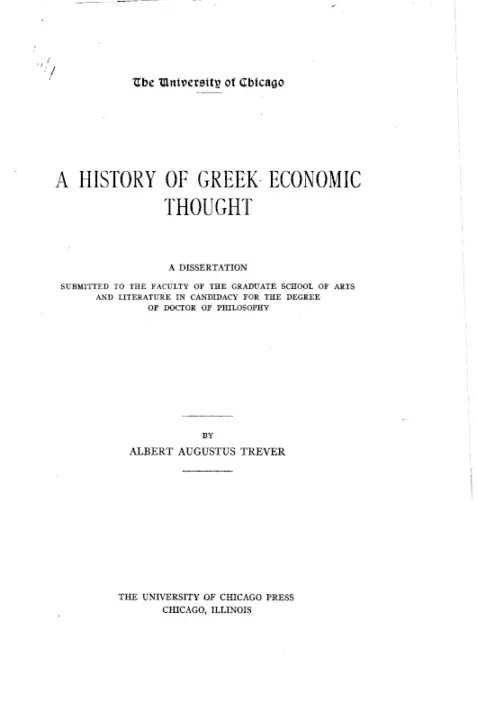
"A History of Greek Economic Thought" by Albert Augustus Trever is a scholarly dissertation composed in the early 20th century. This work explores the evolution of economic theories as conceptualized by ancient Greek philosophers, placing their ideas within the context of both their time and the present humanitarian economic discourse. The book aims to not just chronicle, but also reinterpret Greek economic thought, connecting ancient ideas with modern economic principles. The opening of the work sets forth the author's intention to fulfill a scholarly gap in the discourse of Greek economic theory. It discusses the existing literature on the subject, noting that previous works often failed to approach the topic from the perspective of a classicist infused with a modern economic view. Trever emphasizes that the Greeks, despite their simpler economic environment, fostered significant ethical and humanistic considerations in their economic theories that resonate with contemporary thought. By establishing a chronological format, he intends to analyze the ideas of prominent Greek thinkers, such as Plato and Aristotle, in relation to the economic conditions of their epoch.
Introduction adapted from the source catalogue; source summaries may be automatically generated.
Free to read · English · 58,276 words · No account needed
MAKE TIME FOR A GOOD BOOK
On by default. Untick to stop anonymous reading totals. Each page counts after 10 seconds in view. How this works.
Anonymous counting is on unless you have switched it off.
Footnote 549:
Pol. 1254a16 ff.: κτῆμα δὲ ὄργανον πρακτικὸν καὶ χωριστὸν, similar to Walker’s term “transferability” (Pol. Econ., 3d ed., p. 5); cf. Mill, op. cit., preliminary remarks on the term.
Footnote 550:
N. Eth. iv. 1. 1119b26 f., cited on p. 84, n. 7.
Footnote 551:
Cf. the discussion above on value; cf. Mill, op. cit., Book I, chap, iii, 3, on the quality of “storableness” as an attribute of wealth. Newman (Pol. of Ar., II, note to 1256b26 ff.) asks if θησαυρισμός can be applied to slaves and cattle, and if the definition can include land. These are all included; cf. n. 1, above.
Footnote 552:
Pol. i. 9. 1257a6 and 14 f., and the discussion above of N. Eth.
1133a5 ff.
Footnote 553:
Cf. n. 3.
Footnote 554:
Cf. Smith, op. cit., IV, for criticism of this basal confusion of
the mercantile theory.
Footnote 555:
Rhet. B. 16. 1390-91.
Footnote 556:
Pol. i. 8. 1256b31 f.; N. Eth. i. 8. 1099a31-33, especially ἁδύνατον γὰρ ἢ οὐ ῥάδιον τὰ καλὰ πράττειν ἀχορήγητον ὄντα; 1101a14 f., in the definition of the εὐδαίμων man.
Footnote 557:
Pol. iii. 6. 1265a32 f.: ἐλευθέρως; N. Eth. iii., chaps. 13-14 on σωφροσύνη, and iv, chaps. 1, 2, on ἐλευθεριότης and ἀσωτία; but display of wealth is vulgar (iv. 2. 1123a19-22). Ruskin (Stones of Venice, VIII, 69 [Vol. X, 389]) refers to Aristotle on liberality.
Footnote 558:
ἡ δὲ πενία στάσιν ἐμποιεῖ καί κακουργίαν.
Footnote 559:
v. 1. 1129b3; so Mag. mor. B. 3. 1199b6-9, 14-35; cf. N. Eth. i. 8. 1098b31 ff. for a similar distinction between habit (ἕξις) and practice (χρῆσις) of virtue.
Footnote 560:
v. 1. 1129b4-6; cf. Pol. i. 10. 1258a23-27 on the duty of the weaver or statesman; iv (vii). 15. 1334a36 f.; 13. 1332a22 f.
Footnote 561:
Pol. 1332a25 f.
Footnote 562:
Pol. iv (vii). 13. 1332a26 f.
Footnote 563:
N. Eth. i. 8. 1098b12-15; cf. Pol. 1323a25 f.; Rhet. i. 5. 1360b25 ff.; also Mag. mor. A. 3. 1184b1-5 and Eud. Eth. ii. 1. 1218b32.
Footnote 564:
Pol. 1323a40 f.; cf. Jesus’ sentence, “Seek ye first,” etc.; cf. also 1323b19 f.; also pp. 24 ff., Plato.
Footnote 565:
Pol. 1323b, 1-6.
Footnote 566:
N. Eth. i. 5. 1096a5 f.: ὁ δὲ χρηματιστὴς βίαιος τίς ἐστιν. Cf. also Pol. 1256b28-32, discussed above, and i., chaps. 8 and 9, discussed under exchange.
Footnote 567:
Cf. n. 2.
Footnote 568:
Pol. 1323b7-11, and discussion above.
Footnote 569:
1256b36; N. Eth. i. 5. 1906a6 f.; χρήσιμον γὰρ καὶ ἄλλου χάριν; 7. 1097a27: δῆλον ὡς οὔκ ἐστι πάντα τέλεια.
Footnote 570:
Pol. i. 9. 1258a2 ff.; cf. also Mag. mor. B. 3. 1200a-b.
Footnote 571:
1258a10-14, similar to Plato Rep. i. on the arts and their function; cf. a similar passage from Isocrates (Paneg. 76) on the virtues of the Persian War heroes.
Footnote 572:
Pol. iii. 9. 1280a25-32; the chief ambition of a state is not τῶν κτημάτων χάριν, but εῦ ζῆν. Cf. above on the similar preachments of Plato, for their relation to modern economic ideas and conditions. Cf. Plato Crito 48B: οὐ τὸ ζῆν περὶ πλείστου ποιητέον, ἀλλὰ τὸ εῦ ζῆν.
Footnote 573:
Cf. Souchon, op. cit., p. 69; for Greek terms for production, cf. p.
66 and notes.
Footnote 574:
Your reading position is saved on this browser. Take it to another device with a library code. Reading pages adapt to text, rather than matching a printed edition.
BEHIND THE BOOK
This eBook is for the use of anyone anywhere in the United States and most other parts of the world at no cost and with almost no restrictions whatsoever. You may copy it, give it away or re-use it under the terms of the Project Gutenberg License included with this eBook or online at www.gutenberg.org. If you are not located in the United States, you will have to check the laws of the country where you are located before using this eBook. Read the source licence.
The original source file, including credits and licence, is retained by this library. Request an original-format copy at no charge. Please include the book title and Project Gutenberg identifier #58204.
KEEP YOUR CURIOSITY GOING
Cécile Tormay

Moritz Busch
John L. Ransom
Frances Wright
Cécile Tormay

Mabel Potter Daggett