THE CLASSIC COLLECTION✦An outlaw’s diary: the CommuneCLASSIC FREE BOOKS
An outlaw’s diary: the Commune
Cécile Tormay
THE CLASSIC COLLECTION · 1916
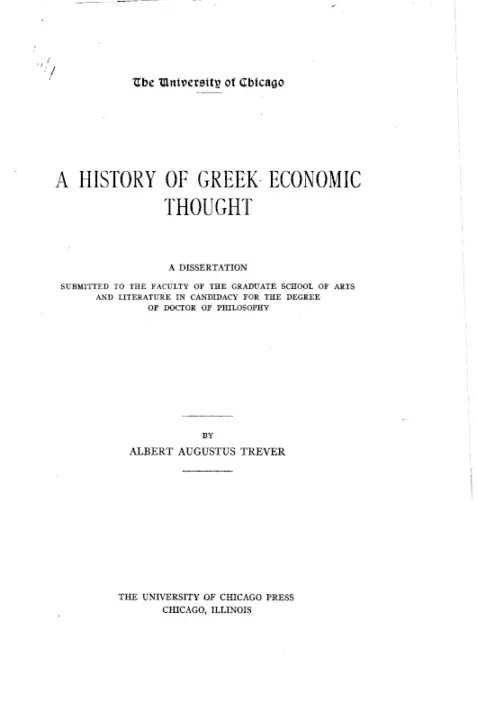
"A History of Greek Economic Thought" by Albert Augustus Trever is a scholarly dissertation composed in the early 20th century. This work explores the evolution of economic theories as conceptualized by ancient Greek philosophers, placing their ideas within the context of both their time and the present humanitarian economic discourse. The book aims to not just chronicle, but also reinterpret Greek economic thought, connecting ancient ideas with modern economic principles. The opening of the work sets forth the author's intention to fulfill a scholarly gap in the discourse of Greek economic theory. It discusses the existing literature on the subject, noting that previous works often failed to approach the topic from the perspective of a classicist infused with a modern economic view. Trever emphasizes that the Greeks, despite their simpler economic environment, fostered significant ethical and humanistic considerations in their economic theories that resonate with contemporary thought. By establishing a chronological format, he intends to analyze the ideas of prominent Greek thinkers, such as Plato and Aristotle, in relation to the economic conditions of their epoch.
Introduction adapted from the source catalogue; source summaries may be automatically generated.
Free to read · English · 58,276 words · No account needed
MAKE TIME FOR A GOOD BOOK
On by default. Untick to stop anonymous reading totals. Each page counts after 10 seconds in view. How this works.
Anonymous counting is on unless you have switched it off.
Cf. the undiscriminating statement of Souchon, op. cit., p. 41: “Et il n’y a guère eu, au cours de l’histoire de la science politique, de conception plus aristocratique que le mythe fameux des trois races d’or, d’argent et d’airain.”
Footnote 271:
Pol. 1264b15-25, repeated by Grote and others.
Footnote 272:
Rep. iv. beg.-421C.
Footnote 273:
I Cor. 12:14 ff.; for other evidence of Plato’s interest in all classes, cf. 519E ff., and the entire argument against Thrasymachus, Book I.
Footnote 274:
Rep. 421A, cited by Zeller, op. cit., II, 1, 907, as evidence of this, states merely that it is more important that there be efficient rulers than efficient cobblers. Cf. Poehlmann, op. cit., II, 36-108, a masterly defense of the Republic on this point, criticizing both Zeller and Gomperz. He errs on the other side, however, as e.g., p. 96, where he infers from Rep. 462C that Plato intended his communism to apply to the whole people.
Footnote 275:
Footnote 276:
415A, introducing the alleged aristocratic myth.
Footnote 277:
Footnote 278:
Footnote 279:
421C-E, cited on p. 48, n. 8. Cf. Poehlmann, op. cit., II, 91.
Footnote 280:
Footnote 281:
Footnote 282:
378B, E, 377B, insisting upon proper stories for all children; 915E-520A, implying that the artisans shall share in all benefits of the state up to their capacity.
Footnote 283:
Footnote 284:
Footnote 285:
Footnote 286:
Mill is an exception, but despite his thoroughgoing definitions of
economics.
Footnote 287:
Cf. Ar. Pol. ii. 1266b17-24.
Footnote 288:
On the Spartan system, cf. Guiraud, La Prop. fonc., pp. 41 f.; Poehlmann, op. cit., I, 75-98, both of whom oppose the more extreme theory of communism in Sparta.
Footnote 289:
On this general subject, cf. Guiraud, La Prop. fonc., 573 f.; cf. S. Cognetti de Martiis, Socialismo Antico (1889), pp. 515-17, on socialistic tendencies in Greek constitutions and politics.
Footnote 290:
E.g., Esmein, Nouvelle Revue historique, 1890, pp. 821 ff. For a refutation, cf. Poehlmann, op. cit., 1st ed., pp. 20 ff.; Guiraud, op. cit., p. 37; Souchon, op. cit., pp. 135 f.
Footnote 291:
Your reading position is saved on this browser. Take it to another device with a library code. Reading pages adapt to text, rather than matching a printed edition.
BEHIND THE BOOK
This eBook is for the use of anyone anywhere in the United States and most other parts of the world at no cost and with almost no restrictions whatsoever. You may copy it, give it away or re-use it under the terms of the Project Gutenberg License included with this eBook or online at www.gutenberg.org. If you are not located in the United States, you will have to check the laws of the country where you are located before using this eBook. Read the source licence.
The original source file, including credits and licence, is retained by this library. Request an original-format copy at no charge. Please include the book title and Project Gutenberg identifier #58204.
KEEP YOUR CURIOSITY GOING
Cécile Tormay

Moritz Busch
John L. Ransom
Frances Wright
Cécile Tormay

Mabel Potter Daggett