THE CLASSIC COLLECTION✦An outlaw’s diary: the CommuneCLASSIC FREE BOOKS
An outlaw’s diary: the Commune
Cécile Tormay
THE CLASSIC COLLECTION · 1916
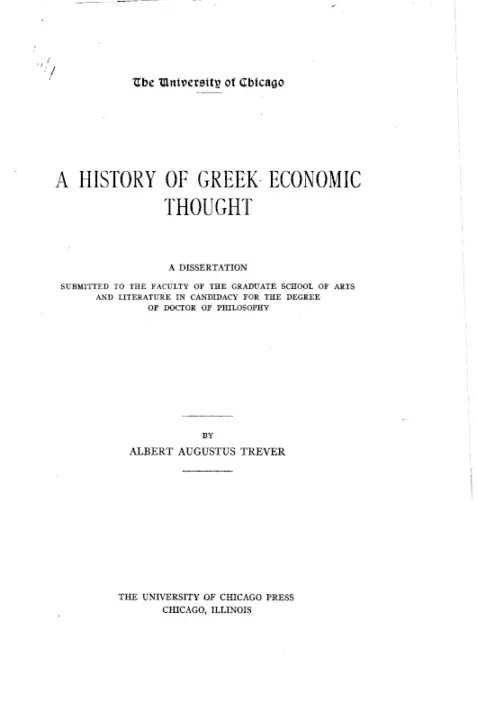
"A History of Greek Economic Thought" by Albert Augustus Trever is a scholarly dissertation composed in the early 20th century. This work explores the evolution of economic theories as conceptualized by ancient Greek philosophers, placing their ideas within the context of both their time and the present humanitarian economic discourse. The book aims to not just chronicle, but also reinterpret Greek economic thought, connecting ancient ideas with modern economic principles. The opening of the work sets forth the author's intention to fulfill a scholarly gap in the discourse of Greek economic theory. It discusses the existing literature on the subject, noting that previous works often failed to approach the topic from the perspective of a classicist infused with a modern economic view. Trever emphasizes that the Greeks, despite their simpler economic environment, fostered significant ethical and humanistic considerations in their economic theories that resonate with contemporary thought. By establishing a chronological format, he intends to analyze the ideas of prominent Greek thinkers, such as Plato and Aristotle, in relation to the economic conditions of their epoch.
Introduction adapted from the source catalogue; source summaries may be automatically generated.
Free to read · English · 58,276 words · No account needed
MAKE TIME FOR A GOOD BOOK
On by default. Untick to stop anonymous reading totals. Each page counts after 10 seconds in view. How this works.
Anonymous counting is on unless you have switched it off.
Footnote 632:
1252b1 ff.; cf. Adam’s note to Rep. 370B; Susemihl and Hicks’s note to Pol. 1252b3, for an exception to the rule (De part. Anim. iv. 6. 11. 683a22). ἀλλ᾽ ὅπου μὴ ἐνδέχεται καταχρῆται τῷ αὐτῷ ἐπὶ πλείω ἔργα.
Footnote 633:
Pol. ii 1261a30 f.; N. Eth. v. 5.
Footnote 634:
Pol. 1261a37-39; 1328b ff. Fontpertuis (op. cit., p. 359) accounts for the comparative superficiality of the Greek theory of labor by the fact that their political constitution diminished its importance, but cf. our introduction. Capitalistic employment of free labor was probably not extensive.
Footnote 635:
Cf. above, p. 16, n. 6; p. 17, n. 1.
Footnote 636:
On the theory of the Sophists, cf. above, pp. 16 f. On the Cynics, cf. infra; also Zeller, op. cit., II, 2, 376; Ar. Pol. 1253b20-23. Barker (op. cit., p. 359), who has a very clear and discriminating criticism of Aristotle’s theory of slavery, also states that slavery had been attacked by the “logic of events”—e.g., the enslavement of Athenians in Sicily, and the freeing of Messenian Helots, during the Theban supremacy, by which Greek freemen had become slaves and Greek slaves had become free. Cf. Pol. 1255a ff., especially 17 f. and 21-23, for the two theories.
Footnote 637:
The locus classicus for his theory is Pol. i. 4-7. 1253b14 ff.; 13. 1259b21 ff. For good criticisms, cf. Wallon, Histoire de l’esclavage dans l’antiquité, 2d ed., pp. 372 ff.; and Barker, op. cit., 1. Cf. also Newman, op. cit., I, 143 ff.
Footnote 638:
Pol. i. 8. 1256b36; 1253b32.
Footnote 639:
Ibid. 33-39. Aristotle would have been satisfied with electricity.
Footnote 640:
1254a8, cited on p. 88, n. 10. This relieves the severity of the doctrine, since it shows that he thinks chiefly of domestic slavery. But in his proposed state, all industry is manned by slaves. Cf. iv (vii). 1330a25-31.
Footnote 641:
Pol. 1254a9-13; cf. Eud. Eth. 1241b17-24.
Footnote 642:
1254a13-17.
Footnote 643:
Op. cit., p. 362.
Footnote 644:
1254a28-31; 1254b15. As Wallon (op. cit., p. 391) points out, his radical error is a constant confusion of hypothesis with reality.
Footnote 645:
1254a23-24.
Footnote 646:
Ibid. 33 f.
Footnote 647:
Ibid. 30-40; 1254b10-13; 1253b7; 18 f., cf. Eud. Eth.
1241b17 ff.
Footnote 648:
1254b16-19.
Footnote 649:
Ibid. 20-26.
Footnote 650:
Ibid. 26 ff.
Footnote 651:
1254a21 f.
Footnote 652:
1254b6-10; 11 f.; 16-20; 1255b6-15; a doctrine emphasized by Plato, Rep. 590D; Laws 645B, 714A, 818A, 684C, as also by Carlyle and Ruskin; cf. Shorey, Class. Phil., IX (1914), 355 ff. Though Ruskin believed that natural slavery was the inevitable lot of many men, he did not uphold negro slavery, Mun. Pul., v, 133 (Vol. XVII, 256 f.); Time and Tide, p. 149 (Vol. XVII, 438). But he pointed to the white economic slavery as equally bad, Stones of Venice, II (Vol. X, 193); Time and Tide, p. 105 (Vol. XVII, 403); Crown of Wild Olive, 119; Cestus Aglaia, p. 55.
Footnote 653:
1254b32-34; 1255b5 ff.
Footnote 654:
1254b38 f.
Your reading position is saved on this browser. Take it to another device with a library code. Reading pages adapt to text, rather than matching a printed edition.
BEHIND THE BOOK
This eBook is for the use of anyone anywhere in the United States and most other parts of the world at no cost and with almost no restrictions whatsoever. You may copy it, give it away or re-use it under the terms of the Project Gutenberg License included with this eBook or online at www.gutenberg.org. If you are not located in the United States, you will have to check the laws of the country where you are located before using this eBook. Read the source licence.
The original source file, including credits and licence, is retained by this library. Request an original-format copy at no charge. Please include the book title and Project Gutenberg identifier #58204.
KEEP YOUR CURIOSITY GOING
Cécile Tormay

Moritz Busch
John L. Ransom
Frances Wright
Cécile Tormay

Mabel Potter Daggett