THE CLASSIC COLLECTION✦An outlaw’s diary: the CommuneCLASSIC FREE BOOKS
An outlaw’s diary: the Commune
Cécile Tormay
THE CLASSIC COLLECTION · 1916
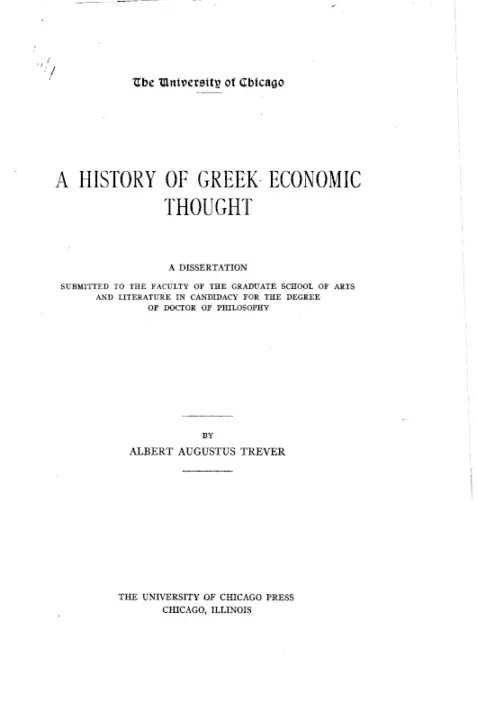
"A History of Greek Economic Thought" by Albert Augustus Trever is a scholarly dissertation composed in the early 20th century. This work explores the evolution of economic theories as conceptualized by ancient Greek philosophers, placing their ideas within the context of both their time and the present humanitarian economic discourse. The book aims to not just chronicle, but also reinterpret Greek economic thought, connecting ancient ideas with modern economic principles. The opening of the work sets forth the author's intention to fulfill a scholarly gap in the discourse of Greek economic theory. It discusses the existing literature on the subject, noting that previous works often failed to approach the topic from the perspective of a classicist infused with a modern economic view. Trever emphasizes that the Greeks, despite their simpler economic environment, fostered significant ethical and humanistic considerations in their economic theories that resonate with contemporary thought. By establishing a chronological format, he intends to analyze the ideas of prominent Greek thinkers, such as Plato and Aristotle, in relation to the economic conditions of their epoch.
Introduction adapted from the source catalogue; source summaries may be automatically generated.
Free to read · English · 58,276 words · No account needed
MAKE TIME FOR A GOOD BOOK
On by default. Untick to stop anonymous reading totals. Each page counts after 10 seconds in view. How this works.
Anonymous counting is on unless you have switched it off.
Footnote 295:
1268a34 ff.
Footnote 296:
So Souchon, op. cit., p. 141, who makes him an individualist.
Footnote 297:
Pol. ii. 7.
Footnote 298:
1266a37 f.
Footnote 299:
1266a40: φησὶ γὰρ δεῖν ἴσας εἶναι τὰς κτήσεις τῶν πολιτῶν; 1266b31-33, to be realized in an old state, partly by allowing only the rich to give dowries and only the poor to receive them; 1266b2-4.
Footnote 300:
Ar. (1267b10) criticizes him for this.
Footnote 301:
1267b15; cf. Poehlmann, op. cit., II, 7 f.
Footnote 302:
1266a37 f.; 1267a1 f. Aristotle’s account of these writers, as of Plato, is incomplete and unsatisfactory.
Footnote 303:
Rep. 415A; cf. above, pp. 48 ff. on this and the following note.
Footnote 304:
Footnote 305:
416D-E, 458C; cf. also Critias 112B-C, where common houses, common meals, and the prohibition of gold and silver are presented as an ideal.
Footnote 306:
Footnote 307:
Footnote 308:
451D-455D. Poehlmann points to this doctrine of the Ebenbürtigkeit of women as an advanced ground even for Christianity.
Footnote 309:
Footnote 310:
Guiraud (La Prop. fonc., p. 578) distinguishes these elements in Plato’s system, Republic and Laws: exclusive right of property vested in the state; use of land granted to a part of the citizens; distribution of the product among all the citizens; obligation to work, tempered by equality of service; inequality of classes, and equality of men in each class; heredity of profession, corrected by selection of talents.
Footnote 311:
Cf. pp. 48 f. and notes. Even Aristotle admits (1264a33) that Plato makes his husbandmen absolute owners of their lots, on condition of paying rental. The rulers alone (μόνοις) are to keep themselves from silver or gold (417A). Cf. Book IV, beg.: οἶον ἄλλοι ἄγρούς τε κεκτημένοι καὶ οἰκίας οἰκοδομούμενοι, etc.; 420A, 416D-E, 458C, 464B-D, where the community is applied to the guards only, and 464A-D, where the same is true of family communism. Doubtless he would have extended it farther, had he thought it feasible (462B-C), but Poehlmann (op. cit., I, 569 f.; II, 96 f.) overemphasizes this demand of Plato. Adler (Geschichte des Socialismus und Kommunismus von Plato bis zur Gegenwart, p. 44), DuBois (op. cit., p. 40), Oncken (op. cit., p. 34), Souchon (op. cit., 148); Malon (op. cit., pp. 90 f.), Shorey (Class. Phil., October, 1914, art. on “Plato’s Laws”) all agree with the foregoing conclusion. Francotte (L’Industrie, II, 258 ff.) leaves the question open, but (261 f.) observes that the third class is at least restrained from extremes of wealth and poverty.
Footnote 312:
Footnote 313:
Ibid., the fundamental idea of the Republic. L. Stein (Sociale Frage, p. 164) rightly says: “Denn der Kommunismus Platons ist seinem Schoepfer nicht Zweck, sondern blosses paedagogisches Mittel.”
Footnote 314:
415E-416A, 417B, 420D, 421A, 421C. He would also avoid vulgarization of the rulers through trade (416E-417A).
Footnote 315:
Footnote 316:
Your reading position is saved on this browser. Take it to another device with a library code. Reading pages adapt to text, rather than matching a printed edition.
BEHIND THE BOOK
This eBook is for the use of anyone anywhere in the United States and most other parts of the world at no cost and with almost no restrictions whatsoever. You may copy it, give it away or re-use it under the terms of the Project Gutenberg License included with this eBook or online at www.gutenberg.org. If you are not located in the United States, you will have to check the laws of the country where you are located before using this eBook. Read the source licence.
The original source file, including credits and licence, is retained by this library. Request an original-format copy at no charge. Please include the book title and Project Gutenberg identifier #58204.
KEEP YOUR CURIOSITY GOING
Cécile Tormay

Moritz Busch
John L. Ransom
Frances Wright
Cécile Tormay

Mabel Potter Daggett