THE CLASSIC COLLECTION✦An outlaw’s diary: the CommuneCLASSIC FREE BOOKS
An outlaw’s diary: the Commune
Cécile Tormay
THE CLASSIC COLLECTION · 1916
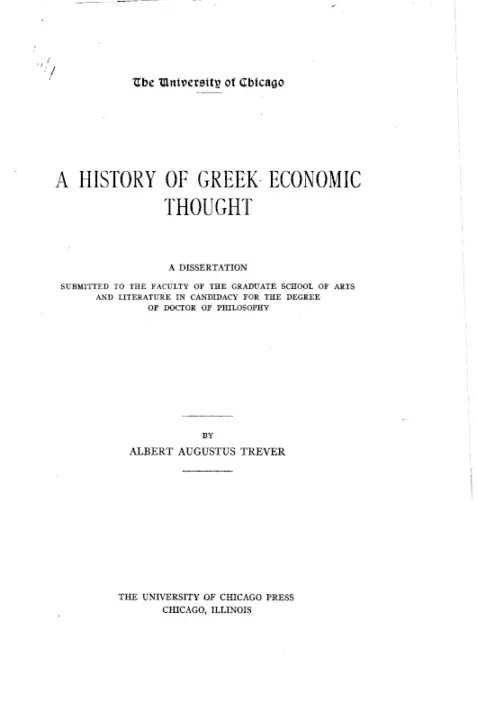
"A History of Greek Economic Thought" by Albert Augustus Trever is a scholarly dissertation composed in the early 20th century. This work explores the evolution of economic theories as conceptualized by ancient Greek philosophers, placing their ideas within the context of both their time and the present humanitarian economic discourse. The book aims to not just chronicle, but also reinterpret Greek economic thought, connecting ancient ideas with modern economic principles. The opening of the work sets forth the author's intention to fulfill a scholarly gap in the discourse of Greek economic theory. It discusses the existing literature on the subject, noting that previous works often failed to approach the topic from the perspective of a classicist infused with a modern economic view. Trever emphasizes that the Greeks, despite their simpler economic environment, fostered significant ethical and humanistic considerations in their economic theories that resonate with contemporary thought. By establishing a chronological format, he intends to analyze the ideas of prominent Greek thinkers, such as Plato and Aristotle, in relation to the economic conditions of their epoch.
Introduction adapted from the source catalogue; source summaries may be automatically generated.
Free to read · English · 58,276 words · No account needed
MAKE TIME FOR A GOOD BOOK
On by default. Untick to stop anonymous reading totals. Each page counts after 10 seconds in view. How this works.
Anonymous counting is on unless you have switched it off.
Footnote 863:
Porph. De abstin. iii. 25.
Footnote 864:
Cf. above on Xenophon.
Footnote 865:
Cf. infra on Cynics; Diog. L. vi. 1. 16; not extant.
Footnote 866:
Diog. L. iv. 12; not extant.
Footnote 867:
περὶ οἰκονομίας; for fragments, cf. ed. Jensen (Teubner). He was an Epicurean; cf. M. Hoderman, “Quaestionum Oeconomicarum Specimen,” Berliner Studien f. Class. Phil., XVI, 4 (1896), 38 f., for a summary statement of his teaching.
Footnote 868:
Diog. L. x. 11. 24: περὶ πλούτου; probably opposed to the Cynic ideas on wealth. Cf. Hoderman, op. cit., 37 and note.
Footnote 869:
For the few fragments, cf. Stob. lxxxv. 21 (Vol. III, p. 150, ed. Mein.), of Stoic tendency. Cf. F. Wilhelm, “Die Oeconomica der Neupythagoreer,” Rhein. Mus., XVII, 2 (1915), 162.
Footnote 870:
For frag., cf. Stob. Flor. xlii. 12 (Vol. II, p. 78, ed. Mein.); 46 (Vol. II, p. 366); lxxiv. 59 (Vol. III, p. 362); lxxxv. 12 (Vol. III, p. 138); of Stoic tendency, though the fragments may not be from him. Cf. Wilhelm, op. cit., p. 162; Hoderman, op. cit., pp. 40 f.
Footnote 871:
Cf. his Conjugalia moralia, which, though it does not bear the name Economica, is similar in content to them. Cf. Hoderman, op. cit., p. 43; cf. also his essay, Περὶ Φιλοπλουτίας, which moralizes on the folly of inordinate desire for wealth, in the Stoic vein, e.g., ed. Bern., Vol. III, 524D, p. 357: πενία γὰρ οὐκ ἔστιν ἀλλ᾽ ἀπληστία τὸ πάθος αὐτοῦ καὶ φιλοπλουτία.
Footnote 872:
Jamblichus (Vit. Pyth. 72. 89. 169 f.) says that among the followers of Pythagoras were those who were called οἰκονομικοί. They date from about the middle to the end of the second century B.C. Cf. Wilhelm, op. cit., pp. 161-224.
Footnote 873:
Cf. Stob. v. 28. 15 (p. 680, 7 ff., ed. Wachs.); called οἰκονομικός. Wilhelm (op. cit., p. 164, n. 3) thinks that the entire essay may be extant in a Hebrew translation. Bryson was Peripatetic in tendency. He makes a third division of slaves, in addition to κατὰ φύσιν and κατὰ νόμον; viz., κατὰ τρόπον τᾶς ψυχᾶς. He also gives a catalogue of vocations, similar to that of Xen. Econ. i. 1-4, and raises the question as to the function of economics.
Footnote 874:
Cf. Stob. v. 28. 16 (p. 681, 15 ff.); iv. 22. 101 (p. 534, 10 ff.); v. 28. 17 (p. 684, 16 ff.); v. 28. 18 (p. 686, 16 ff., ed. Wachs.): περὶ τᾶς τῶν οἰκήιων εὐδαιμονίας; composed largely of negative utterances on the rich, and of observations on the relations of the sexes; Platonic and Stoic in tendency. Cf. Wilhelm, op. cit., pp. 177, 222.
Footnote 875:
Cf. Stob. iv. 25. 50; v. 28. 19 (ed. Wachs.): περὶ γυναικὸς ἁρμονίας and περὶ γυναικὸς σωφροσύνας; similar to Stoics.
Footnote 876:
Cf. Stob. iv. 23. 61 f. (p. 588, 17 ff., ed. Wachs.); Stoic-Peripatetic in tendency. The two latter deal chiefly with the marriage relation. On the general subject of Economica, cf. Hoderman and Wilhelm, as above.
Footnote 877:
Your reading position is saved on this browser. Take it to another device with a library code. Reading pages adapt to text, rather than matching a printed edition.
BEHIND THE BOOK
This eBook is for the use of anyone anywhere in the United States and most other parts of the world at no cost and with almost no restrictions whatsoever. You may copy it, give it away or re-use it under the terms of the Project Gutenberg License included with this eBook or online at www.gutenberg.org. If you are not located in the United States, you will have to check the laws of the country where you are located before using this eBook. Read the source licence.
The original source file, including credits and licence, is retained by this library. Request an original-format copy at no charge. Please include the book title and Project Gutenberg identifier #58204.
KEEP YOUR CURIOSITY GOING
Cécile Tormay

Moritz Busch
John L. Ransom
Frances Wright
Cécile Tormay

Mabel Potter Daggett