THE CLASSIC COLLECTION✦An outlaw’s diary: the CommuneCLASSIC FREE BOOKS
An outlaw’s diary: the Commune
Cécile Tormay
THE CLASSIC COLLECTION · 1916
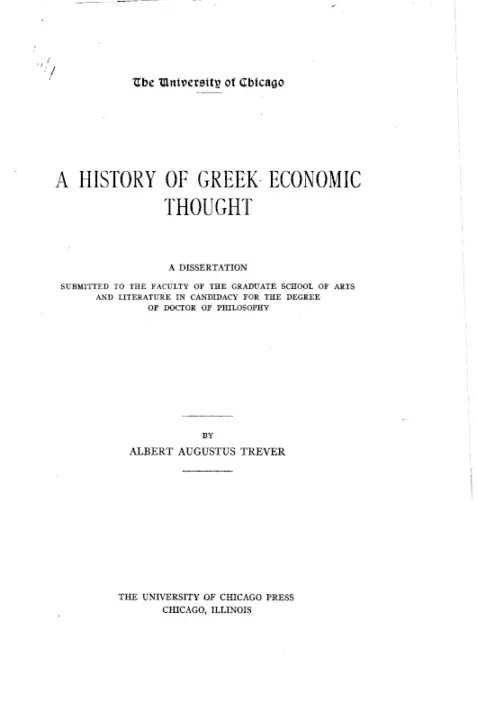
"A History of Greek Economic Thought" by Albert Augustus Trever is a scholarly dissertation composed in the early 20th century. This work explores the evolution of economic theories as conceptualized by ancient Greek philosophers, placing their ideas within the context of both their time and the present humanitarian economic discourse. The book aims to not just chronicle, but also reinterpret Greek economic thought, connecting ancient ideas with modern economic principles. The opening of the work sets forth the author's intention to fulfill a scholarly gap in the discourse of Greek economic theory. It discusses the existing literature on the subject, noting that previous works often failed to approach the topic from the perspective of a classicist infused with a modern economic view. Trever emphasizes that the Greeks, despite their simpler economic environment, fostered significant ethical and humanistic considerations in their economic theories that resonate with contemporary thought. By establishing a chronological format, he intends to analyze the ideas of prominent Greek thinkers, such as Plato and Aristotle, in relation to the economic conditions of their epoch.
Introduction adapted from the source catalogue; source summaries may be automatically generated.
Free to read · English · 58,276 words · No account needed
MAKE TIME FOR A GOOD BOOK
On by default. Untick to stop anonymous reading totals. Each page counts after 10 seconds in view. How this works.
Anonymous counting is on unless you have switched it off.
Footnote 883:
Ibid. 20 ff.: νόμισμα, ἐξαγώγιμα, εἰσαγώγιμα, and ἀναλώματα.
Footnote 884:
1343a25-27.
Footnote 885:
Ibid. 28-30. Cf. Aristotle, who makes war a natural pursuit.
Footnote 886:
1343b2 f.
Footnote 887:
Cf. preceding n. 8.
Footnote 888:
1343b3 f.
Footnote 889:
Ibid. 26 ff.
Footnote 890:
1344b15 f.; 1344a23-1344b11.
Footnote 891:
1348b17 ff.
Footnote 892:
1349a33 ff.
Footnote 893:
1350a23 ff.
Footnote 894:
1349b31 ff. Debasement of the currency was common in the time of the
author.
Footnote 895:
1346b24 ff.; 1347b3 ff.; cf. At. Pol. 1259a6-35.
Footnote 896:
1346a14-16: τὸ τἀναλώματα μὴ μείζω τῶν προσόδων γίνεσθαι.
Footnote 897:
1352a16 ff.; cf. above on the Socratics, under exchange.
Footnote 898:
Of Cyrene (435 B.C.), a pupil of Socrates. No genuine fragments of his writings are extant. Cf. Zeller, II, 1, 346 ff.
Footnote 899:
Cf. Horace Ep. i. 17, 23.
Footnote 900:
Cf. Zeller, II, 1, 346, n. 2, and Xen. Mem. ii. 1. 9.
Footnote 901:
Zeller II, 1, 346, n. 2; cf. Oncken, op. cit., p. 47, a basal
principle of hedonism.
Footnote 902:
Cf. Hor. Ep. ii. 2. 60.
Footnote 903:
342-270 B.C. His theory was far different than the Cyrenaic doctrine of the pleasure of the moment.
Footnote 904:
Diog. L. x. 130, 144, 146; Stob. Flor. xvii. 23.
Footnote 905:
Usener, Epicurea (1887), pp. 300-304, ὤρισται.
Footnote 906:
Ibid., p. 302, fr. 473; p. 303, fr. 476.
Footnote 907:
Diog. L. x. 130 f.
Footnote 908:
Usener, p. 304, fr. 479.
Footnote 909:
Ibid., p. 302, fr. 473 f.; cf. Stob. Flor. xvii. 30.
Footnote 910:
Usener, p. 303, and fragments.
Footnote 911:
Stob. xvii. 34; Seneca Ep. 25. 4 f.; Cic. Tusc. disp. v. 31.
Footnote 912:
Diog. L. x. 119; Philod. De vit. ix. cols. 12 ff., 27, 40.
Footnote 913:
Cf. Barker, op. cit., p. 37; cf. above on Sophists; also Dunning, Political Theories Ancient and Mediaeval (1913), pp. 103 f.
Footnote 914:
Cf. Hasbach, Allgemeine philosophische Grundlagen der Pol. Econ. (1890), pp. 76 and 36 f.; Dunning, as above.
Footnote 915:
For his life, cf. Zeller, II, 1, 280 ff., and Diog. L. vi. A few fragments of his philosophical dialogues are extant. Cf. above, p. 126, n. 7. for his Economicus. He and Diogenes are discussed at this point, since the Cynic movement as a whole is logically post-Aristotelian.
Footnote 916:
Diog. L. vi. 1. 15; cf. Gomperz, op. cit., II, 117 and note, with citations from Dio of Prusa; also Zeller, op. cit., II, 1, 325 f. and note, who thinks Plato’s ironical “city of pigs” (Rep. ii) may well have been a reference to the ideas of Antisthenes.
Footnote 917:
Cf. preceding note, and infra, on later ideal states.
Footnote 918:
Pol. i. 1253a1-4: ἄνθρωπος φύσει πολιτικὸν ζῷον, etc.
Footnote 919:
Dionis Prus. Opera (ed. Arnim, 1893, or vi. 25 f.), ascribed to Diogenes, but it was also the idea of Antisthenes. Cf. Gomperz, op. cit., II, 118; compare Rousseau.
Footnote 920:
Diog. L. vi. 104.
Footnote 921:
Ibid. vi. 12; cf. chap. 9, 105.
Footnote 922:
Xen. Symp. iv. 34, 34-43, on the advantages and disadvantages of the two kinds of wealth; iii. 8; Econ. i. 7 f.; ii. 2 f.
Footnote 923:
Xen. Symp. iv. 35
Footnote 924:
Mullach, op. cit., II, p. 289, fr. 86: φιλάργυρος.
Footnote 925:
Your reading position is saved on this browser. Take it to another device with a library code. Reading pages adapt to text, rather than matching a printed edition.
BEHIND THE BOOK
This eBook is for the use of anyone anywhere in the United States and most other parts of the world at no cost and with almost no restrictions whatsoever. You may copy it, give it away or re-use it under the terms of the Project Gutenberg License included with this eBook or online at www.gutenberg.org. If you are not located in the United States, you will have to check the laws of the country where you are located before using this eBook. Read the source licence.
The original source file, including credits and licence, is retained by this library. Request an original-format copy at no charge. Please include the book title and Project Gutenberg identifier #58204.
KEEP YOUR CURIOSITY GOING
Cécile Tormay

Moritz Busch
John L. Ransom
Frances Wright
Cécile Tormay

Mabel Potter Daggett