THE CLASSIC COLLECTION✦An outlaw’s diary: the CommuneCLASSIC FREE BOOKS
An outlaw’s diary: the Commune
Cécile Tormay
THE CLASSIC COLLECTION · 1916
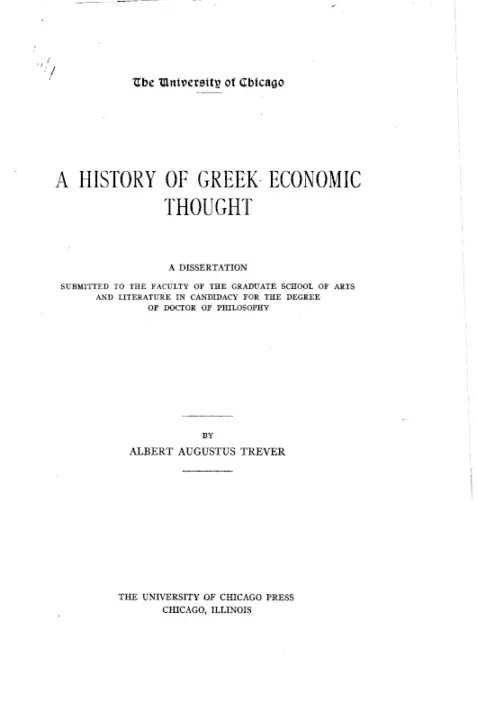
"A History of Greek Economic Thought" by Albert Augustus Trever is a scholarly dissertation composed in the early 20th century. This work explores the evolution of economic theories as conceptualized by ancient Greek philosophers, placing their ideas within the context of both their time and the present humanitarian economic discourse. The book aims to not just chronicle, but also reinterpret Greek economic thought, connecting ancient ideas with modern economic principles. The opening of the work sets forth the author's intention to fulfill a scholarly gap in the discourse of Greek economic theory. It discusses the existing literature on the subject, noting that previous works often failed to approach the topic from the perspective of a classicist infused with a modern economic view. Trever emphasizes that the Greeks, despite their simpler economic environment, fostered significant ethical and humanistic considerations in their economic theories that resonate with contemporary thought. By establishing a chronological format, he intends to analyze the ideas of prominent Greek thinkers, such as Plato and Aristotle, in relation to the economic conditions of their epoch.
Introduction adapted from the source catalogue; source summaries may be automatically generated.
Free to read · English · 58,276 words · No account needed
MAKE TIME FOR A GOOD BOOK
On by default. Untick to stop anonymous reading totals. Each page counts after 10 seconds in view. How this works.
Anonymous counting is on unless you have switched it off.
Footnote 683:
1133a29.
Footnote 684:
Ibid. 5-19; 25; 27 f.; 1133b10, etc.
Footnote 685:
1133a19-22, 25 f.; 1133b16; 22; ix. 1164a1 f.; Pol. 1258b1-5, μεταβολῆς χάριν; 1257a30 ff. Stewart (op. cit., I, 416 ff.) thinks that the author meant to apply the corrective (διορθωτικόν) function of justice also to money, in that it makes exchange more fair and uniform. As evidence, he points to N. Eth. 1131a18 ff. and 1133a19-22, where the functions of justice and money are defined in similar terms. Cf. also his interesting remarks on the dianemetic function, which prompts exchange and distribution.
Footnote 686:
1133b10-13.
Footnote 687:
Ibid. 15-18: οὔτε γὰρ ἂν μὴ οὔσης αλλαγῆς κοινωνία ἦν, etc.
Footnote 688:
Pol. 1257b8 f.
Footnote 689:
1257b10-18; for the theory of the Cynics, cf. infra, especially on Eryxias. Cf. Newman, op. cit., II, 188, note, and his reference to Macaulay’s note on the margin of his edition of the Politics.
Footnote 690:
1257b19 ff.; cf. the transitional sentence, 18, a slight hint that
he accepts the theory.
Footnote 691:
N. Eth. v. 5. 1133a29-31; cf. 1133b20 f., ἐξ ὑποθέσεως, cf. infra, where the pseudo-Economica takes it for granted.
Footnote 692:
Pol. 1257a36 f., cited on p. 102.
Footnote 693:
N. Eth. v. 5. 1133b13 f.: οὐ γὰρ ἀεὶ ἴσον δύναται· ὅμως δὲ βούλεται μένειν μᾶλλον.
Footnote 694:
Cf. p. 86, n. 1, for passages.
Footnote 695:
Blanqui (op. cit., pp. 36, 88), Ingram (op. cit., p. 18), DuBois (op. cit., p. 51 and n. 1), Zmavc (Zeitschr. f. d. ges. Staatswiss. [1902], pp. 76 f.), Palgrave’s Dictionary (art. “Aristotle,” p. 54), all admit this conclusion. Barker (op. cit., p. 380) says that the idea is hinted at. Souchon (op. cit., pp. 110 f.) accepts the other view, stating that this was his purpose, to show the folly of making merely imaginary goods the goal of all life.
Footnote 696:
Cf. N. Eth. v. 5. 1133b13 f.
Footnote 697:
Pol. 1257b5-8, and the whole of 1257b; 1258b1-5.
Footnote 698:
1258b25.
Footnote 699:
N. Eth. 1121b34: καὶ τοκισταὶ κατὰ μικρὰ καὶ ἐπὶ πολλῷ. Cf. Zell’s translation.
Footnote 700:
Pol. 1258b1-8; but cf. p. 39 on this point. The etymology should not be taken seriously. Ruskin cites Aristotle on this point. Cf. above, p. 39, n. 10.
Footnote 701:
Cf. Barker, op. cit., p. 385 and n. 2, where he criticizes Poehlmann for his idea that Aristotle “is attacking a great credit system,” and “is enunciating a gospel of socialism.” But cf. infra.
Footnote 702:
Pol. 1257b5 ff.
Footnote 703:
Ibid. 33 ff.; for further discussion of chrematistik, cf. infra.
Footnote 704:
Cf. Haney, op. cit., p. 49: “In Athens, the circulation of capital was inconsiderable, and money was not lent for productive purposes as often as for the purpose of relieving distress”; Souchon, op. cit., p. 93, though (pp. 106 f.) he recognizes the other side.
Footnote 705:
Cf. Paley and Sandys ed., especially Or. xxxvi; Isoc. Trapeziticus; Boeckh, op. cit., I, 160 ff.; V. Brants, “Les operations de banque dans la Grèce antique,” Le Muséon, I, 2, 196-203; Koutorga, Le trapézites, (Paris, 1859); cf. also E. Meyer, Kleine Schriften.
Footnote 706:
Your reading position is saved on this browser. Take it to another device with a library code. Reading pages adapt to text, rather than matching a printed edition.
BEHIND THE BOOK
This eBook is for the use of anyone anywhere in the United States and most other parts of the world at no cost and with almost no restrictions whatsoever. You may copy it, give it away or re-use it under the terms of the Project Gutenberg License included with this eBook or online at www.gutenberg.org. If you are not located in the United States, you will have to check the laws of the country where you are located before using this eBook. Read the source licence.
The original source file, including credits and licence, is retained by this library. Request an original-format copy at no charge. Please include the book title and Project Gutenberg identifier #58204.
KEEP YOUR CURIOSITY GOING
Cécile Tormay

Moritz Busch
John L. Ransom
Frances Wright
Cécile Tormay

Mabel Potter Daggett