THE CLASSIC COLLECTION✦An outlaw’s diary: the CommuneCLASSIC FREE BOOKS
An outlaw’s diary: the Commune
Cécile Tormay
THE CLASSIC COLLECTION · 1916
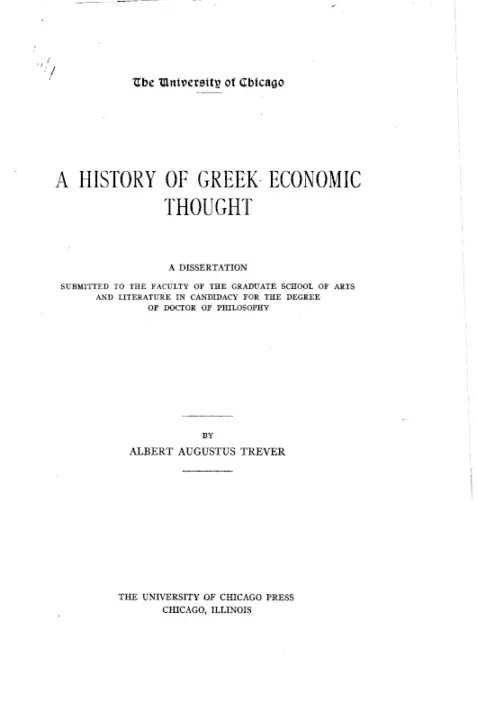
"A History of Greek Economic Thought" by Albert Augustus Trever is a scholarly dissertation composed in the early 20th century. This work explores the evolution of economic theories as conceptualized by ancient Greek philosophers, placing their ideas within the context of both their time and the present humanitarian economic discourse. The book aims to not just chronicle, but also reinterpret Greek economic thought, connecting ancient ideas with modern economic principles. The opening of the work sets forth the author's intention to fulfill a scholarly gap in the discourse of Greek economic theory. It discusses the existing literature on the subject, noting that previous works often failed to approach the topic from the perspective of a classicist infused with a modern economic view. Trever emphasizes that the Greeks, despite their simpler economic environment, fostered significant ethical and humanistic considerations in their economic theories that resonate with contemporary thought. By establishing a chronological format, he intends to analyze the ideas of prominent Greek thinkers, such as Plato and Aristotle, in relation to the economic conditions of their epoch.
Introduction adapted from the source catalogue; source summaries may be automatically generated.
Free to read · English · 58,276 words · No account needed
MAKE TIME FOR A GOOD BOOK
On by default. Untick to stop anonymous reading totals. Each page counts after 10 seconds in view. How this works.
Anonymous counting is on unless you have switched it off.
Unto This Last, beginning; cf. preceding n. 1; Ruskin took Xen. Econ. as the foundation on which he built all his own economic studies. Cf. Unto This Last, Pref., Vol. XVII, pp. xlix and 18; Vol. XXXI, Introd.; pp. xv ff. It was the first in his Bib. Pastorum. Cf. his Preface to his translation of the Economicus; Arrows of the Chace, Vol. XXXIV, 547; Letters, II (Vol. XXXVII, 350). In Mun. Pul., IV, 105 (Vol. XVII, 230); also on pp. 288 and 88, he refers to Xenophon’s “faultless” definition of wealth, citing Mem. ii. 3. 7. Cf. also Vol. XXXI, pp. xvii and 27. Fontpertuis (“Filiation des idées économiques dans l’antiquité,” Jour. des écon., September, 1871, p. 361) thinks this is at bottom the true theory of value.
Footnote 384:
Econ. i. 2: ἀποδιδομένοις μὲν οἱ αὐλοὶ χρήματα, μὴ αποδιδομένοις δὲ ἀλλὰ κεκτημένοις οὔ, τοῖς μὴ ἐπισταμένοις αὐτοῖς χρῆσθαι. Brants (Xen. Econ., p. 8) overemphasizes this.
Footnote 385:
Rev. iv. 6-10, a remarkable passage, though he fails to include silver in the law. Cf. Kautz, op. cit., p. 129; Kaulla, Die geschichtliche Entwickelung der modernen Werttheorien, p. 2.
Footnote 386:
Especially in the story of Isomachus (Econ.), and the Revenues.
Footnote 387:
Cf. infra; also Espinas, Histoire des doctrines economiques, p.
20.
Footnote 388:
Econ. vi. 4; cf. i. 7 ff., cited above, p. 64, n. 1.
Footnote 389:
P. 64 and notes. Büchsenschütz (Besitz und Erwerb, p. 15) criticizes it as too broad, including spiritual goods; too narrow, including only what one can use.
Footnote 390:
In Econ. ii. 2-8, Socrates’ comparison of himself with the wealthy Critoboulos; Hiero iv. 6-10; Mem. iv. 2. 37 f.; i. 6. 1-10, where Socrates defends his own simple life, especially 10: ἐγὼ δ᾽ ἐνόμιζον τὸ μὲν μηδενὸς δεῖσθαι θεῖον εἶναι. If meant in the economic sense, this would approach a definition of capital, as “excess of goods over needs.”
Footnote 391:
Cf. p. 25, n. 11, on the similar modern doctrine.
Footnote 392:
Symp. iii. 8 and iv. 34-44, given as the doctrine of Antisthenes, the Cynic, though with apparent approval; Mem. iv. 2. 9.
Footnote 393:
Econ. xi. 9.
Footnote 394:
Cyrop. viii. 2. 23.
Footnote 395:
Mem. ii. 7. 7; Rev. iv. 29.
Footnote 396:
Thuc. vii. 6. 2, of walls; Gorg. 449D, ἱματίων; Theaet. 146D, ὑποδημάτων; Xen. Econ. vii. 21, ἐσθῆτος.
Footnote 397:
Hdt. i. 68; Charm. 173E; Thuc. iv. 105.
Footnote 398:
Ar. Frogs 1034; Isoc. Areop. 30.
Footnote 399:
Isoc. Areop., 146d, cited infra on the terms for capital; Ad
Nicocl. 18C.
Footnote 400:
Mem. iii. 10. 1; Dem. xxxiii. 4.
Footnote 401:
C.I.A. 3924: ἡ ἐργασία τῶν βαφέων.
Footnote 402:
Ar. N. Eth. vi. 4. 2 ff.
Footnote 403:
Op. cit., 1st ed., p. 55.
Footnote 404:
Econ., especially chaps. v-vii; iv. 4; Mem. ii. 1. 6; Econ. v. 17: εὒ μὲν γὰρ φερομένης τῆς γεωργίας ἔρρωνται καὶ ἄλλαι τέχναι ἄπασαι, ὅπου δ᾽ ἂν ἀναγκασθῇ ἡ γῆ χερσεύειν, ἀποσβέννυνται καὶ αἱ ἄλλαι τέχναι σχεδόν τι καὶ κατὰ γῆν καὶ κατὰ θάλατταν, a very true statement, which does not belittle other industries.
Footnote 405:
Ibid. v. 2; iii. 15. 11, 16; Rev. i. 2 ff., etc.
Footnote 406:
Pol. i. 8 and 9.
Footnote 407:
Mem. ii. 7. 13 f., from Socrates. Cf. infra under distribution, on
this.
Footnote 408:
Rev. iv. 5-7; Cossa, op. cit., p. 148; Kautz, Histoire des doctrines économiques, p. 127; Fontpertuis, op. cit., p. 367.
Footnote 409:
Your reading position is saved on this browser. Take it to another device with a library code. Reading pages adapt to text, rather than matching a printed edition.
BEHIND THE BOOK
This eBook is for the use of anyone anywhere in the United States and most other parts of the world at no cost and with almost no restrictions whatsoever. You may copy it, give it away or re-use it under the terms of the Project Gutenberg License included with this eBook or online at www.gutenberg.org. If you are not located in the United States, you will have to check the laws of the country where you are located before using this eBook. Read the source licence.
The original source file, including credits and licence, is retained by this library. Request an original-format copy at no charge. Please include the book title and Project Gutenberg identifier #58204.
KEEP YOUR CURIOSITY GOING
Cécile Tormay

Moritz Busch
John L. Ransom
Frances Wright
Cécile Tormay

Mabel Potter Daggett