THE CLASSIC COLLECTION✦An outlaw’s diary: the CommuneCLASSIC FREE BOOKS
An outlaw’s diary: the Commune
Cécile Tormay
THE CLASSIC COLLECTION · 1916
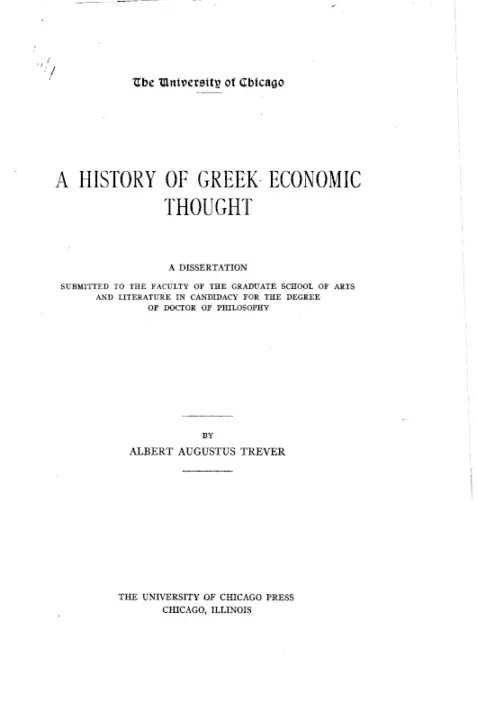
"A History of Greek Economic Thought" by Albert Augustus Trever is a scholarly dissertation composed in the early 20th century. This work explores the evolution of economic theories as conceptualized by ancient Greek philosophers, placing their ideas within the context of both their time and the present humanitarian economic discourse. The book aims to not just chronicle, but also reinterpret Greek economic thought, connecting ancient ideas with modern economic principles. The opening of the work sets forth the author's intention to fulfill a scholarly gap in the discourse of Greek economic theory. It discusses the existing literature on the subject, noting that previous works often failed to approach the topic from the perspective of a classicist infused with a modern economic view. Trever emphasizes that the Greeks, despite their simpler economic environment, fostered significant ethical and humanistic considerations in their economic theories that resonate with contemporary thought. By establishing a chronological format, he intends to analyze the ideas of prominent Greek thinkers, such as Plato and Aristotle, in relation to the economic conditions of their epoch.
Introduction adapted from the source catalogue; source summaries may be automatically generated.
Free to read · English · 58,276 words · No account needed
MAKE TIME FOR A GOOD BOOK
On by default. Untick to stop anonymous reading totals. Each page counts after 10 seconds in view. How this works.
Anonymous counting is on unless you have switched it off.
Footnote 1000:
Seneca Benef. vii. 3. 2 f.; 6. 3; 8. 1.
Footnote 1001:
Diog. L. vii. 125. On both the citations above, cf. Zeller, III, 1,
251.
Footnote 1002:
Called Citieus, born 320 B.C., of Semitic descent.
Footnote 1003:
Stoic Vet. Fr., ed. Arnim, 1905, I, 47, fr. 190 (Stob. Ecl. ii. 7. 5, pp. 57 f., ed. Wachs.); Diog. L. vii. 101 f., 103-5.
Footnote 1004:
Von Arnim, op. cit., p. 53, fr. 220; Cic. De fin. v. 84: “At Zeno eum (mendicum) non beatum modo, sed etiam divitem dicere ausus est.”
Footnote 1005:
Von Arnim (p. 52, fr. 216 [Stob. Ecl. ii. 7. 11g, pp. 991., ed. Wachs.]) cites Zeno as placing among the goods of the σπουδαῖος man the fact that he is οἰκονομικός and χρηματιστικός, while the φαῦλοι are opposite; cf. also p. 100.
Footnote 1006:
Von Arnim, p. 61, fr. 264 (Clem. Alex. Strom. v. 12. 76, p. 691p).
Footnote 1007:
Von Arnim, p. 62, fr. 268 (Diog. L. vii. 33): νόμισμα δ᾽ οὔτ᾽ ἀλλαγῆς ἕνεκεν οἴεσθαι δεῖν κατασκευάζειν οὔτ᾽ ἀποδημίας ἕνεκεν. Oncken (op. cit., p. 48) thinks that the Stoics were forerunners of the physiocrats.
Footnote 1008:
Plut. De Alex. Fort. i. 6: ἡ πολὺ θαυμαζομένη πολιτεία τοῦ ... Ζήνονος. He says that it agreed in principle with the states of Plato and Lycurgus. Cf. Poehlmann, op. cit., II, 341 ff., but cf. infra, p. 140 f. Cf. n. 2, above. Ar. Pol. ii. 4. 1266a: εἰσὶ δέ τινες πολιτεῖαι καὶ ἄλλαι, etc., shows that a series of ideal states had preceded his, though he says Plato’s was the most radical.
Footnote 1009:
Plut. De Alex. Fort. i. 6.
Footnote 1010:
Diog. L. vii. 33, 131; cf. nn. 3 and 5 above.
Footnote 1011:
Diog. L. vii. 131; 33.
Footnote 1012:
Poehlmann, op. cit., II, 342, n. 1.
Footnote 1013:
Cf. above, n. 5; Athen. xiii. 561c.
Footnote 1014:
Cf. Poehlmann, op. cit., I, 11, n. 8; also 346.
Footnote 1015:
Diog. L. vii. 33.
Footnote 1016:
On this double tendency in the Stoics, and reasons therefore, cf. Souchon (op. cit., pp. 173 f.); Poehlmann (op. cit., II, 342 f., and I, 111) and Wolf (op. cit., pp. 116 ff.) exaggerate their socialistic tendency. For further discussion, cf. infra. Cf. L. Stein, Soc. Frage, pp. 171-80.
Footnote 1017:
280-206 B.C. Aristo and Cleanthes, successors of Zeno, also emphasized similar doctrines in relation to wealth. Cf. von Arnim, I, p. 89, frs. 396, 397, 398, from Aristo; ibid., p. 137, fr. 617, from Cleanthes.
Footnote 1018:
Ibid., II, 79, fr. 240; III, 28, fr. 117; p. 29, frs. 122, 123; p.
32, fr. 135.
Footnote 1019:
Ibid., III, 156, fr. 598; p. 159, fr. 618; p. 155, fr. 593.
Footnote 1020:
Ibid., p. 155, fr. 597.
Footnote 1021:
Ibid., p. 160, fr. 629, “Lucro autem numquam sapiens studet.”
Footnote 1022:
Ibid., p. 169, fr. 623: μόνον δὲ τὸν σπουδαῖον ἄνορα χρηματιστικὸν εἶναι, γινώσκοντα ἀφ᾽ ὧν, χρηματιστέον, καὶ πότε καὶ πῶς καὶ μέχρι πότε.
Footnote 1023:
Von Arnim, III, 168, fr. 674.
Footnote 1024:
Ibid., p. 36, frs. 151, 152, “Bonum ex malo non fit: divitiae fiunt: fiunt autem ex avaritia divitiae ergo non sunt bonum” (Seneca Ep. 87. 22).
Footnote 1025:
Von Arnim, p. 172, fr. 686 (Stob. Ecl. ii. 7, p. 109, 10): .... λόγους κατηλεύειν, οὐ φαμένων δεῖν ἀπὸ παιδείας παρὰ τῶν ἐπιτυχόντων χρηματίζεσθαι.
Footnote 1026:
Von Arnim, p. 86, fr. 352: ἄνθρωπος γὰρ ἐκ φύσεως δοῦλος οὐδείς; p. 87, fr. 358; cf. p. 141, n. 7, above.
Footnote 1027:
Ibid., fr. 357.
Footnote 1028:
Ibid., 89, fr. 365; p. 86, frs. 356, 354.
Footnote 1029:
Ibid., p. 86, fr. 355; p. 88, fr. 362; p. 89, 364. Cf. Espinas, Hist. des doctrines èconomiques, 56 f., on the Stoics’ attitude toward labor and slavery: “Ni les Cyniques ni les Stoiciens ne méprisaient le travail”; “La seule servitude déshonorante est celle des passions et du vice.”
Your reading position is saved on this browser. Take it to another device with a library code. Reading pages adapt to text, rather than matching a printed edition.
BEHIND THE BOOK
This eBook is for the use of anyone anywhere in the United States and most other parts of the world at no cost and with almost no restrictions whatsoever. You may copy it, give it away or re-use it under the terms of the Project Gutenberg License included with this eBook or online at www.gutenberg.org. If you are not located in the United States, you will have to check the laws of the country where you are located before using this eBook. Read the source licence.
The original source file, including credits and licence, is retained by this library. Request an original-format copy at no charge. Please include the book title and Project Gutenberg identifier #58204.
KEEP YOUR CURIOSITY GOING
Cécile Tormay

Moritz Busch
John L. Ransom
Frances Wright
Cécile Tormay

Mabel Potter Daggett