THE CLASSIC COLLECTION✦An outlaw’s diary: the CommuneCLASSIC FREE BOOKS
An outlaw’s diary: the Commune
Cécile Tormay
THE CLASSIC COLLECTION · 1916
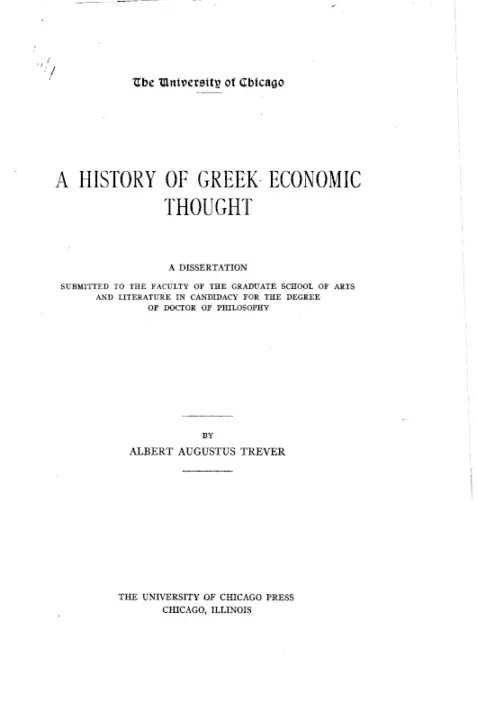
"A History of Greek Economic Thought" by Albert Augustus Trever is a scholarly dissertation composed in the early 20th century. This work explores the evolution of economic theories as conceptualized by ancient Greek philosophers, placing their ideas within the context of both their time and the present humanitarian economic discourse. The book aims to not just chronicle, but also reinterpret Greek economic thought, connecting ancient ideas with modern economic principles. The opening of the work sets forth the author's intention to fulfill a scholarly gap in the discourse of Greek economic theory. It discusses the existing literature on the subject, noting that previous works often failed to approach the topic from the perspective of a classicist infused with a modern economic view. Trever emphasizes that the Greeks, despite their simpler economic environment, fostered significant ethical and humanistic considerations in their economic theories that resonate with contemporary thought. By establishing a chronological format, he intends to analyze the ideas of prominent Greek thinkers, such as Plato and Aristotle, in relation to the economic conditions of their epoch.
Introduction adapted from the source catalogue; source summaries may be automatically generated.
Free to read · English · 58,276 words · No account needed
MAKE TIME FOR A GOOD BOOK
On by default. Untick to stop anonymous reading totals. Each page counts after 10 seconds in view. How this works.
Anonymous counting is on unless you have switched it off.
Footnote 358:
780B; women and children separate, 806E; on its Cretan origin, 625E
ff.
Footnote 359:
Footnote 360:
744B; cf. pp. 55 f. on equality; cf. 757B-D, contrasting the mere arithmetical equality (τὴν ἀριθμῷ ἴσην), which is easily realized, and the true equality, which is very difficult. This latter apportions to each in accord with his nature (πρὸς τὴν φύσιν αὐτῶν). The two are almost opposites (ἐναντιαῖν). Espinas (op. cit., p. 236) thinks that the division into property classes in the Laws is an attempt to realize this principle.
Footnote 361:
Footnote 362:
Footnote 363:
Op. cit., p. 143; cf. also pp. 163-65, where he compares it to modern collectivism; cf. p. 162; also Poehlmann, op. cit., II, 295.
Footnote 364:
923A; cf. 877D, and much of the legislation on property, above.
Footnote 365:
Cf. pp. 59 f. and notes. The modern analogy is not close, yet in each case the aim is to prevent undue gains whereby the public is oppressed.
Footnote 366:
Cf. p. 30, n. 3.
Footnote 367:
Cf. p. 59 and notes. The socialistic tendency to overemphasize the power of law is also strong here as in the Republic. But cf. p. 36, n. 4, and Laws 807B, 746A-B, 747B.
Footnote 368:
Time and Tide, IX, 5-9. Modern Painters, V, Pt. 8, chap. i, 6 (Vol. VII, 207). Espinas (Revue des Etudes Grecques, XXVII [1914], 246) calls this Platonic denial of “conflict of interest” in trade “le thème éternel de la chimère socialiste.”
Footnote 369:
Laws 626E: τὸ πολεμίους εἶναι πάντας πᾶσιν; cited by Poehlmann, op. cit., I, 557; but he exaggerates the analogy.
Footnote 370:
Cf. 742D-E, 743D-E, 729A, and the remarks on retail trade, 918B-919E, 870B; cf. also, above, on wealth.
Footnote 371:
As seen above, they are all slaves or strangers. A direct comparison is hardly possible, since in the Republic, the masses are the majority of the citizens, while in the Laws, there are none.
Footnote 372:
744D; cf. Shorey, Class. Phil., IX (1914), 363: “Plato’s object, however, is not socialistic equalization of the ‘good things’ of life, but the enforced disinterestedness of the rulers, and the complete self-realization of every type of man, in limitation to his own proper sphere and task.”
Footnote 373:
Cf. pp. 55 and 60, on equality; also note 4, above.
Footnote 374:
Your reading position is saved on this browser. Take it to another device with a library code. Reading pages adapt to text, rather than matching a printed edition.
BEHIND THE BOOK
This eBook is for the use of anyone anywhere in the United States and most other parts of the world at no cost and with almost no restrictions whatsoever. You may copy it, give it away or re-use it under the terms of the Project Gutenberg License included with this eBook or online at www.gutenberg.org. If you are not located in the United States, you will have to check the laws of the country where you are located before using this eBook. Read the source licence.
The original source file, including credits and licence, is retained by this library. Request an original-format copy at no charge. Please include the book title and Project Gutenberg identifier #58204.
KEEP YOUR CURIOSITY GOING
Cécile Tormay

Moritz Busch
John L. Ransom
Frances Wright
Cécile Tormay

Mabel Potter Daggett