THE CLASSIC COLLECTION✦An outlaw’s diary: the CommuneCLASSIC FREE BOOKS
An outlaw’s diary: the Commune
Cécile Tormay
THE CLASSIC COLLECTION · 1916
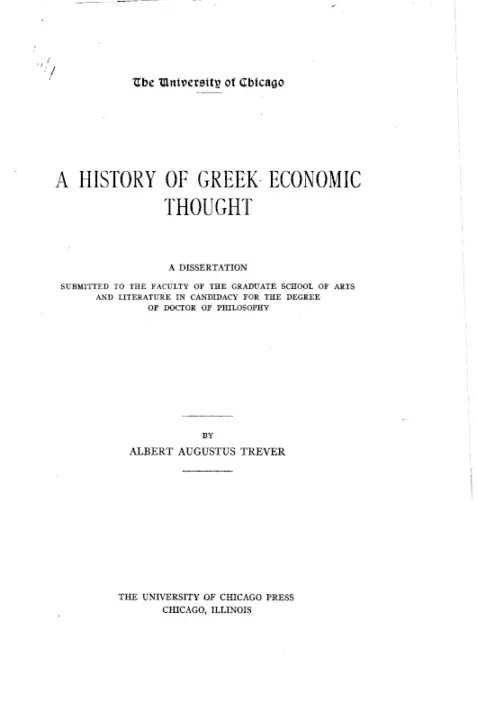
"A History of Greek Economic Thought" by Albert Augustus Trever is a scholarly dissertation composed in the early 20th century. This work explores the evolution of economic theories as conceptualized by ancient Greek philosophers, placing their ideas within the context of both their time and the present humanitarian economic discourse. The book aims to not just chronicle, but also reinterpret Greek economic thought, connecting ancient ideas with modern economic principles. The opening of the work sets forth the author's intention to fulfill a scholarly gap in the discourse of Greek economic theory. It discusses the existing literature on the subject, noting that previous works often failed to approach the topic from the perspective of a classicist infused with a modern economic view. Trever emphasizes that the Greeks, despite their simpler economic environment, fostered significant ethical and humanistic considerations in their economic theories that resonate with contemporary thought. By establishing a chronological format, he intends to analyze the ideas of prominent Greek thinkers, such as Plato and Aristotle, in relation to the economic conditions of their epoch.
Introduction adapted from the source catalogue; source summaries may be automatically generated.
Free to read · English · 58,276 words · No account needed
MAKE TIME FOR A GOOD BOOK
On by default. Untick to stop anonymous reading totals. Each page counts after 10 seconds in view. How this works.
Anonymous counting is on unless you have switched it off.
Rep. 371B. The word is νόμισμα, something established by usage, hence “current coin,” not necessarily suggestive of intrinsic worth, as are χρήματα and the metals. Cf. Ar. Clouds 248 for a play on the word, θεοὶ ἡμῖν νόμισμ᾽ οὐκ ἔστι. Cf. the simile, Frogs 720, and Phaedo 69A, for an analogy between it and wisdom.
Footnote 188:
Rep. 371B: ξύμβολον τῆς ἀλλαγῆς.
Footnote 189:
Fors Clav., IV, 11, note (Vol. XXVIII, 134 f.); cf. also Vol. XVII,
50, 194 f.
Footnote 190:
742A-B: νόμισμα δ᾽ ἕνεκα ἀλλαγῆς; 918B: ἐξευπορεῖν καὶ ὁμαλότητα ταῖς οὐσίαις, referring directly to traders.
Footnote 191:
Laws 918B.
Footnote 192:
Rep. 553E; for Aristotle, cf. infra.
Footnote 193:
Laws 743D.
Footnote 194:
Footnote 195:
742C, 915D-E; Rep. 556A-B; Laws 850A.
Footnote 196:
921C, an obol per month.
Footnote 197:
Rep. 555E.
Footnote 198:
Fors. Clav., notes to Letter 43, 14 (Vol. XXVIII, 121 f.), notes to Letter 81, 16 (Vol. XXIX, 212), where he refers to Plato and Aristotle; Mun. Pul., IV, 98, note (Vol. XVII, 220), where he absolutely condemns it; On the Old Road, Vol. XXXIV, 425, on usury, ends with a citation from the Laws 913C; ἃ μὴ κατέθου, μὴ ἀνέλη.
Footnote 199:
E.g. J. Scott Nearing’s recent book on Income.
Footnote 200:
Laws 679B, 831C; Rep. 545B ff., 548B. Cf. Ruskin on the evils arising from money, Vol. XX, 295 f.
Footnote 201:
Laws 743D, 742A-B, 801B.
Footnote 202:
Footnote 203:
Ruskin, Mun. Pul., I, 25. He thinks it is a relic of a barbarism that will disappear as civilization develops.
Footnote 204:
Laws 742A-B.
Footnote 205:
Sophist. 223C-D; cf. Pol., 289E for the triple division of commercials, κάπηλοι, ἔμποροι, and ἀργυραμοίβοι; cf. Phaedo, 69A for a figurative use of ἀλλαγή.
Footnote 206:
Rep. 370A-E, home; 370E-371E, foreign; cf. Adam Smith’s idea above.
Footnote 207:
370E-371A; Cornford (op. cit., p. 66) wrongly asserts that Plato did not know the law that exports must balance imports. Cf. op. cit., p. 37.
Footnote 208:
Boeckh, Die Staataushaltung der Athener, I, pp. 382 ff.; Zimmern, op. cit., 1st ed., p. 317. But cf. Brants, Xenophon Economiste, p. 18, n. 2 and references, on the protectionist tendency of the commercial policy of Athens.
Footnote 209:
Laws 847C; Souchon (op. cit., p. 102) sees in this a mercantile trend, but the purposes are entirely different.
Footnote 210:
Footnote 211:
Rep. 371C-D.
Footnote 212:
Laws 918B-C.
Footnote 213:
Rep. 369C.
Footnote 214:
On the relation of exchange to production, cf. above, p. 28.
Footnote 215:
Pp. 19 ff.
Footnote 216:
P. 41 and notes.
Footnote 217:
Laws 918B.
Footnote 218:
Footnote 219:
Footnote 220:
P. 41 and notes.
Footnote 221:
Laws 918A, 920C. He seems to feel that trade as regularly pursued is a form of cheatery, in which one gains what the other loses. Cf. Ruskin, Unto This Last, I, 22 (Vol. XVII, 40 f.); IV, 66 ff. (Vol. XVII, 90 ff.); Mun. Pul., IV 95 ff. (Vol. XVII, 217 ff.), where he refers to Rep. 426E, on the difficulty of curing this disease of traders; cf. Vol. XVII, Intro., p. xlvi, citing Xen. Mem., iii. 7. 5, 6, on those who are “always thinking how they may buy cheapest and sell dearest.”
Footnote 222:
Rep. 371C.
Footnote 223:
Your reading position is saved on this browser. Take it to another device with a library code. Reading pages adapt to text, rather than matching a printed edition.
BEHIND THE BOOK
This eBook is for the use of anyone anywhere in the United States and most other parts of the world at no cost and with almost no restrictions whatsoever. You may copy it, give it away or re-use it under the terms of the Project Gutenberg License included with this eBook or online at www.gutenberg.org. If you are not located in the United States, you will have to check the laws of the country where you are located before using this eBook. Read the source licence.
The original source file, including credits and licence, is retained by this library. Request an original-format copy at no charge. Please include the book title and Project Gutenberg identifier #58204.
KEEP YOUR CURIOSITY GOING
Cécile Tormay

Moritz Busch
John L. Ransom
Frances Wright
Cécile Tormay

Mabel Potter Daggett