THE CLASSIC COLLECTION✦An outlaw’s diary: the CommuneCLASSIC FREE BOOKS
An outlaw’s diary: the Commune
Cécile Tormay
THE CLASSIC COLLECTION · 1916
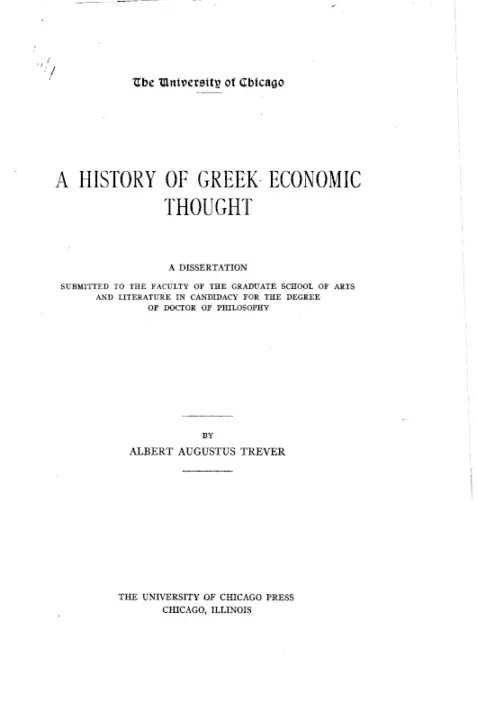
"A History of Greek Economic Thought" by Albert Augustus Trever is a scholarly dissertation composed in the early 20th century. This work explores the evolution of economic theories as conceptualized by ancient Greek philosophers, placing their ideas within the context of both their time and the present humanitarian economic discourse. The book aims to not just chronicle, but also reinterpret Greek economic thought, connecting ancient ideas with modern economic principles. The opening of the work sets forth the author's intention to fulfill a scholarly gap in the discourse of Greek economic theory. It discusses the existing literature on the subject, noting that previous works often failed to approach the topic from the perspective of a classicist infused with a modern economic view. Trever emphasizes that the Greeks, despite their simpler economic environment, fostered significant ethical and humanistic considerations in their economic theories that resonate with contemporary thought. By establishing a chronological format, he intends to analyze the ideas of prominent Greek thinkers, such as Plato and Aristotle, in relation to the economic conditions of their epoch.
Introduction adapted from the source catalogue; source summaries may be automatically generated.
Free to read · English · 58,276 words · No account needed
MAKE TIME FOR A GOOD BOOK
On by default. Untick to stop anonymous reading totals. Each page counts after 10 seconds in view. How this works.
Anonymous counting is on unless you have switched it off.
δεμιουργοὺς ἐλευθερίας; Rep. 395C, 434A-D; cf. also 420B-421B. In the Laws, the artisans and traders are non-citizens (846D, 847A, 918B-C), not because of prejudice primarily, but for the sake of better government.
Footnote 170:
Rep. 374B-E.
Footnote 171:
395A-B; cf. Adam’s note to 395A, explaining Sympos. 223D, where Plato asserts the opposite. He thinks Plato is speaking ideally in the Republic passage, but here of the actual fact. But cf. Shorey, Unity, etc., p. 78, n. 597.
Footnote 172:
Rep. 433A-B, D, 434A-D, 432A, 443-444A, 396D-E; Charm. 161E. In his broad application of the law, he has advanced beyond Adam Smith. Cf. Souchon, op. cit., p. 81 and n. 2.
Footnote 173:
Rep. 397E-398A.
Footnote 174:
443C-D; cf. Nettleship Lectures on the Republic of Plato, p. 71.
Footnote 175:
Oncken observes (Geschichte der Nationalökonomie, pp. 34-36) that while Smith drew from the law the idea of freedom of trade and industry, Plato inferred the strictest subordination of these to the will of the state, and that he also based the caste system on the principle. For the alleged caste system, cf. Souchon, op. cit., p. 82, and infra, under distribution. Aristotle’s state implies even a more rigid separation of the capable few. On Plato’s insight into economic principles, cf. Robin, op. cit., pp. 229 ff. He criticizes Guiraud for belittling the value of Plato’s social ideas, and urges that he should be judged, not by the worth of his proposed remedies, but by his scientific insight (p. 252).
Footnote 176:
Rep. 395A-B; 374E, 395B; εἰς σμικρότερα κατακερματίσθαι.
Footnote 177:
Apol. 21C-22E; cf. Rep. 495D-E, though it applies rather to the evil effects of the banausic life. Cf. Bonar, op. cit., p. 16. Ruskin (Stones of Venice, VI, 16 [Vol. X, 196]), says: It is “not the labor that is divided but the men—divided into segments of men.” It stunts their faculties.
Footnote 178:
Rep. 552A.
Footnote 179:
396C-373E; cf. Bonar, op. cit., p. 27.
Footnote 180:
Footnote 181:
Cf. Zimmern, op. cit., p. 389, note; Laws 777B: δῆλον ὡς ἐπειδὴ δύσκολόν ἐστι τὸ θρέμμα ἄνθρωπος καὶ πρὸς τὴν ἀναγκαίαν διόρισιν, τὸ δοῦλόν τε ἔργῳ διορίζεσθαι καὶ ἐλεύθερον καὶ δεσπότην οὐδαμῶς εὕχρηστον ἐθέλει εἶναι τε καὶ γίγνεσθαι. On his alleged caste system, cf. above, n. 2, and infra.
Footnote 182:
Rep. 469C; cf. Pol. 309A.
Footnote 183:
Laws 806D. For Ruskin on slavery, cf. infra on Aristotle.
Footnote 184:
Laws 776D-777E. Espinas (Revue des Etudes Grecques, XXVII [1914], 256) observes that Plato adopts the mean between the two extremes in his attitude to slaves.
Footnote 185:
Cf. Xen. Ath. Pol. i. 10-12 on the easy life of slaves in Athens, and Zimmern, op. cit., pp. 382 f., who points out that this resulted from economic necessity. Cf. 777C-D; cf. Rep. 578D-579A on the dangers and troubles arising from extensive slave-holding.
Footnote 186:
Laws 915A ff., another striking evidence of the actual status of freedmen and slaves in Athens.
Footnote 187:
Your reading position is saved on this browser. Take it to another device with a library code. Reading pages adapt to text, rather than matching a printed edition.
BEHIND THE BOOK
This eBook is for the use of anyone anywhere in the United States and most other parts of the world at no cost and with almost no restrictions whatsoever. You may copy it, give it away or re-use it under the terms of the Project Gutenberg License included with this eBook or online at www.gutenberg.org. If you are not located in the United States, you will have to check the laws of the country where you are located before using this eBook. Read the source licence.
The original source file, including credits and licence, is retained by this library. Request an original-format copy at no charge. Please include the book title and Project Gutenberg identifier #58204.
KEEP YOUR CURIOSITY GOING
Cécile Tormay

Moritz Busch
John L. Ransom
Frances Wright
Cécile Tormay

Mabel Potter Daggett