THE CLASSIC COLLECTION✦An outlaw’s diary: the CommuneCLASSIC FREE BOOKS
An outlaw’s diary: the Commune
Cécile Tormay
THE CLASSIC COLLECTION · 1916
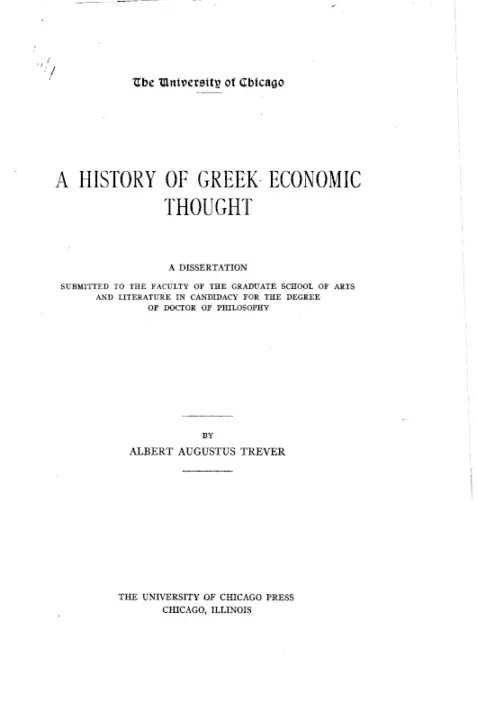
"A History of Greek Economic Thought" by Albert Augustus Trever is a scholarly dissertation composed in the early 20th century. This work explores the evolution of economic theories as conceptualized by ancient Greek philosophers, placing their ideas within the context of both their time and the present humanitarian economic discourse. The book aims to not just chronicle, but also reinterpret Greek economic thought, connecting ancient ideas with modern economic principles. The opening of the work sets forth the author's intention to fulfill a scholarly gap in the discourse of Greek economic theory. It discusses the existing literature on the subject, noting that previous works often failed to approach the topic from the perspective of a classicist infused with a modern economic view. Trever emphasizes that the Greeks, despite their simpler economic environment, fostered significant ethical and humanistic considerations in their economic theories that resonate with contemporary thought. By establishing a chronological format, he intends to analyze the ideas of prominent Greek thinkers, such as Plato and Aristotle, in relation to the economic conditions of their epoch.
Introduction adapted from the source catalogue; source summaries may be automatically generated.
Free to read · English · 58,276 words · No account needed
MAKE TIME FOR A GOOD BOOK
On by default. Untick to stop anonymous reading totals. Each page counts after 10 seconds in view. How this works.
Anonymous counting is on unless you have switched it off.
Laws 918B-919C, referring to retail trade; but if he could admit it for this, he surely could for the industries. Cf. Aristotle’s passage on liberal and illiberal work (Pol. 1337b5-22).
Footnote 151:
Mun. Pul., V, 105 and note (Vol. XVII, 234 f.), where he refers to Plato’s diminutive, ἄνθρωπίσκοι, as applied to laborers (Rep. 495C; Laws 741E); Time and Tide, 103 (Vol. XVII, 402), 127 (p. 423 and note); Crown of Wild Olive, 2 (Vol. XVIII, 388), on the furnace; Lectures on Art, IV, 123 (Vol. XX, 113); on the evil effects of arts needing fire, as iron-working, where Xen. Econ. iv. 2, 3 is cited. He makes frequent reference to the Greek attitude, e.g., Vol. XVIII, 241, 461, and above. But he was not absolutely opposed to machinery; cf. Cestus Aglaia, 33 for what is called the finest eulogy of a machine in English literature. He even anticipated the great future mechanical development (Mun. Pul., 17).
Footnote 152:
Stones of Venice (Vol. X, 201); cf. also IV, 6 (Vol. XI, 202 f.), where he cites Plato Alc. I. 129.
Footnote 153:
Fors. Clav., VII, 9 (Vol. XIX, 230).
Footnote 154:
Cf. Vol. XXVII, Intro., p. lxv.
Footnote 155:
Rep. 370A-C and many other passages. Cf. infra; Laws 846E-847A. Cf. infra on the unfair interpretation of Rep. 421A by Zeller and others. Plato implies by the passage merely that specialization is more important for the statesman than for the cobbler (421C).
Footnote 156:
Rep. 369C. Adam Smith makes this the basal fact of exchange (Wealth
of Nations, I, ii).
Footnote 157:
Rep. 370C: πλείω τε ἕκαστα γίγνεται καὶ κάλλιον καὶ ρᾷον, ὅταν ἑἶς ἓν κατὰ φύσιν, καὶ ἐν καιρῷ σχολὴν τῶν ἄλλων ἄγων, πράττῃ. He first states the principle less plausibly as a literary device, Rep. 369C; cf. 433A.
Footnote 158:
Rep. 370C, B.
Footnote 159:
Op. cit., I, chap. ii.
Footnote 160:
So Herbert Spencer, Principles of Sociology (1900), III, 342-49. Cf. also Ruskin, Fors Clav., IV, 15 (Vol. XXVIII, 160).
Footnote 161:
Rep. 370B-C, 374B-E.
Footnote 162:
Op. cit., I, chap. 1. Plato implies the increase in wealth. Haney (op. cit., p. 41) observes that Plato thought especially of the advantages of division of labor to the state, rather than to the individual. Cf. further Wealth of Nations, II, Intro.
Footnote 163:
Rep. 370C-371B; cf. DuBois, op. cit., p. 37.
Footnote 164:
Rep. 370C-D.
Footnote 165:
Footnote 166:
371B; Laws 918B.
Footnote 167:
Rep. 370E-371A. In the Laws, he does not extend the principle to international trade. Cf. Bonar, op. cit., p. 17.
Footnote 168:
Poehlmann (op. cit., II, 185 f.) notes a contradiction between Plato’s insistence upon the division of labor and his desire for the simple life. But the philosopher is aware of this, and knows that the simpler ideal is impossible. Cf. V. Brants, Revue de l’instr. pub. en Belg., XXVI (1883), 102-4, on the fact of the extensive division of labor in Athenian industry.
Footnote 169:
Your reading position is saved on this browser. Take it to another device with a library code. Reading pages adapt to text, rather than matching a printed edition.
BEHIND THE BOOK
This eBook is for the use of anyone anywhere in the United States and most other parts of the world at no cost and with almost no restrictions whatsoever. You may copy it, give it away or re-use it under the terms of the Project Gutenberg License included with this eBook or online at www.gutenberg.org. If you are not located in the United States, you will have to check the laws of the country where you are located before using this eBook. Read the source licence.
The original source file, including credits and licence, is retained by this library. Request an original-format copy at no charge. Please include the book title and Project Gutenberg identifier #58204.
KEEP YOUR CURIOSITY GOING
Cécile Tormay

Moritz Busch
John L. Ransom
Frances Wright
Cécile Tormay

Mabel Potter Daggett