THE CLASSIC COLLECTION✦An outlaw’s diary: the CommuneCLASSIC FREE BOOKS
An outlaw’s diary: the Commune
Cécile Tormay
THE CLASSIC COLLECTION · 1916
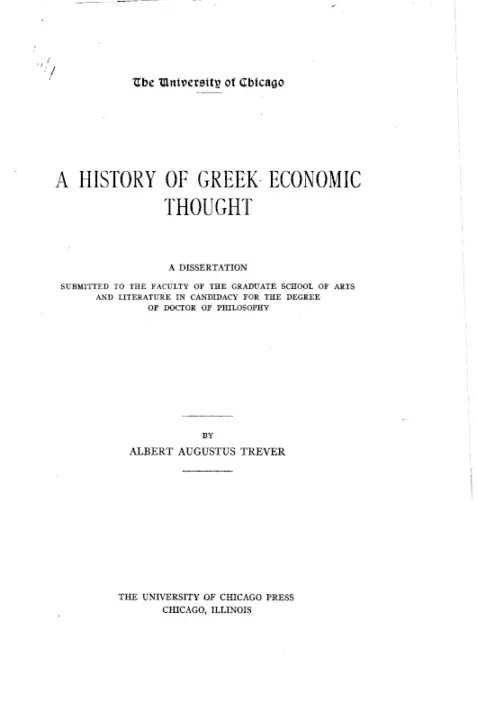
"A History of Greek Economic Thought" by Albert Augustus Trever is a scholarly dissertation composed in the early 20th century. This work explores the evolution of economic theories as conceptualized by ancient Greek philosophers, placing their ideas within the context of both their time and the present humanitarian economic discourse. The book aims to not just chronicle, but also reinterpret Greek economic thought, connecting ancient ideas with modern economic principles. The opening of the work sets forth the author's intention to fulfill a scholarly gap in the discourse of Greek economic theory. It discusses the existing literature on the subject, noting that previous works often failed to approach the topic from the perspective of a classicist infused with a modern economic view. Trever emphasizes that the Greeks, despite their simpler economic environment, fostered significant ethical and humanistic considerations in their economic theories that resonate with contemporary thought. By establishing a chronological format, he intends to analyze the ideas of prominent Greek thinkers, such as Plato and Aristotle, in relation to the economic conditions of their epoch.
Introduction adapted from the source catalogue; source summaries may be automatically generated.
Free to read · English · 58,276 words · No account needed
MAKE TIME FOR A GOOD BOOK
On by default. Untick to stop anonymous reading totals. Each page counts after 10 seconds in view. How this works.
Anonymous counting is on unless you have switched it off.
Cf. Rep. 552B, and p. 27. Kautz (op. cit., p. 119) overemphasizes this; cf. Souchon, op. cit., p. 91, n. 2, who observes, however, that Plato, by his insistence upon collectivism in landed property implies that “la terre est toujours un capital, et que la fortune mobilière ne l’est jamais.”
Footnote 128:
Cf. infra on money.
Footnote 129:
On the general attitude toward labor in Athens, cf. p. 30, n. 4. On Plato’s regard for the laborer, cf. infra, under distribution.
Footnote 130:
Rep. 590C, but only for him whose higher nature (τὸ τοῦ βελτίστου εἴδος) is naturally weak, though the implication is that this is characteristic of the artisans. Cf. Poehlmann, op. cit., II, 49 f.
Footnote 131:
Laws 842D, 806D-E, 741E, 846D, 919D.
Footnote 132:
Footnote 133:
Footnote 134:
Charm. 163A-C.
Footnote 135:
Gorg. 517D-518E.
Footnote 136:
Footnote 137:
Ibid. 300E.
Footnote 138:
Cf. Rep. 371C for a contrast in his attitude toward the two; cf. Bonar, op. cit., pp. 21 f.
Footnote 139:
Laws 846D, 847A. Ruskin (Fors Clav., Letter 82, 34 [Vol. XXIX, 253 f.]) contrasts the fevered leisure that results from extreme money-making with the true leisure, citing Laws 831.
Footnote 140:
Laws 743D. The aristocratic Greek feeling of independence against selling one’s powers to another, and the fact of the frank acceptance of slavery, by most contemporary thinkers, as the natural order, also exerted some unconscious influence.
Footnote 141:
Cf. infra for citations from Zeller, and Poehlmann’s able, but somewhat extreme, defense of Plato (op. cit., II, 36 ff.). He cites Adam Smith, Wealth of Nations, V, I, Pt. 2, art. 2, in similar vein to Plato, on the ill-effects of mechanical labor, despite his undoubted interest in the industrial arts.
Footnote 142:
Francotte, L’Industrie, I, 246, in reference to the Laws.
Footnote 143:
Op. cit., p. 26, n. 2.
Footnote 144:
Eisenhart (Geschichte der Nationalökonomie, p. 5) also says that Plato calls “Volkswirtschaft gerade zu den Staat der Schweine.” Dietzel (“Beiträge zur Geschichte des Socialismus und des Kommunismus,” Zeitschrift für Literatur und Geschichte der Staatswissenschaften, p. 397, n. 1) criticizes both the foregoing.
Footnote 145:
Sympos. 209A; Phileb. 56C.
Footnote 146:
Protag. 321E.
Footnote 147:
Rep. 420E, 421C; Laws 779A, 807A-E, 808C. The passages in the Laws apply particularly to the work of the soldier and the citizen. Cf. Ruskin, Unto This Last, I, 22 (Vol. XVII, 40) for a similar idea that the function of the laborer is not primarily to draw his pay, but to do his work well.
Footnote 148:
Rep. 433A.
Footnote 149:
Rep. 552A, C, 564E; cf. Laws 901A, where he refers to the passage in Hesiod’s Erga 304: κηφηνέσσι κοθούροις. Cf. p. 27, n. 1, above. Poehlmann (op. cit., II, 87 f.) points to Plato’s demand that woman be freed, so that the total number of free workers may be increased, but Plato is thinking only of the ruling class.
Footnote 150:
Your reading position is saved on this browser. Take it to another device with a library code. Reading pages adapt to text, rather than matching a printed edition.
BEHIND THE BOOK
This eBook is for the use of anyone anywhere in the United States and most other parts of the world at no cost and with almost no restrictions whatsoever. You may copy it, give it away or re-use it under the terms of the Project Gutenberg License included with this eBook or online at www.gutenberg.org. If you are not located in the United States, you will have to check the laws of the country where you are located before using this eBook. Read the source licence.
The original source file, including credits and licence, is retained by this library. Request an original-format copy at no charge. Please include the book title and Project Gutenberg identifier #58204.
KEEP YOUR CURIOSITY GOING
Cécile Tormay

Moritz Busch
John L. Ransom
Frances Wright
Cécile Tormay

Mabel Potter Daggett