THE CLASSIC COLLECTION✦An outlaw’s diary: the CommuneCLASSIC FREE BOOKS
An outlaw’s diary: the Commune
Cécile Tormay
THE CLASSIC COLLECTION · 1916
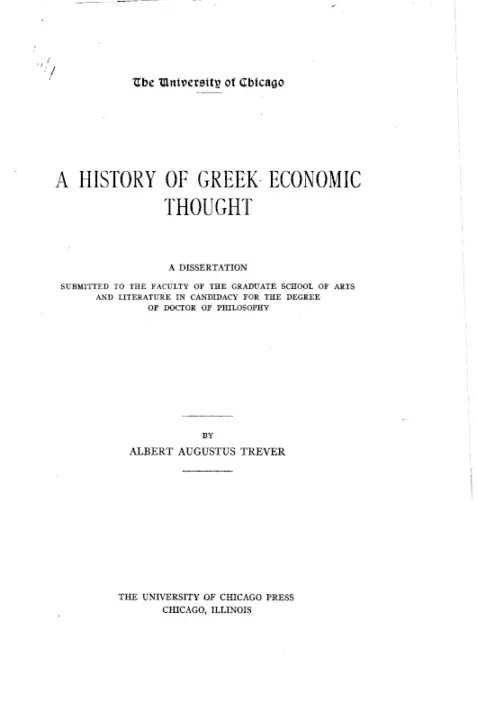
"A History of Greek Economic Thought" by Albert Augustus Trever is a scholarly dissertation composed in the early 20th century. This work explores the evolution of economic theories as conceptualized by ancient Greek philosophers, placing their ideas within the context of both their time and the present humanitarian economic discourse. The book aims to not just chronicle, but also reinterpret Greek economic thought, connecting ancient ideas with modern economic principles. The opening of the work sets forth the author's intention to fulfill a scholarly gap in the discourse of Greek economic theory. It discusses the existing literature on the subject, noting that previous works often failed to approach the topic from the perspective of a classicist infused with a modern economic view. Trever emphasizes that the Greeks, despite their simpler economic environment, fostered significant ethical and humanistic considerations in their economic theories that resonate with contemporary thought. By establishing a chronological format, he intends to analyze the ideas of prominent Greek thinkers, such as Plato and Aristotle, in relation to the economic conditions of their epoch.
Introduction adapted from the source catalogue; source summaries may be automatically generated.
Free to read · English · 58,276 words · No account needed
MAKE TIME FOR A GOOD BOOK
On by default. Untick to stop anonymous reading totals. Each page counts after 10 seconds in view. How this works.
Anonymous counting is on unless you have switched it off.
Sophist. 219A-D. Bonar’s (op. cit., p. 20) criticism of this on the ground that learning may produce something new, while the arts may merely change the shape of things, takes Plato too seriously. We have here only a characteristic Platonic generalization. Cf. Shorey, Unity of Plato’s Thought (1903), p. 64, n. 500, on the foregoing passages from Sophist. and Pol.; cf. Robin, op. cit., pp. 231 f.
Footnote 115:
Rep. 371C.
Footnote 116:
Laws 918B-C, especially πῶς γὰρ οὐκ εὐεργέτης πᾶς ὃς ἂν οὐσίαν χρημάτων ὡντινωνοῦν, ἀσύμμετρον οὔσαν καὶ ἀνώμαλον, ὁμαλήν τε καὶ σύμμετρον ἀπεργάζεται.
Footnote 117:
Cf. DuBois, Precis de l’histoire des doctrines économiques dans leurs rapports avec les faits et avec les institutions, pp. 45-47, comparing Plato and Aristotle on this point. Laws 743D and Plato’s attitude on agriculture (cf. infra) might seem to point the other way. Cf. infra, p. 41, nn. 7-10. Espinas (Revue des études Grecques, XXVII [1914], 247, n. 1) is extreme in calling him a physiocrat. The term would more nearly apply to Aristotle.
Footnote 118:
Ar. (Pol. vi [iv]. 1291a12-19) so interprets him, because he finds the origin of the state in physical needs (Rep. 369C ff.), but this is a carping criticism. Blanqui is hardly fair to Plato on this point (Histoire de l’économie politique en Europe, p. 88). Cf. above, p. 22, n. 4, on Plato’s other theory of origins.
Footnote 119:
Pol. 279C.
Footnote 120:
Cf. infra and Poehlmann, op. cit., I, 574.
Footnote 121:
As we shall see, the third reason has been exaggerated for the philosophers. On the favorable attitude to labor at Athens, cf. V. Brants, Revue de l’instruction publique in Belg., XXVI (1883), 108 f., 100 f.; he distinguishes between the doctrine philosophique and the doctrine politique. So also Guiraud, La main-d’œuvre industrielle dans l’ancienne Grèce (1900), pp. 36-50; Zimmern, op. cit., pp. 382 ff., 256-72. For the older view of general prejudice against free labor in Greece, cf. Drumann, Arbeiter und Communisten in Griechenland u. Rom (1860), pp. 24 ff. Francotte (L’Industrie) takes the more conservative position. Cf. infra for further notice of this problem.
Footnote 122:
Hesiod Erga; Theog. 969-975, though even here it is opposed to
commerce.
Footnote 123:
Laws 743D, but he would even limit this, so that it may not become a
sordid occupation.
Footnote 124:
Laws 760E-761C, 763D. Ruskin cites this in Fors Clav.; cf. Vol.
XXIX, 546.
Footnote 125:
Cf. pp. 19 f., and notes; cf. also p. 106, n. 1. The extensive commerce of Athens necessitated the presence of a comparatively large amount of money capital, and a large amount was also invested in slaves. For further notice, cf. infra, p. 68, nn. 8 ff., on the terms.
Footnote 126:
But cf. Laws 742C (κεφάλαιον), and infra, under Xenophon, on the terms for capital.
Footnote 127:
Your reading position is saved on this browser. Take it to another device with a library code. Reading pages adapt to text, rather than matching a printed edition.
BEHIND THE BOOK
This eBook is for the use of anyone anywhere in the United States and most other parts of the world at no cost and with almost no restrictions whatsoever. You may copy it, give it away or re-use it under the terms of the Project Gutenberg License included with this eBook or online at www.gutenberg.org. If you are not located in the United States, you will have to check the laws of the country where you are located before using this eBook. Read the source licence.
The original source file, including credits and licence, is retained by this library. Request an original-format copy at no charge. Please include the book title and Project Gutenberg identifier #58204.
KEEP YOUR CURIOSITY GOING
Cécile Tormay

Moritz Busch
John L. Ransom
Frances Wright
Cécile Tormay

Mabel Potter Daggett