THE CLASSIC COLLECTION✦An outlaw’s diary: the CommuneCLASSIC FREE BOOKS
An outlaw’s diary: the Commune
Cécile Tormay
THE CLASSIC COLLECTION · 1916
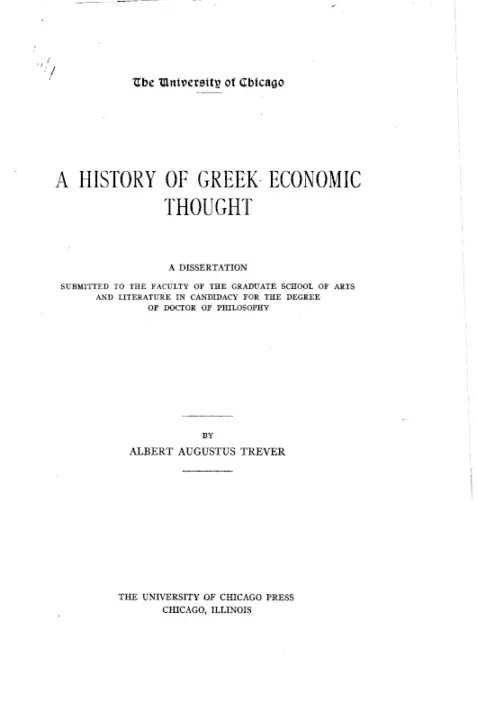
"A History of Greek Economic Thought" by Albert Augustus Trever is a scholarly dissertation composed in the early 20th century. This work explores the evolution of economic theories as conceptualized by ancient Greek philosophers, placing their ideas within the context of both their time and the present humanitarian economic discourse. The book aims to not just chronicle, but also reinterpret Greek economic thought, connecting ancient ideas with modern economic principles. The opening of the work sets forth the author's intention to fulfill a scholarly gap in the discourse of Greek economic theory. It discusses the existing literature on the subject, noting that previous works often failed to approach the topic from the perspective of a classicist infused with a modern economic view. Trever emphasizes that the Greeks, despite their simpler economic environment, fostered significant ethical and humanistic considerations in their economic theories that resonate with contemporary thought. By establishing a chronological format, he intends to analyze the ideas of prominent Greek thinkers, such as Plato and Aristotle, in relation to the economic conditions of their epoch.
Introduction adapted from the source catalogue; source summaries may be automatically generated.
Free to read · English · 58,276 words · No account needed
MAKE TIME FOR A GOOD BOOK
On by default. Untick to stop anonymous reading totals. Each page counts after 10 seconds in view. How this works.
Anonymous counting is on unless you have switched it off.
Rep. 550D, 373D: ἐὰν καὶ ἐκεῖνοι ἀφῶσιν αὑτοὺς ἐπὶ χρημάτων κτῆσιν ἄπειρον ὑπερβάντες τὸν τῶν ἀναγκαίων ὄρον. On ἄπειρος cf. infra under Aristotle. Cf. Dobbs, op. cit., pp. 202 f. and note, on the evil results of excessive wealth and poverty in the Greece of that age. Like Ruskin, Mun. Pul., VI, 153 and note (Vol. XVII, 277), who cites Laws 736E; Aratra Pentelici, IV, 138 (Vol. XX, 295 f.) on money as the root of all evil, citing Laws 705B.
Footnote 92:
Laws 729A.
Footnote 93:
Footnote 94:
Rep. 421D.
Footnote 95:
Laws 742E, especially πλουσίους δ᾽ αὒ σφόδρα καὶ ἀγαθοὺς ἀδύνατον. For the modern application of this doctrine, cf. infra; cf. also 743A, C; Rep. 550E, 551A.
Footnote 96:
Rep. 422; cf. 372E ff. on the φλεγμαίνουσα state.
Footnote 97:
373E; Phaedo 66C. Compare the modern doctrine that lasting peace is impossible under the present economic system.
Footnote 98:
Laws 744D: διάστασις; also a basal idea of the Republic.
Footnote 99:
This is the spirit of the Republic throughout, but cf. especially 369C-374D, and p. 25, n. 7.
Footnote 100:
Laws 736E: καὶ πενίαν ἡγουμένους εἶναι μὴ τὸ τὴν οὐσίαν ἐλάττω ποιεῖν, ἀλλὸ τὸ τὴν ἀπληστίαν πλείω. Cf. infra on Xenophon for similar ideas. Carlyle, Sartor Resartus, chapter on “Everlasting Yea”: “The fraction of life can be increased in value not so much by increasing your numerator as by lessening your denominator.” Ruskin, Time and Tide, II, 5 ff. (Vol. XVII, 319 ff.); cf. 320, n. 1, for other references. Thoreau: “A man is wealthy in proportion to the number of things he can let alone”—an overemphasized truth.
Footnote 101:
So Socrates (Apol. 41E, 29D-E) and Jesus (Matt. 6:33).
Footnote 102:
Laws 634A.
Footnote 103:
Rep. 329E-330A, 330D-331B; cf. also the prayer of Phaedrus 279C: τὸ δὲ χρυσοῦ πλῆθος εἴη μοι ὅσον μήτε ἅγειν δύναιτ᾽ ἄλλος ἢ ὁ σώφρων; Laws 679B; Gorg. 477E: τίς οὖν τέχνη πενίας ἀππαλλάττει; οὐ χρηματιστική; cf. also 452C.
Footnote 104:
Cf. preceding notes; also Rep. 421D-E; Laws 744D.
Footnote 105:
Bonar (Philosophy and Political Economy, pp. 13 f.) criticizes Rep. 400-402 for not seeing that unlimited wealth is necessary for the realization of the highest art and beauty.
Footnote 106:
Plato also emphasizes this, Laws 743E, 870B: οὐ χρὴ πλουτεῖν ζητεῖν τὸν εὐδαίμονα ἐσόμενον, ἀλλὰ δικαίως πλουτεῖν καὶ σωφρόνως; 660E; though he implies that unlimited wealth is necessarily evil.
Footnote 107:
Rep. 552B-D; cf. Robin, op. cit., p. 243, n. 1, on κηφήν.
Footnote 108:
In Mun. Pul., III, 91 (Vol. XVII, 213), he makes Circe’s swine a type of false consumption; cf. Fors Clav., Letter 38 (Vol. XXVIII, 30 ff.); Mun. Pul., Pref., 16 (Vol. XVII, 139 f.); Queen of the Air, III, 124 ff. (Vol. XIX, 404 ff.); Pol. Econ. of Art, I, 48 ff. (Vol. XVI, 47 ff.); Unto This Last, IV, 76 (Vol. XVII, 102); Mill also attacked this idea.
Footnote 109:
Unto This Last, II, 40 (Vol. XVII, 56); cf. also Mun. Pul., II, 54
(Vol. XVII, 178 f.).
Footnote 110:
Discussed above.
Footnote 111:
Cf. Pol. 281D-283A, for an excellent description of the weaving industry; also Crat. 388C ff.; Phileb. 56B, on carpentry.
Footnote 112:
Pol. 287D-289B; cf. Espinas, op. cit., pp. 35 f.; “L’Art économie dans Platon,” Revue des Etudes Grecques, XXVII (1914), 106 ff.
Footnote 113:
Pol. 281D-E; cf. also Phaedo 99A-B; Phileb. 27A; Timaeus
46C-D.
Footnote 114:
Your reading position is saved on this browser. Take it to another device with a library code. Reading pages adapt to text, rather than matching a printed edition.
BEHIND THE BOOK
This eBook is for the use of anyone anywhere in the United States and most other parts of the world at no cost and with almost no restrictions whatsoever. You may copy it, give it away or re-use it under the terms of the Project Gutenberg License included with this eBook or online at www.gutenberg.org. If you are not located in the United States, you will have to check the laws of the country where you are located before using this eBook. Read the source licence.
The original source file, including credits and licence, is retained by this library. Request an original-format copy at no charge. Please include the book title and Project Gutenberg identifier #58204.
KEEP YOUR CURIOSITY GOING
Cécile Tormay

Moritz Busch
John L. Ransom
Frances Wright
Cécile Tormay

Mabel Potter Daggett