THE CLASSIC COLLECTION✦An outlaw’s diary: the CommuneCLASSIC FREE BOOKS
An outlaw’s diary: the Commune
Cécile Tormay
THE CLASSIC COLLECTION · 1916
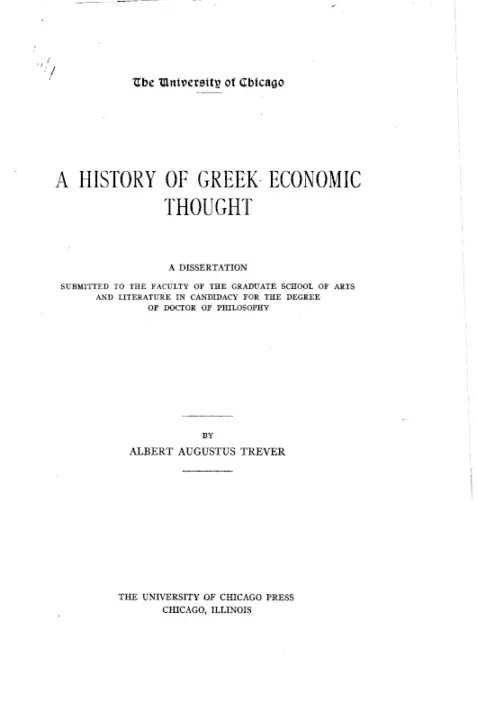
"A History of Greek Economic Thought" by Albert Augustus Trever is a scholarly dissertation composed in the early 20th century. This work explores the evolution of economic theories as conceptualized by ancient Greek philosophers, placing their ideas within the context of both their time and the present humanitarian economic discourse. The book aims to not just chronicle, but also reinterpret Greek economic thought, connecting ancient ideas with modern economic principles. The opening of the work sets forth the author's intention to fulfill a scholarly gap in the discourse of Greek economic theory. It discusses the existing literature on the subject, noting that previous works often failed to approach the topic from the perspective of a classicist infused with a modern economic view. Trever emphasizes that the Greeks, despite their simpler economic environment, fostered significant ethical and humanistic considerations in their economic theories that resonate with contemporary thought. By establishing a chronological format, he intends to analyze the ideas of prominent Greek thinkers, such as Plato and Aristotle, in relation to the economic conditions of their epoch.
Introduction adapted from the source catalogue; source summaries may be automatically generated.
Free to read · English · 58,276 words · No account needed
MAKE TIME FOR A GOOD BOOK
On by default. Untick to stop anonymous reading totals. Each page counts after 10 seconds in view. How this works.
Anonymous counting is on unless you have switched it off.
Footnote 68:
To judge by Xen. Mem., this might have been said of Socrates had he
been a writer.
Footnote 69:
Robin (Platon et la science sociale, p. 239) makes him the forerunner of the triple division of economics—production, exchange, distribution—but this is hardly warranted.
Footnote 70:
Rep. 369 B-C.
Footnote 71:
Pol. i. chap. 2. But in the Laws, Plato’s theory of origins is more social, tracing society back to clan and family.
Footnote 72:
Cf. Laws 889 D-E, 709 B-D, and Robin, op. cit., pp. 224 f.; also the entire argument of the Republic on justice.
Footnote 73:
Laws 921B. The word is ἀξία.
Footnote 74:
Ibid.: γιγνώσκει γὰρ ὅγε δημιουργὸς τὴν ἀξίαν.
Footnote 75:
Cf. p. 15, n. 7 above.
Footnote 76:
Euthydemus 280B-E, 281B, D, 288E-289A; Meno 88D-E.
Footnote 77:
Unto This Last, IV, 62: “Useful articles that we can use”; 64: “Wealth is the possession of the valuable by the valiant” (Vol. XVII, 86 ff.); Fors Clavigera, Letter 70 (Vol. XXVIII, 712 ff.); Munera Pulveris, I, 14 (Vol. XVII, 154); II, 35 (Vol. XVII, 166 f.). Plato’s economic ideas greatly influenced Ruskin. Cf. infra, p. 149, n. 2. Cf. also Vol. XXXVIII, 112; XXXIX, 411, of Ruskin. He says, in the preface to Unto This Last (Vols. XVII, XVIII), that his “real purpose is to give ... a logical definition of wealth,” which has “often been given incidentally in good Greek by Plato and Xenophon.” Cf. ibid., n. 1, for other such references.
Footnote 78:
Ibid.
Footnote 79:
Cf. above note and Mun. Pul., II, 30, notes; Fors Clav., Letter 70, 3 (Vol. XXVII, 713), the “good things.”
Footnote 80:
Fors Clav., Lett. 70, 8 f. (Vol. XXVIII, 718 ff.), where he refers
to Plato’s Laws 727A.
Footnote 81:
Cf. infra for citations.
Footnote 82:
Cf. p. 23 and notes.
Footnote 83:
Laws 697B, 631C, 728A, 870B; Apol. 29D-E.
Footnote 84:
Apol. 30B; also Laws 743E; Gorg. 451E; cf. Ruskin, Fors Clav., Lett. 70, 6 and 11 (Vol. XXVIII, 717), where he cites Laws 726-728A, on the value of the soul. He also cites Laws 742-743 and Rep. 416E (cf. Mun. Pul. [Vol. XVII, 89, 148]).
Footnote 85:
Laws 743E.
Footnote 86:
831C-D. Ruskin (Crown of Wild Olive, 83, Vol. XVIII, 456 f.) cites Critias 120E ff., in urging the same idea. He also cites Plato’s myth of the metals, Rep. 416E, in similar vein (Mun. Pul., III, 89, Vol. XVII, 211).
Footnote 87:
631C cited by Ruskin, Mun. Pul., III, 88 (Vol. XVII, 210).
Footnote 88:
661A, 661B; Rep. 331A-B.
Footnote 89:
Laws 661B; Hipp. Maj. 290D; Menex. 246E.
Footnote 90:
Mun. Pul., II, 35 ff.; he refers to both Xenophon and Plato as being right on this point. Cf. Fors. Clav., I, 8 (Vol. XXVII, 122); Unto This Last, 64 (Vol. XVII, 89).
Footnote 91:
Your reading position is saved on this browser. Take it to another device with a library code. Reading pages adapt to text, rather than matching a printed edition.
BEHIND THE BOOK
This eBook is for the use of anyone anywhere in the United States and most other parts of the world at no cost and with almost no restrictions whatsoever. You may copy it, give it away or re-use it under the terms of the Project Gutenberg License included with this eBook or online at www.gutenberg.org. If you are not located in the United States, you will have to check the laws of the country where you are located before using this eBook. Read the source licence.
The original source file, including credits and licence, is retained by this library. Request an original-format copy at no charge. Please include the book title and Project Gutenberg identifier #58204.
KEEP YOUR CURIOSITY GOING
Cécile Tormay

Moritz Busch
John L. Ransom
Frances Wright
Cécile Tormay

Mabel Potter Daggett