THE CLASSIC COLLECTION✦An outlaw’s diary: the CommuneCLASSIC FREE BOOKS
An outlaw’s diary: the Commune
Cécile Tormay
THE CLASSIC COLLECTION · 1916
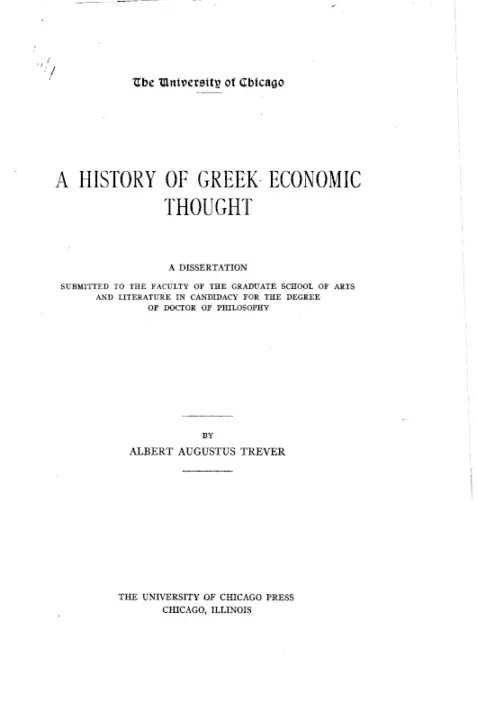
"A History of Greek Economic Thought" by Albert Augustus Trever is a scholarly dissertation composed in the early 20th century. This work explores the evolution of economic theories as conceptualized by ancient Greek philosophers, placing their ideas within the context of both their time and the present humanitarian economic discourse. The book aims to not just chronicle, but also reinterpret Greek economic thought, connecting ancient ideas with modern economic principles. The opening of the work sets forth the author's intention to fulfill a scholarly gap in the discourse of Greek economic theory. It discusses the existing literature on the subject, noting that previous works often failed to approach the topic from the perspective of a classicist infused with a modern economic view. Trever emphasizes that the Greeks, despite their simpler economic environment, fostered significant ethical and humanistic considerations in their economic theories that resonate with contemporary thought. By establishing a chronological format, he intends to analyze the ideas of prominent Greek thinkers, such as Plato and Aristotle, in relation to the economic conditions of their epoch.
Introduction adapted from the source catalogue; source summaries may be automatically generated.
Free to read · English · 58,276 words · No account needed
MAKE TIME FOR A GOOD BOOK
On by default. Untick to stop anonymous reading totals. Each page counts after 10 seconds in view. How this works.
Anonymous counting is on unless you have switched it off.
Ibid. 25-27. This contrasted yet overlapping relation between the two kinds of finance is well represented by Haney, op. cit., 46. Cf. also Ashley, op. cit., p. 340, for a synopsis of the divisions of κτητική.
Footnote 764:
1258b27-33.
Footnote 765:
Op. cit., pp. 333 ff., more satisfactory than Jowett’s idea that the intermediateness consists either in exchange for money of the direct products of the earth, or else that wood-cutting and mining are themselves the intermediate form; or than Newman’s (op. cit., II, 202 f.) theory that it consists in the fact that in this type wealth is sought, not from fruits or animals, but from things, just as exchange seeks wealth from other men or from money, as Ashley shows. However, two questions still remain unanswered: why Aristotle has three forms in chap. 11 and only two elsewhere; and why the terms, ἀκάρπων, wood-cutting, and mining are so prominent, if their relation to the thought is only incidental.
Footnote 766:
Pol. iv (vii). 1328b39 ff.; 1327a29-31.
Footnote 767:
This was a common Greek feeling (Dem. xxv. 46).
Footnote 768:
But he seems to recognize it elsewhere (N. Eth. v. 8).
Footnote 769:
Cf. DuBois, op. cit., p. 48.
Footnote 770:
Cf. the entire criticism of chrematistik, and especially 1257b40-42, the contrast between ζῆν and εὐ ζῆν. On this point, cf. above, pp. 109 f. and 87 ff. Zmavc (Zeitschrift, etc., p. 52), rightly states that even Adam Smith made his economic theory a subordinate part of his practical philosophy.
Footnote 771:
An unfair criticism, as seen above.
Footnote 772:
Pol. 1266b8-14; iv (vii). 1335b22 ff.
Footnote 773:
1265b6-12.
Footnote 774:
1270a40 ff.
Footnote 775:
Cf. iv (vii). 4. 1326a25-30, especially, τῶν γοῦν δοκουσῶν πολιτεύεσθαι καλῶς οὐδεμίαν ὁρῶμεν οὖσαν ἀνειμένην πρὸς τὸ πλῆθος. Cf. entire chapter.
Footnote 776:
1130b ff.; cf. under value, money, and exchange. The terms are διανομή or ἡ τῶν κοινῶν διανομή.
Footnote 777:
1131a11.
Footnote 778:
Ibid. 21: καὶ ἡ αὐτὴ ἔσται ἱσότης, οἷς καὶ ἐν οἶς. Cf. above, pp. 55 f. and 60 f., on Plato’s idea of equality; cf. infra for further comments on Aristotle.
Footnote 779:
1132b32 f.; cf. pp. 107 ff. and notes for a more detailed discussion, and for Greek expressions.
Footnote 780:
1131b27-32: ἡ διανομὴ ἔσται κατὰ τὸν λόγον τὸν αὐτὸν ὅνπερ ἔχουσι πρὸς ἄλληλα τὰ εἰσενεχθέντα. Cf. Mag. mor. i. 33. 1193b36 ff. Stewart (op. cit., I, 432) says that the expression ἡ τῶν κοινῶν διανομή must mean more than distribution by some central authority, for the most important form of it is the distribution of wealth, operating under economic laws that regulate wages and profits.
Footnote 781:
1131a24-26.
Footnote 782:
Ibid. 22-24. For Plato, cf. pp. 55 f.
Footnote 783:
Ibid. 26-29.
Footnote 784:
Ibid.; Pol. iii. 1280a7 ff.; 1282b23 ff.
Footnote 785:
Cf. above, pp. 113, and 93 ff. on labor.
Footnote 786:
Pol. ii. 4. 1262b2 f.
Footnote 787:
1264a11-17; 36-38; 1264b11-13, all discussed above under Plato.
Footnote 788:
iv (vii). 1329b41 ff.
Footnote 789:
1271a29-37; 1272a12-21.
Footnote 790:
N. Eth. v. chaps. 4-5, discussed above.
Footnote 791:
Pol. vi (iv). 1295b35 ff.
Footnote 792:
Your reading position is saved on this browser. Take it to another device with a library code. Reading pages adapt to text, rather than matching a printed edition.
BEHIND THE BOOK
This eBook is for the use of anyone anywhere in the United States and most other parts of the world at no cost and with almost no restrictions whatsoever. You may copy it, give it away or re-use it under the terms of the Project Gutenberg License included with this eBook or online at www.gutenberg.org. If you are not located in the United States, you will have to check the laws of the country where you are located before using this eBook. Read the source licence.
The original source file, including credits and licence, is retained by this library. Request an original-format copy at no charge. Please include the book title and Project Gutenberg identifier #58204.
KEEP YOUR CURIOSITY GOING
Cécile Tormay

Moritz Busch
John L. Ransom
Frances Wright
Cécile Tormay

Mabel Potter Daggett