THE CLASSIC COLLECTION✦An outlaw’s diary: the CommuneCLASSIC FREE BOOKS
An outlaw’s diary: the Commune
Cécile Tormay
THE CLASSIC COLLECTION · 1916
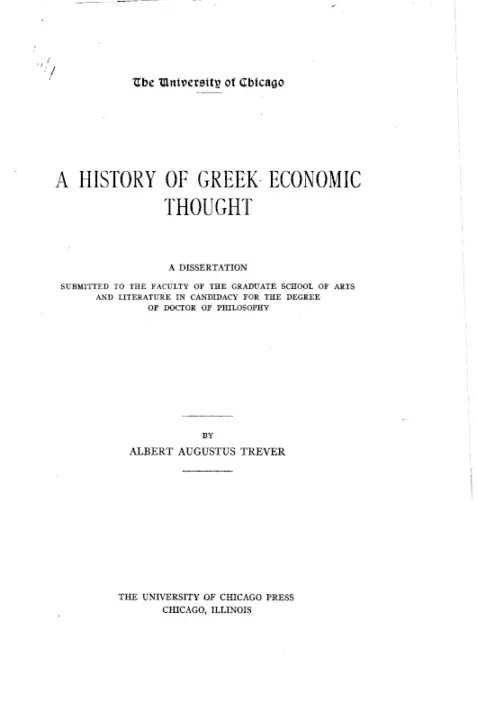
"A History of Greek Economic Thought" by Albert Augustus Trever is a scholarly dissertation composed in the early 20th century. This work explores the evolution of economic theories as conceptualized by ancient Greek philosophers, placing their ideas within the context of both their time and the present humanitarian economic discourse. The book aims to not just chronicle, but also reinterpret Greek economic thought, connecting ancient ideas with modern economic principles. The opening of the work sets forth the author's intention to fulfill a scholarly gap in the discourse of Greek economic theory. It discusses the existing literature on the subject, noting that previous works often failed to approach the topic from the perspective of a classicist infused with a modern economic view. Trever emphasizes that the Greeks, despite their simpler economic environment, fostered significant ethical and humanistic considerations in their economic theories that resonate with contemporary thought. By establishing a chronological format, he intends to analyze the ideas of prominent Greek thinkers, such as Plato and Aristotle, in relation to the economic conditions of their epoch.
Introduction adapted from the source catalogue; source summaries may be automatically generated.
Free to read · English · 58,276 words · No account needed
MAKE TIME FOR A GOOD BOOK
On by default. Untick to stop anonymous reading totals. Each page counts after 10 seconds in view. How this works.
Anonymous counting is on unless you have switched it off.
v (vi). 1320a33 ff.; cf. pp. 95 f.; cf. especially 35: τεχναστέον οὖν ὅπως, ἂν εὐπορία γένοιτο χρόνιος, and 1267b3 ff. on the insatiety of the masses. He believed that the state doles for mere consumption aggravated the evil—a very sane doctrine which our city charity organizations are prone to overlook.
Footnote 793:
Cf. Poehlmann, op. cit., II, 339 f., on this passage.
Footnote 794:
Cf. above, n. 4 above, and pp. 95 f.
Footnote 795:
1320a36: ἐπεὶ δὲ συμφέρει τοῦτο καὶ τοῖς εὐπόροις, and 34, τοῦτο γὰρ αἴτιον τοῦ μοχθηρὰν εἶναι τὴν δημοκρατίαν; viz., undue poverty of the masses.
Footnote 796:
Op. cit., p. 7; cf. Poehlmann, op. cit., I, 600, on this point.
Footnote 797:
Pol. ii. 7. 1266b14-25, as advocated by Phaleas; cf. above. Cf. infra for Aristotle’s advocacy of equality in landed property.
Footnote 798:
1267a37-39.
Footnote 799:
Ibid. 39-41.
Footnote 800:
1267b1-4; vii (vi). 1320a31; cf. p. 117 on this idea. He does not consider the rise in the cost of living.
Footnote 801:
1266b28-30.
Footnote 802:
Cf. Bonar, op. cit., p. 45.
Footnote 803:
Aristotle, like Plato, strongly emphasizes education as a great cure for the ills of the state (1310a15 ff.). It should be common to all citizens, and be publicly supervised (1336a22 ff.).
Footnote 804:
1267a13-17.
Footnote 805:
1266b38-1267a2.
Footnote 806:
Ecclesiazusae. Poehlmann (op. cit., I, 403) argues that such ideas were widespread in Greece.
Footnote 807:
Pol. iii. 9. 1280a14-21: σχεδὸν δ᾽ οἱ πλεῖστοι φαῦλοι κριταὶ περὶ τῶν οἰκείων. Cf. 7-31, his discriminating remarks on equality in general.
Footnote 808:
vii (vi). 5; iii. 10; cf. Haney op. cit., p. 45.
Footnote 809:
Cf. above on fair exchange; also p. 116 and notes.
Footnote 810:
vi (iv). 4. 1292a4-38.
Footnote 811:
vii (vi). 3. 1318b1-5, especially οἱ δὲ κρατοῦντες οὐδὲν φροντίζουσιν; cf. iii. 9. 1280a, especially 22-30, on the false idea of equality on both sides.
Footnote 812:
i. 1: ζῷον πολιτικόν; 1280a31 ff.; 1252b30 f.; cf. all of chap. 9 to 1281a10.
Footnote 813:
1280b10-12, against Lycophron; cf., above, p. 16; καὶ ὁ νόμος συνθήκη καὶ ... ἐγγυητὴς ἀλλήλοις τῶν δικαίων, ἀλλ᾽ οὐχ οἵος ποιεῖν ἀγαθοὺς καὶ δικαίους τοὺς πολίτας.
Footnote 814:
Op. cit., II, 304.
Footnote 815:
Pol. v (viii). 1. 1337a27-30, a remarkable passage, suggestive of Plato and of St. Paul’s analogy of the body. Aristotle paints vividly the antithesis between political and economic equality, whereby there grows up a state within a state (1295b13 ff.), for he believes with the author of Eud. Eth. vii. 10. 1242a, that man is not only a πολιτικόν, but also an οἰκονομικόν ζῷον. Cl. Poehlmann, op. cit., I, 276 ff.
Footnote 816:
1266b8-14; 1265a38-42; unfair to Plato, as seen above.
Footnote 817:
1266b24-28; 1265a28-38.
Footnote 818:
1265b22 ff.
Footnote 819:
1267b9-13.
Footnote 820:
Cf. his criticism of the Spartan system, 1270a40 ff.
Footnote 821:
On its wisdom, cf. infra; on its feasibility, cf. 1263b29: πάμπαν
ἀδύνατος.
Footnote 822:
1261a16-1261b15.
Footnote 823:
1261b30-32; 24-28.
Footnote 824:
Footnote 825:
1262b4-24.
Footnote 826:
Footnote 827:
1262a40-1262b3.
Footnote 828:
1263b30 ff., and preceding note.
Footnote 829:
1263a11-16.
Footnote 830:
22-26; 39 f.
Footnote 831:
26-30, citing the proverb κοινὰ τὰ φίλων. Cf. 1329b14 ff. N. Eth. viii; 8 f. on φιλία; Pol. 1252b29; 1280a25; cf. Xen. Laced. Pol. vi. 3-4.
Footnote 832:
Cf. preceding note, and 1261b32 ff.
Footnote 833:
Your reading position is saved on this browser. Take it to another device with a library code. Reading pages adapt to text, rather than matching a printed edition.
BEHIND THE BOOK
This eBook is for the use of anyone anywhere in the United States and most other parts of the world at no cost and with almost no restrictions whatsoever. You may copy it, give it away or re-use it under the terms of the Project Gutenberg License included with this eBook or online at www.gutenberg.org. If you are not located in the United States, you will have to check the laws of the country where you are located before using this eBook. Read the source licence.
The original source file, including credits and licence, is retained by this library. Request an original-format copy at no charge. Please include the book title and Project Gutenberg identifier #58204.
KEEP YOUR CURIOSITY GOING
Cécile Tormay

Moritz Busch
John L. Ransom
Frances Wright
Cécile Tormay

Mabel Potter Daggett