THE CLASSIC COLLECTION✦An outlaw’s diary: the CommuneCLASSIC FREE BOOKS
An outlaw’s diary: the Commune
Cécile Tormay
THE CLASSIC COLLECTION · 1916
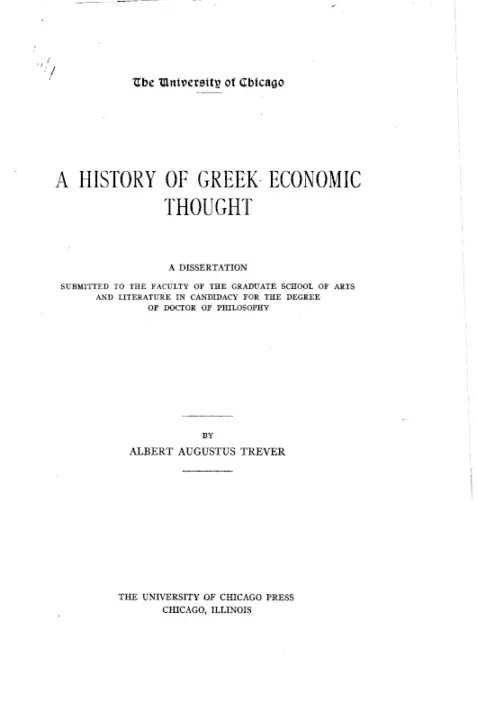
"A History of Greek Economic Thought" by Albert Augustus Trever is a scholarly dissertation composed in the early 20th century. This work explores the evolution of economic theories as conceptualized by ancient Greek philosophers, placing their ideas within the context of both their time and the present humanitarian economic discourse. The book aims to not just chronicle, but also reinterpret Greek economic thought, connecting ancient ideas with modern economic principles. The opening of the work sets forth the author's intention to fulfill a scholarly gap in the discourse of Greek economic theory. It discusses the existing literature on the subject, noting that previous works often failed to approach the topic from the perspective of a classicist infused with a modern economic view. Trever emphasizes that the Greeks, despite their simpler economic environment, fostered significant ethical and humanistic considerations in their economic theories that resonate with contemporary thought. By establishing a chronological format, he intends to analyze the ideas of prominent Greek thinkers, such as Plato and Aristotle, in relation to the economic conditions of their epoch.
Introduction adapted from the source catalogue; source summaries may be automatically generated.
Free to read · English · 58,276 words · No account needed
MAKE TIME FOR A GOOD BOOK
On by default. Untick to stop anonymous reading totals. Each page counts after 10 seconds in view. How this works.
Anonymous counting is on unless you have switched it off.
Op. cit., p. 384.
Footnote 729:
Cf. citations above, p. 42, n. 7, and p. 44, n. 2. Cf. DuBois, op.
cit., p. 46.
Footnote 730:
Cf. Haney, op. cit., p. 48.
Footnote 731:
Pol. 1259a2 f.; 33-35.
Footnote 732:
iv (vii). 6. 1327a25-30.
Footnote 733:
Rhet. i. 4. 7: περὶ τῶν εἰσαγομένων καὶ ἐξαγομένων, as among the subjects for a statesman’s consideration; cf. also 11.
Footnote 734:
Pp. 89 and notes.
Footnote 735:
Pol. 1257a28-30; vi (iv). 4. 1291a4-6; 1291b19 f.; vii (vi). 7. 1321a6, all seem to take retail and wholesale trade in the state for granted. But it is not named in the list of necessary callings in the ideal state, 1328b24 ff.; 5 ff.; cf. also 1329a40 ff. Of course the citizens are not to engage in it (1328b37 ff.).
Footnote 736:
N. Eth. v. 8. 1132b4 f.; 1133a27; all of chap. 8; cf. above, on
just exchange.
Footnote 737:
Pol. iv (vii). 6. 1327a25-28.
Footnote 738:
vii (vi). 5. 1320a39: ἀφορμὴν ἐμπορίας. Cf. p. 96.
Footnote 739:
Cf. discussion above of just exchange.
Footnote 740:
Pol. i. chaps. 8-11. Ruskin does not seem to have used the term “chrematistik,” and he has no reference to this passage, though, as seen above, he has much to say in the same general spirit.
Footnote 741:
Pol. 1256a11 f.; cf. p. 40 on Plato’s terms for trade. For the word χρηματιστική, cf. Rep. 415E, contrasted to soldiers; Gorg. 477E, the art that frees from poverty; 452C; Euthyd. 304C, of the Sophists; Xen. Econ. ii. 18, where no prejudice is implied.
Footnote 742:
Pol. i. 8. 1256a10-12; but cf. N. Eth. i. 1. 1094a9: τέλος οἰκονομικῆς δὲ πλοῦτος; and Pol. iii. 4. 1277b24 f.: ἐπεὶ καὶ οἰκονομία ἑτέρα ἀνδρὸς καὶ γυναικός· τοῦ μὲν γὰρ κτᾶσθαι τῆς δὲ φυλάττειν ἔργον ἐστίν. An American economist would hardly make the latter distinction. Newman (op. cit., II, 166) thinks that in these two passages he states the actual condition, but cf. infra, where Aristotle admits a degree of acquisition in domestic economy.
Footnote 743:
1256a15 ff.
Footnote 744:
1256b26-39.
Footnote 745:
Ibid. 30-37; cf. above on the definition of wealth.
Footnote 746:
1258a19 ff. He would combat the common idea that the first business of economics is to provide unlimited revenue (1259a35; 1254a1 f.)
Footnote 747:
1256b40-42; 1257a4 f.; 17 f.; cf. Eud. Eth. iii. 4. 1232a6-9.
Footnote 748:
1257b1 f.; 9 f.
Footnote 749:
1257a18 f., 28-30; 1257b19 f.; 31 ff.
Footnote 750:
1257a31 ff. Poehlmann (op. cit., I, 599) cites Schaeffle, Bau und Leben des sozialen Körpers, I, 256, that this analysis of the change from natural to capitalistic economy holds “im Kern die ganze moderne Kritik des Kapitals,” but the standpoint of the two is essentially different.
Footnote 751:
1258a1-14. Extreme desire demands superfluity (ὑπερβολή).
Footnote 752:
1257b20 f.
Footnote 753:
Ibid. 23 ff.
Footnote 754:
Ibid. 35 f. The two uses overlap (ἐπαλλάττει).
Footnote 755:
Ibid. 36-39.
Footnote 756:
1258a16-18.
Footnote 757:
Ibid. 19 ff. The other function is secondary (ὑπερετική).
Footnote 758:
Ibid. 39 f.
Footnote 759:
Ibid. 37 f.
Footnote 760:
1258b12-21.
Footnote 761:
Ibid. 1 f.; cf. 1256a40 ff., where καπηλεία is opposed to αὐτόφυτον ἔχουσι τὴν ἐργασίαν.
Footnote 762:
1258b20-23.
Footnote 763:
Your reading position is saved on this browser. Take it to another device with a library code. Reading pages adapt to text, rather than matching a printed edition.
BEHIND THE BOOK
This eBook is for the use of anyone anywhere in the United States and most other parts of the world at no cost and with almost no restrictions whatsoever. You may copy it, give it away or re-use it under the terms of the Project Gutenberg License included with this eBook or online at www.gutenberg.org. If you are not located in the United States, you will have to check the laws of the country where you are located before using this eBook. Read the source licence.
The original source file, including credits and licence, is retained by this library. Request an original-format copy at no charge. Please include the book title and Project Gutenberg identifier #58204.
KEEP YOUR CURIOSITY GOING
Cécile Tormay

Moritz Busch
John L. Ransom
Frances Wright
Cécile Tormay

Mabel Potter Daggett