THE CLASSIC COLLECTION✦An outlaw’s diary: the CommuneCLASSIC FREE BOOKS
An outlaw’s diary: the Commune
Cécile Tormay
THE CLASSIC COLLECTION · 1916
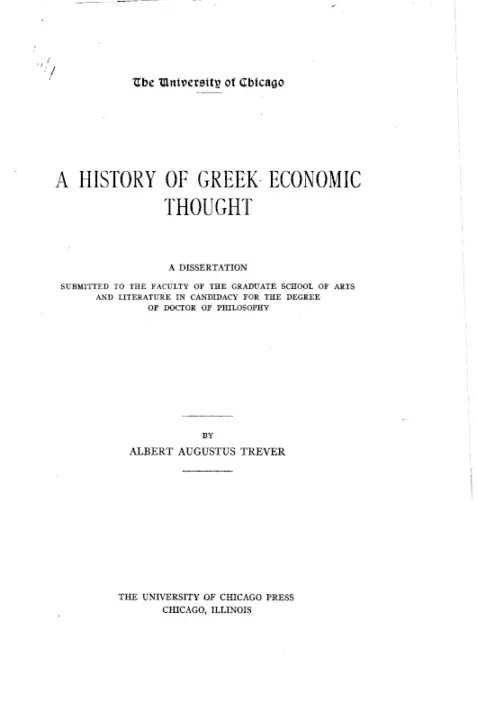
"A History of Greek Economic Thought" by Albert Augustus Trever is a scholarly dissertation composed in the early 20th century. This work explores the evolution of economic theories as conceptualized by ancient Greek philosophers, placing their ideas within the context of both their time and the present humanitarian economic discourse. The book aims to not just chronicle, but also reinterpret Greek economic thought, connecting ancient ideas with modern economic principles. The opening of the work sets forth the author's intention to fulfill a scholarly gap in the discourse of Greek economic theory. It discusses the existing literature on the subject, noting that previous works often failed to approach the topic from the perspective of a classicist infused with a modern economic view. Trever emphasizes that the Greeks, despite their simpler economic environment, fostered significant ethical and humanistic considerations in their economic theories that resonate with contemporary thought. By establishing a chronological format, he intends to analyze the ideas of prominent Greek thinkers, such as Plato and Aristotle, in relation to the economic conditions of their epoch.
Introduction adapted from the source catalogue; source summaries may be automatically generated.
Free to read · English · 58,276 words · No account needed
MAKE TIME FOR A GOOD BOOK
On by default. Untick to stop anonymous reading totals. Each page counts after 10 seconds in view. How this works.
Anonymous counting is on unless you have switched it off.
Or. xx. 25.
Footnote 707:
Or. xxxvi. 44: εἰ δὲ τοῦτ᾽ ἀγνοεῖς, ὅτι πίστις ἀφορμὴ τῶν πασῶν ἐστὶ μεγίστη πρὸς χρηματισμόν, πᾶν ἂν ἀγνοήσειας.
Footnote 708:
Ibid. 57 ff.
Footnote 709:
Cf. p. 105, n. 7, on Souchon; E. Boehm von Bawerk (Capital und Capitalzins, [1900] I, 17 f.) says: “Die Geschäftsleute und Praktiker standen sicher auf der zinsfreundlichen Seite.” He accounts for the fact that almost the only passages against interest are in the philosophers by the inference that to uphold interest was superfluous, and to oppose it was useless. Poehlmann exaggerates both the degree of credit operations, and the prejudice of Aristotle.
Footnote 710:
For the Greek terms, cf. p. 40.
Footnote 711:
Pol. 1257a15-17.
Footnote 712:
Ibid. 22-28; N. Eth. v. 5. 1133b26-28.
Footnote 713:
Pol. 1257a30 ff. These two periods of οἰκονομική and χρηματιστική correspond well to the German terms Naturalwirtschaft and Geldwirtschaft. Kautz (op. cit., p. 137, n. 4) says that this antithesis was about as dear to Aristotle as it is to moderns. For the terms, cf. infra.
Footnote 714:
N. Eth. v. 4. 1132b11-1133b28; cf. also under value and money, above; cf. Mag. mor. i. 33. 1193b19 ff.
Footnote 715:
1132b11-20; cf. Rep. 369B-C; 370B, for a similar idea of Plato.
Footnote 716:
1132b33.
Footnote 717:
Ibid. 32-34, especially τῷ ἀντιποιεῖν ἀνάλογον συμμένει ἡ πίλις; 17 f.; Stewart, op. cit., I, 449.
Footnote 718:
1133a5-10, cited on p. 83, nn. 2-7; cf. Eud. Eth. vii. 10.
1243b28-38.
Footnote 719:
1133a10 f.
Footnote 720:
Cf. p. 83, n. 7. The less valuable product must make up in quantity what it lacks in quality. The proportion thus becomes, γεωργός : σκυτοτόμος : : x pairs of shoes : a quantity of grain of equal value (1133a32 f.). Cf. other methods of statement, 1133b4 f., 22 Stewart, op. cit., I, 453 f.
Footnote 721:
1133b1-4.
Footnote 722:
1133a11 f.; 16-18: ἑτέρων καὶ οὐκ ἴσων. Cf. Rep. 369C, 370B; Ar. Pol. 1261a22 for a similar idea. Stewart (op. cit., I, 464 f.), following Jackson, interprets, on the basis of 1132a33, the buyer’s two advantages to be, if he buys too cheaply, the part of the article still unpaid for, and the money he should have paid for it. Cf. ibid. pp. 455-67 for other interpretations.
Footnote 723:
1133a15 f.: ἀνῃροῦντο γὰρ ἄν, εἰ μὴ ὁ ἐποίει τὸ ποιοῦν καὶ ὅσον καὶ οἷον, καὶ τὸ πάσχειν ἔπασχε τοῦτο και τοσοῦτον καὶ τοιοῦτον. I follow Jackson, note, pp. 97 f.; Rassow, Forsch., p. 18 (Peters’ trans., p. 154, n. 2), in accepting this difficult passage as an integral part of its context, and in interpreting it as above, though aside from the context, it would hardly bear this meaning. Stewart (op. cit., I, 455 ff.) thinks it is an interpolation or note, referring merely to the mechanical fact in the arts that material is receptive to the impression.
Footnote 724:
1133a18 f.; 25-28; 1133b6-8; 19 f.; cf. Rep. 369C.
Footnote 725:
1133a19-29; cf. Stewart’s excellent comments, op. cit., I, 459 ff.
Footnote 726:
1133b14-16; 20-22: τοῦτο γὰρ πάντα ποιεῖ σύμμετρα; e.g., if a house is equal to five minae and a bed is worth one, five beds equal one house (23-26).
Footnote 727:
Handwörterbuch der Staatswwissenschaft, art. “Geld,” 2d ed., Bd. IV,
82 f.
Footnote 728:
Your reading position is saved on this browser. Take it to another device with a library code. Reading pages adapt to text, rather than matching a printed edition.
BEHIND THE BOOK
This eBook is for the use of anyone anywhere in the United States and most other parts of the world at no cost and with almost no restrictions whatsoever. You may copy it, give it away or re-use it under the terms of the Project Gutenberg License included with this eBook or online at www.gutenberg.org. If you are not located in the United States, you will have to check the laws of the country where you are located before using this eBook. Read the source licence.
The original source file, including credits and licence, is retained by this library. Request an original-format copy at no charge. Please include the book title and Project Gutenberg identifier #58204.
KEEP YOUR CURIOSITY GOING
Cécile Tormay

Moritz Busch
John L. Ransom
Frances Wright
Cécile Tormay

Mabel Potter Daggett