THE CLASSIC COLLECTION✦An outlaw’s diary: the CommuneCLASSIC FREE BOOKS
An outlaw’s diary: the Commune
Cécile Tormay
THE CLASSIC COLLECTION · 1916
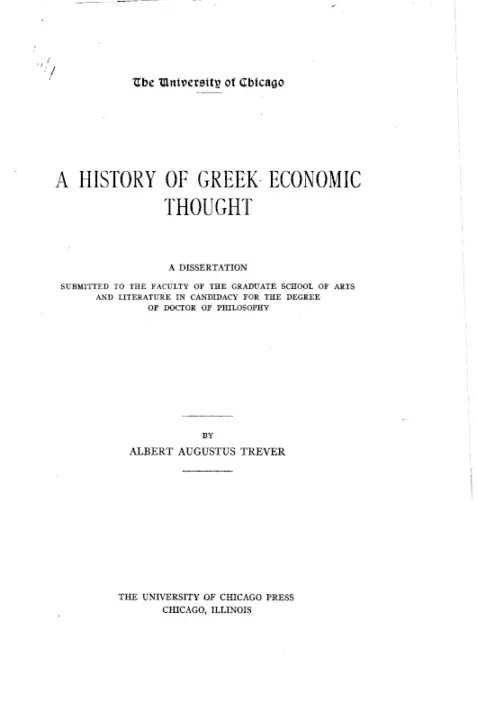
"A History of Greek Economic Thought" by Albert Augustus Trever is a scholarly dissertation composed in the early 20th century. This work explores the evolution of economic theories as conceptualized by ancient Greek philosophers, placing their ideas within the context of both their time and the present humanitarian economic discourse. The book aims to not just chronicle, but also reinterpret Greek economic thought, connecting ancient ideas with modern economic principles. The opening of the work sets forth the author's intention to fulfill a scholarly gap in the discourse of Greek economic theory. It discusses the existing literature on the subject, noting that previous works often failed to approach the topic from the perspective of a classicist infused with a modern economic view. Trever emphasizes that the Greeks, despite their simpler economic environment, fostered significant ethical and humanistic considerations in their economic theories that resonate with contemporary thought. By establishing a chronological format, he intends to analyze the ideas of prominent Greek thinkers, such as Plato and Aristotle, in relation to the economic conditions of their epoch.
Introduction adapted from the source catalogue; source summaries may be automatically generated.
Free to read · English · 58,276 words · No account needed
MAKE TIME FOR A GOOD BOOK
On by default. Untick to stop anonymous reading totals. Each page counts after 10 seconds in view. How this works.
Anonymous counting is on unless you have switched it off.
Footnote 655:
1255a3-7.
Footnote 656:
Ibid. 19-21 and next note.
Footnote 657:
Ibid. 24 f.
Footnote 658:
Ibid. 25 f.: καὶ τὸν ἀνάξιον δουλεύειν οὐδαμῶς ἂν φαίη τις δοῦλον εἶναι.
Footnote 659:
Ibid. 26-28.
Footnote 660:
Ibid. 33 ff.
Footnote 661:
1255b20-22. Barker (op. cit., p. 369, n. 1) well observes that this is a challenge of the right of slavery, not an argument for it, and that it may have impressed his contemporaries so. Cf. Ruskin: “So there is only one way to have good servants; that is to be worthy of being well served.” (Letters on Servants and Houses, Vol. XVII, 5-18, App. V); cf. also pp. 520 ff.
Footnote 662:
1259b26-28.
Footnote 663:
Ibid. 36-38.
Footnote 664:
Ibid. 39-41.
Footnote 665:
1260a2-4; 14-16; cf. 33 ff., which sets a limit on the slave’s
virtue.
Footnote 666:
1260a39-42; 1260b2 f. Cf. Ruskin, Fors Clav., III, Letter 28, 14, on the virtue of the “menial” condition.
Footnote 667:
Cf. Barker, op. cit., p. 370.
Footnote 668:
N. Eth. 1161b1-10, especially 5: ᾗ μὲν οῦν δοῦλος, οὔκ ἐστι φιλία πρὸς αὐτόν, ᾗ δ᾽ ἄνθρωπος.
Footnote 669:
Cf. his reference to Cleisthenes’ gift of Athenian citizenship to many slaves; also his own emancipation, by will, of five of his own slaves (Diog. L. V. 1. 9).
Footnote 670:
Cf. Barker, op. cit., p. 370.
Footnote 671:
Sesame and Lilies, end of lecture on “Kings’ Treasuries”; cf. Fors Clav., VII, 9 (Vol. XXIX, 230); Mun. Pul., 130, note; cf. Fors Clav., III (Vol. XXVII, 515 f.). Lett. 28, 13 ff., on the workman as a serf.
Footnote 672:
Barker, op. cit., 368.
Footnote 673:
On the servile condition of the modern laborer, cf. Ruskin as above; a common idea also of Carlyle and of many modern economic writings.
Footnote 674:
Pol. 1257a31 ff., praised for its exactness and insight. Cf. Poehlmann, op. cit., I, 585; Dühring (op. cit., p. 23) belittles it. Newman (op. cit., II, 184) points to ξενικωτέρας as implying that the increased distance between buyers and sellers also caused the origin of money.
Footnote 675:
N. Eth. v. 5. 1133b26-28.
Footnote 676:
Pol. 1257a31-36; ξενικωτέρας γὰρ γενομένης τῆς βοηθείας τῷ εἰσάγεσθαι ὦν ἐνδεεῖς καὶ ἐκπέμπειν ὦν ἐπλεόναζον, ἐξ ἀνάνκης ἡ τοῦ νομίσματος ἐπορίσθη χρῆσις, etc.
Footnote 677:
Ibid. 36-38; εὐμεταχείριστον could mean “malleability,” but probably not, since he considers coinage to be an afterthought.
Footnote 678:
Ibid. 38 f.
Footnote 679:
Ibid. 39-41.
Footnote 680:
1257b1-5.
Footnote 681:
As a symbol of exchange (ξύμβολον τῆς ἀλλαγῆς) it is a medium of exchange and a measure of value (Rep. 371B; Laws 742A-B, 918B).
Footnote 682:
Your reading position is saved on this browser. Take it to another device with a library code. Reading pages adapt to text, rather than matching a printed edition.
BEHIND THE BOOK
This eBook is for the use of anyone anywhere in the United States and most other parts of the world at no cost and with almost no restrictions whatsoever. You may copy it, give it away or re-use it under the terms of the Project Gutenberg License included with this eBook or online at www.gutenberg.org. If you are not located in the United States, you will have to check the laws of the country where you are located before using this eBook. Read the source licence.
The original source file, including credits and licence, is retained by this library. Request an original-format copy at no charge. Please include the book title and Project Gutenberg identifier #58204.
KEEP YOUR CURIOSITY GOING
Cécile Tormay

Moritz Busch
John L. Ransom
Frances Wright
Cécile Tormay

Mabel Potter Daggett