THE CLASSIC COLLECTION✦An outlaw’s diary: the CommuneCLASSIC FREE BOOKS
An outlaw’s diary: the Commune
Cécile Tormay
THE CLASSIC COLLECTION · 1916
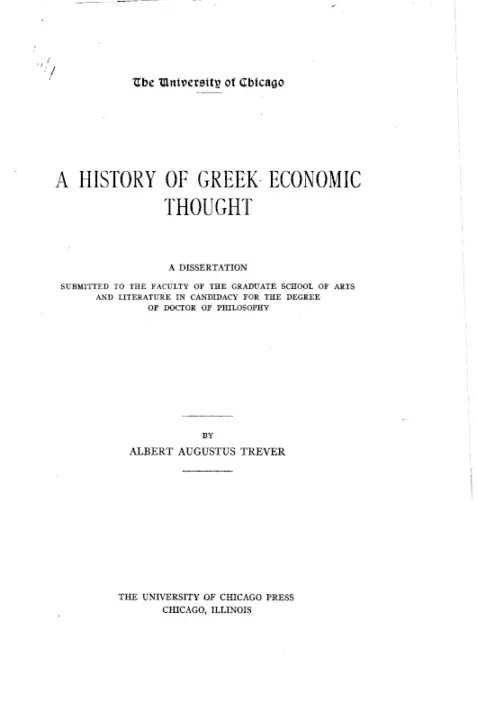
"A History of Greek Economic Thought" by Albert Augustus Trever is a scholarly dissertation composed in the early 20th century. This work explores the evolution of economic theories as conceptualized by ancient Greek philosophers, placing their ideas within the context of both their time and the present humanitarian economic discourse. The book aims to not just chronicle, but also reinterpret Greek economic thought, connecting ancient ideas with modern economic principles. The opening of the work sets forth the author's intention to fulfill a scholarly gap in the discourse of Greek economic theory. It discusses the existing literature on the subject, noting that previous works often failed to approach the topic from the perspective of a classicist infused with a modern economic view. Trever emphasizes that the Greeks, despite their simpler economic environment, fostered significant ethical and humanistic considerations in their economic theories that resonate with contemporary thought. By establishing a chronological format, he intends to analyze the ideas of prominent Greek thinkers, such as Plato and Aristotle, in relation to the economic conditions of their epoch.
Introduction adapted from the source catalogue; source summaries may be automatically generated.
Free to read · English · 58,276 words · No account needed
MAKE TIME FOR A GOOD BOOK
On by default. Untick to stop anonymous reading totals. Each page counts after 10 seconds in view. How this works.
Anonymous counting is on unless you have switched it off.
Ruskin thinks that inequality of possessions, in itself, does not necessarily mean either evil or good for a nation (Unto This Last, II, 31 [Vol. XVII, 46 f.]); he argues that each is born with an absolutely limited capacity, and calls the idea of natural equality of men “radical blockheadism” (Fors Clav., VIII, Letter 95, 6 [Vol. XXIX, 496]); cf. Unto This Last, III, 54 (Vol. XVII, 74); Modern Painters, III, Pt. IV, chap. x, 22 (Vol. III, 189); Seven Lamps of Architecture, IV, 28 (Vol. VIII, 167); Fors Clav., II, Letter 14, 4 and note (Vol. XXVII, 248); Stones of Venice, III, 4 (Vol. XI, 260), all of which emphasize its impossibility. He strongly opposes socialism, cf. above, and Mun. Pul., 21 (Vol. XVII, 144), though his economic ideas contained essentially the germ of modern socialistic doctrine.
Footnote 317:
Cf. his ironical criticism of democratic equality in Athens, 558C: ἰσότητά τινα ὁμοίως ἴσοις τε καὶ ἀνίσοις διανέμουσα; Laws 757B-D, 744B-C; cf. infra for Aristotle’s idea. Cf. p. 61, n. 1 for further notice of these passages.
Footnote 318:
Poehlmann (op. cit., I, 553, n. 3) is extreme in asserting that Plato’s account of the growth of the proletariat, and the rise of class struggles (Book VIII) contains “alle wesentlichen Züge des Bildes, welches die moderne Plutokratie gewährt,” and (560), “Das vierte Jahrhundert v. Chr. hat uns den Kampf vorgekämpft in welchem wir selbst mittenhineinstehen.”
Footnote 319:
Pohlenz (op. cit., p. 240) makes his socialism a reaction against the individualism of Pericles, but makes the extreme assertion: “Die Grundlage auf der Plato seinen Idealstaat aufbaut, ist der strengste Socialismus.”
Footnote 320:
Cf. p. 43, n. 10. He evidently recognizes his ideas on the family and on the philosopher-king as utopian; cf. also 425D-E; but Poehlmann (op. cit., II, 144-52) opposes this view. Cf. Shorey, Class. Phil., October, 1914, pp. 357 f., on the idea of law in the Laws and Politics.
Footnote 321:
When advocated, it has not been with the lofty motive of Plato.
Footnote 322:
Poehlmann ((op. cit., I, 579, 598) admits this. Guiraud (La Prop. fonc., p. 594) points out that the analogy with modern socialism is difficult, owing to the modern abolition of slavery, great extent of states, and large increase in personal property.
Footnote 323:
Your reading position is saved on this browser. Take it to another device with a library code. Reading pages adapt to text, rather than matching a printed edition.
BEHIND THE BOOK
This eBook is for the use of anyone anywhere in the United States and most other parts of the world at no cost and with almost no restrictions whatsoever. You may copy it, give it away or re-use it under the terms of the Project Gutenberg License included with this eBook or online at www.gutenberg.org. If you are not located in the United States, you will have to check the laws of the country where you are located before using this eBook. Read the source licence.
The original source file, including credits and licence, is retained by this library. Request an original-format copy at no charge. Please include the book title and Project Gutenberg identifier #58204.
KEEP YOUR CURIOSITY GOING
Cécile Tormay

Moritz Busch
John L. Ransom
Frances Wright
Cécile Tormay

Mabel Potter Daggett