THE CLASSIC COLLECTION✦An outlaw’s diary: the CommuneCLASSIC FREE BOOKS
An outlaw’s diary: the Commune
Cécile Tormay
THE CLASSIC COLLECTION · 1916
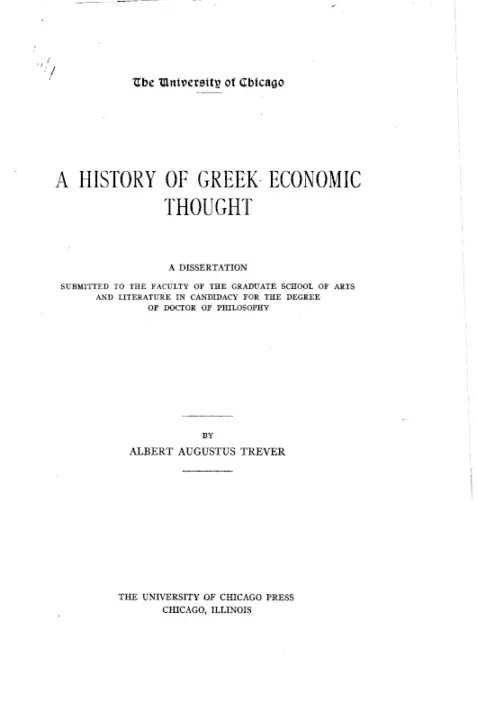
"A History of Greek Economic Thought" by Albert Augustus Trever is a scholarly dissertation composed in the early 20th century. This work explores the evolution of economic theories as conceptualized by ancient Greek philosophers, placing their ideas within the context of both their time and the present humanitarian economic discourse. The book aims to not just chronicle, but also reinterpret Greek economic thought, connecting ancient ideas with modern economic principles. The opening of the work sets forth the author's intention to fulfill a scholarly gap in the discourse of Greek economic theory. It discusses the existing literature on the subject, noting that previous works often failed to approach the topic from the perspective of a classicist infused with a modern economic view. Trever emphasizes that the Greeks, despite their simpler economic environment, fostered significant ethical and humanistic considerations in their economic theories that resonate with contemporary thought. By establishing a chronological format, he intends to analyze the ideas of prominent Greek thinkers, such as Plato and Aristotle, in relation to the economic conditions of their epoch.
Introduction adapted from the source catalogue; source summaries may be automatically generated.
Free to read · English · 58,276 words · No account needed
MAKE TIME FOR A GOOD BOOK
On by default. Untick to stop anonymous reading totals. Each page counts after 10 seconds in view. How this works.
Anonymous counting is on unless you have switched it off.
On its origin, cf. Otto Schrohl, De Eryx. qui fertur Platonis (dissertation, 1901) which gives a full bibliography, pp. 5 ff.; Heidel (Pseudo-Platonica, p. 61), following Steinhart (Mueller, VII, 14), attributes it to a later Socratic, in sympathy with Antisthenes; p. 69, n. 3, he thinks it grew out of Euthyd. 288E ff.; for other points of contact, cf. Schrohl, 10 ff.
Footnote 947:
On the first, cf. 393A-394E, 402E-403C; on the second, cf. 396E-397D,
405C-406B.
Footnote 948:
Cf. preceding n. 3.
Footnote 949:
Footnote 950:
Cf. above, in loc.
Footnote 951:
For Stoics, cf. infra.
Footnote 952:
Xen. Mem. i. 6, especially end: ἐγὼ δὲ νομίζω τὸ μὲν μηδενὸς δεῖσθαι θεῖον εἶναι, etc.; cf. Schrohl, op. cit., pp. 26-28.
Footnote 953:
Footnote 954:
401A: ἀλλὰ ποῖα δὴ τῶν χρησίμων, ἐπειδή γε οὐ πάντα. Cf. also 400E.
Footnote 955:
Footnote 956:
402E, 393E-394E, and the general thesis that the wisest are richest.
Footnote 957:
400A-E, 394D, arguing that economic demand might make a man’s wisdom more valuable than another’s house.
Footnote 958:
Footnote 959:
Cf. 399E, where Eristratos defines πλοῦτος as τὰ χρήματα πολλὰ κεκτῆσθαι.
Footnote 960:
393A, 393D-394A; cf. above, pp. 24 ff. and notes for Plato and others.
Footnote 961:
Footnote 962:
393E, 396E-397E, 403E, the insistence upon ability to use, so common in Plato, Xenophon, and Ruskin.
Footnote 963:
394D-E, which reads like a passage from the New Testament.
Footnote 964:
Footnote 965:
396C: ἂν μέν τι ἕχῃς, ἄξιός του, ἐὰν δὲ μή, οὐδενός. Cf. The Simple Life: “He who has nothing is nothing.” Cf. Eurip. fr. 328, Danae (Nauck): κακὸς δ᾽ ὁ μὴ ἔχων, οἱ δ᾽ ἔχοντες ὄλβιοι.
Footnote 966:
396E-397E; cf. infra, the Stoic doctrine of “indifferents”; but they included health and wealth in the same class, while the Eryxias does not. Cf. Diog. L. vii. 103; cf. a similar passage in the Euthydemus; cf. Schrohl, op. cit., p. 34.
Footnote 967:
396E-397E, as above; 393A.
Footnote 968:
Footnote 969:
Footnote 970:
Footnote 971:
Ibid., but cf. 134, n. 8, where Socrates approaches this asceticism.
Footnote 972:
403E, distinguishing the materials of a house, the tools by which they are provided, and the tools for building. Cf. Plato and Aristotle, in loc., for a like distinction.
Footnote 973:
Footnote 974:
Footnote 975:
400A-B. Heidel (op. cit., p. 61) points to his “ostentatious display
of learning” here.
Footnote 976:
Footnote 977:
Footnote 978:
400C-E, especially ὅσα μέν ἄρα τυγχάνει χρήσιμα ὄντα ἡμῖν ταῦτα χρήματα, though at this point the term has been made to include all wealth; cf. also 402C: ἀλλὰ ταῦτ᾽ ἂν εἴν (χρήματα) οἷς τὰ χρήσιμα οἶοί τ᾽ ἐσμὲν ἐκπορίζεσθαι.
Footnote 979:
Cf. Teletis Reliquiae, ed. Hense, Freiburg, 1889. The ancient source is Stobaeus. Teles, a Cynic of Megara, wrote about 240 B.C. Cf. Hense, op. cit., XXI-XXXV; Gomperz, op. cit., II, 129 ff. Fr. iv. A, pp. 24 ff., and iv. B, p. 34, are of special economic interest.
Footnote 980:
Fr. IV, A, pp. 24 ff.
Footnote 981:
Fr. IV, A, p. 24: δι᾽ ἀνελευθερίαν καὶ ῥυπαρίαν.
Footnote 982:
Ibid. 27; cf. the example of the Φορκίδες, who have an eye, but do not use it; cf. also the quotation from the “ancients” on the distinction between χρήματα, “used wealth,” and κτήματα, “wealth merely possessed” (ll. 13 f.).
Footnote 983:
Your reading position is saved on this browser. Take it to another device with a library code. Reading pages adapt to text, rather than matching a printed edition.
BEHIND THE BOOK
This eBook is for the use of anyone anywhere in the United States and most other parts of the world at no cost and with almost no restrictions whatsoever. You may copy it, give it away or re-use it under the terms of the Project Gutenberg License included with this eBook or online at www.gutenberg.org. If you are not located in the United States, you will have to check the laws of the country where you are located before using this eBook. Read the source licence.
The original source file, including credits and licence, is retained by this library. Request an original-format copy at no charge. Please include the book title and Project Gutenberg identifier #58204.
KEEP YOUR CURIOSITY GOING
Cécile Tormay

Moritz Busch
John L. Ransom
Frances Wright
Cécile Tormay

Mabel Potter Daggett