THE CLASSIC COLLECTION✦An outlaw’s diary: the CommuneCLASSIC FREE BOOKS
An outlaw’s diary: the Commune
Cécile Tormay
THE CLASSIC COLLECTION · 1916
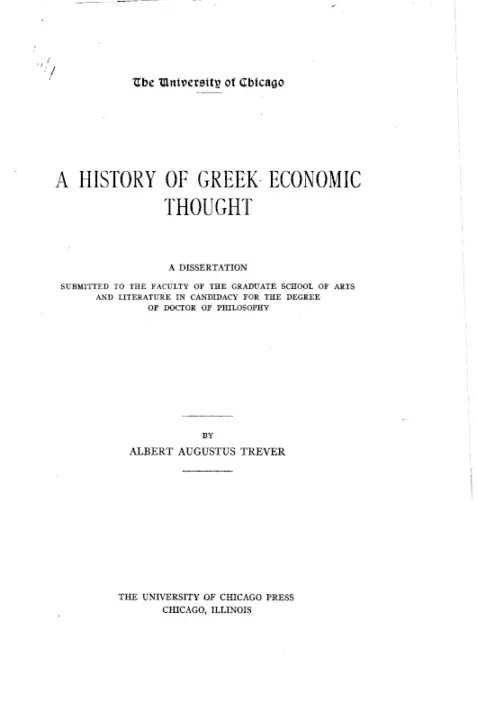
"A History of Greek Economic Thought" by Albert Augustus Trever is a scholarly dissertation composed in the early 20th century. This work explores the evolution of economic theories as conceptualized by ancient Greek philosophers, placing their ideas within the context of both their time and the present humanitarian economic discourse. The book aims to not just chronicle, but also reinterpret Greek economic thought, connecting ancient ideas with modern economic principles. The opening of the work sets forth the author's intention to fulfill a scholarly gap in the discourse of Greek economic theory. It discusses the existing literature on the subject, noting that previous works often failed to approach the topic from the perspective of a classicist infused with a modern economic view. Trever emphasizes that the Greeks, despite their simpler economic environment, fostered significant ethical and humanistic considerations in their economic theories that resonate with contemporary thought. By establishing a chronological format, he intends to analyze the ideas of prominent Greek thinkers, such as Plato and Aristotle, in relation to the economic conditions of their epoch.
Introduction adapted from the source catalogue; source summaries may be automatically generated.
Free to read · English · 58,276 words · No account needed
MAKE TIME FOR A GOOD BOOK
On by default. Untick to stop anonymous reading totals. Each page counts after 10 seconds in view. How this works.
Anonymous counting is on unless you have switched it off.
Diog. L. vi. 2, καὶ ὅτι ὁ πόνος ἀγαθὸν συνέστησε διὰ τοῦ μεγάλου Ἡρακλέους καὶ τοῦ κύρου. Heracles, the toiler, was their patron saint. Antisthenes is said to have written two dialogues called Heracles (Diog. L. vi. 2. 18), but Zeller, (op. cit., II, 1, 307, n. 4) thinks only one was genuine.
Footnote 926:
Cf. infra on Diogenes. Ar. Pol. 1253b20-22 probably refers to the Cynics, as holding it to be κατὰ φύσιν, οὐδὲ δίκαιων, and βίαιων. Cf. Newman, op. cit., I, 140, n. 2, on this. He cites Strabo, p. 15; 110, on the opposition of the Cynic Onesicritus to slavery. Cf. above, pp. 97 ff.; Zeller, op. cit., II, 1, 280 ff., 323 f.
Footnote 927:
Cf. infra on Diogenes and Eryxias; Ar. Pol. 1257b10, probably
Cynic.
Footnote 928:
412-323 B.C.; cf. Zeller, op. cit., II, 1, 280 ff.
Footnote 929:
Mullach, F.Ph.G., II, 326, fr. 276; cf. Diog. L. vi. 47: τὸν πλούσιον ἀμαθῆ, πρόβατον εἶπε χρυσόμαλλον.
Footnote 930:
Mullach, II, 302, fr. 27; 327, fr. 285; cf. infra on Teles, for like
idea.
Footnote 931:
Mullach, II, 316, fr. 168; Chrysost. Homil. lxiv in Matthew points to Paul’s parallel, I Tim. 6: 10: ῥἰζα γὰρ πάντων τῶν κακῶν ἐστιν ἡ φιλαργυρία.
Footnote 932:
Mullach, II, 305, fr. 63.
Footnote 933:
Ibid. fr. 66; 65.
Footnote 934:
Ibid. fr. 61; p. 327, fr. 285.
Footnote 935:
Gomperz, op. cit., II, 133; Zeller (op. cit., II, 1, 323 f.) is not sure that the Cynics taught a positive anti-slavery doctrine, but cf. p. 132, n. 2.
Footnote 936:
Diog. L. vi. 66, 74 f.; cf. Epict. Dissert. iii. 24. 67.
Footnote 937:
Athen. iv. 159c; Διογένης δ᾽ ἐν τῇ πολιτείᾳ νόμισμα εἶναι νομοθετεῖ ἀστραγάλους.
Footnote 938:
Diog. L. vi. 72: ἔλεγε δὲ καὶ κοινὰς εἶναι δεῖν τὰς γυναῖκας, etc. Aristotle (Pol. ii. 7. 1266a34) names Plato as its sole advocate, but cf. Zeller, op. cit., II, 1, 321 f., n. 4, and Gomperz, op. cit., II, 132, though they think that he did not hold it in the extreme form stated by Diogenes Laertius.
Footnote 939:
There is no specific evidence, though it would accord well with his other teachings. Cf. Gomperz, op. cit., II, 132.
Footnote 940:
Called “Thebaios”; flor. ca. 328 B.C.; cf. Diog. L. vi. 87.
Footnote 941:
Mullach, F. Ph. G., II, 334, fr. 6; 338, frs. 38, 39; cf. also Diog.
L. vi. 86.
Footnote 942:
Cf. The Beggar’s Wallet, an amusing parody of the Odyssey (von Arnim, Leben und Werke des Dio von Prusa [1898], 255 ff.) Gomperz (op. cit., II, n. 545 to p. 125) doubts its genuineness for Crates, but thinks it is from a Cynic source; cf. also infra on Teles.
Footnote 943:
The pseudo-Aristotelian Economics is a possible exception. The Economics of Xenophon has a broader theme, and the Revenues is for practical purposes.
Footnote 944:
Pseudo-Platonica, p. 59.
Footnote 945:
It is given mere passing mention in Boeckh, op. cit., I, 693; Hoderman, op. cit., p. 9; Francotte, L’Industrie, II, 310, n. 1; Cossa, op. cit., p. 146; Oncken, op. cit., p. 37; Bonar, op. cit., p. 11, n. 1; Kautz, op. cit., p. 121; Simey, op. cit., p. 474; Hagen, Observationum oec. pol. in Aesch. dialog., qui Eryx. inscribitur (dissertation, 1822). The latter has not been examined.
Footnote 946:
Your reading position is saved on this browser. Take it to another device with a library code. Reading pages adapt to text, rather than matching a printed edition.
BEHIND THE BOOK
This eBook is for the use of anyone anywhere in the United States and most other parts of the world at no cost and with almost no restrictions whatsoever. You may copy it, give it away or re-use it under the terms of the Project Gutenberg License included with this eBook or online at www.gutenberg.org. If you are not located in the United States, you will have to check the laws of the country where you are located before using this eBook. Read the source licence.
The original source file, including credits and licence, is retained by this library. Request an original-format copy at no charge. Please include the book title and Project Gutenberg identifier #58204.
KEEP YOUR CURIOSITY GOING
Cécile Tormay

Moritz Busch
John L. Ransom
Frances Wright
Cécile Tormay

Mabel Potter Daggett