THE CLASSIC COLLECTION✦An outlaw’s diary: the CommuneCLASSIC FREE BOOKS
An outlaw’s diary: the Commune
Cécile Tormay
THE CLASSIC COLLECTION · 1916
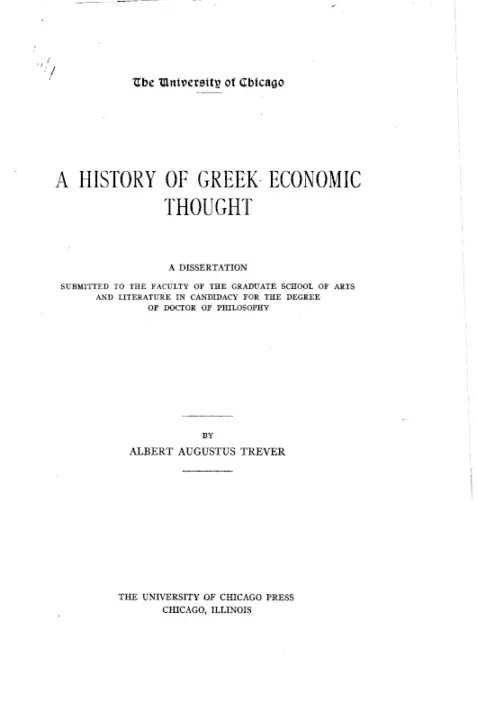
"A History of Greek Economic Thought" by Albert Augustus Trever is a scholarly dissertation composed in the early 20th century. This work explores the evolution of economic theories as conceptualized by ancient Greek philosophers, placing their ideas within the context of both their time and the present humanitarian economic discourse. The book aims to not just chronicle, but also reinterpret Greek economic thought, connecting ancient ideas with modern economic principles. The opening of the work sets forth the author's intention to fulfill a scholarly gap in the discourse of Greek economic theory. It discusses the existing literature on the subject, noting that previous works often failed to approach the topic from the perspective of a classicist infused with a modern economic view. Trever emphasizes that the Greeks, despite their simpler economic environment, fostered significant ethical and humanistic considerations in their economic theories that resonate with contemporary thought. By establishing a chronological format, he intends to analyze the ideas of prominent Greek thinkers, such as Plato and Aristotle, in relation to the economic conditions of their epoch.
Introduction adapted from the source catalogue; source summaries may be automatically generated.
Free to read · English · 58,276 words · No account needed
MAKE TIME FOR A GOOD BOOK
On by default. Untick to stop anonymous reading totals. Each page counts after 10 seconds in view. How this works.
Anonymous counting is on unless you have switched it off.
Cf. Glaucon’s tentative argument presenting the Sophist theory, Rep. 358E ff., very similar to that of Hobbes. Cf. Barker’s (op. cit., pp. 27 ff.) excellent presentation of the rise of this theory and its causes.
Footnote 40:
Cf. A. Dobbs, Philosophy and Popular Morals in Ancient Greece (1907), p. 48. For examples, cf. Hippias, cited below, n. 6, or Lycophron, opposed by Aristotle, cited below in Aristotle’s criticism of socialism (Pol. 1280b10-12).
Footnote 41:
Rep. i, and the story of Gyges, Rep. ii.
Footnote 42:
Gorg. 482E ff., though Callicles was hardly a Sophist.
Footnote 43:
E.g., Hippias in Protag. 337C, where he says that men are related (συγγενεῖς, οἰκείους) by nature, not by law, and that the law is a tyrant of men that does much violence contrary to nature (παρὰ τὴν φύσιν).
Footnote 44:
Cf. Alcidamas frag., cited infra on Aristotle’s theory of slavery, and Ar. Pol. i. 3. 1253b20-23; Lycophron (pseudo-Plut. Pro. Nob. 18. 2) denies the reality of the distinction between noble and ill-born. Cf. also on Euripides, infra. On the development of the opposition to slavery in Greece, cf. Newman, Pol. of Arist., I, 139 ff.
Footnote 45:
Diog. L. ix. 55: δίκη ὑπὲρ μισθοῦ. Cf. Diels, op. cit., II, 220, 231; Croiset, Hist. de la Litt. Gr., IV, 54. Souchon (op. cit., p. 23, n. 1) thinks that it may have taught the dignity of all labor. Cf. also Plato (Sophist 232 D): τὰ πρωταγόρεια ... περί τε πάλης καὶ τῶν ἄλλων τεχνῶν. Gomperz (Die Apologie der Heilkunst, p. 33) infers that Protagoras had published a Gesammtapologie der Künste. Cf. Pol. 299C, and Diog. L. ix. 8. 55.
Footnote 46:
Cf. Plato Protag. 328B, where Protagoras states his rule as to charges for his lectures. Cf. Zeller, op. cit., I, 2, 1080 ff., on the earnings of the Sophists. Cf. Plato Euthyd. 304C: ὅτι οὐδὲ τοῦ χρηματίζεσθαί φατον διακωλύειν οὐδέν.
Footnote 47:
Plato Charm. 163 B-D on Hesiod.
Footnote 48:
Xen. Mem. ii. 1. 21-34, the story of Heracles (28).
Footnote 49:
Pseudo-Platon. Eryxias 397 D-E, discussed infra.
Footnote 50:
Hippias Minor 368 D, where he is presented as the jack of all trades. Cf. infra for the antithetic attitude of Plato.
Footnote 51:
Orestes 917-22; Supplices 399-456, 238-45; Phoenissae 535-51 (Dindorf), cited by Dümmler, Proleg. zu Platons Staat (1891), to show that there are traces of a political treatise of the school of Antiphon in Euripides. Cf. Barker, op. cit., p. 25 and note.
Footnote 52:
Orestes 917 ff.; cf. also the noble character of the peasant (αὐτουργός) in the Electra, who is a noble soul (252 f.), and who speaks the prologue, though he is only a secondary person in the play. Cf. also 367-82.
Footnote 53:
Fr. 345 (Nauck), the unjust man is ignoble (δυσγενής), though better born than Zeus; frs. 54 (Alex.), 514 (Melanippe), 8 (Electra); cf. n. 1 above, and infra. He puts worthy sentiments into the mouths of slaves and dresses his nobles in rags.
Footnote 54:
Ion 854; ἐν γάρ τι τοῦς δούλοισιν αἰσχύνην φέρει || τὀύνομα; frs. 828 (Phrixus), 515 (Melanippe) (Nauck); Helena 730; cf. Decharme, Euripide et l’esprit de son théâtre, pp. 162 ff.
Your reading position is saved on this browser. Take it to another device with a library code. Reading pages adapt to text, rather than matching a printed edition.
BEHIND THE BOOK
This eBook is for the use of anyone anywhere in the United States and most other parts of the world at no cost and with almost no restrictions whatsoever. You may copy it, give it away or re-use it under the terms of the Project Gutenberg License included with this eBook or online at www.gutenberg.org. If you are not located in the United States, you will have to check the laws of the country where you are located before using this eBook. Read the source licence.
The original source file, including credits and licence, is retained by this library. Request an original-format copy at no charge. Please include the book title and Project Gutenberg identifier #58204.
KEEP YOUR CURIOSITY GOING
Cécile Tormay

Moritz Busch
John L. Ransom
Frances Wright
Cécile Tormay

Mabel Potter Daggett