THE CLASSIC COLLECTION✦An outlaw’s diary: the CommuneCLASSIC FREE BOOKS
An outlaw’s diary: the Commune
Cécile Tormay
THE CLASSIC COLLECTION · 1916
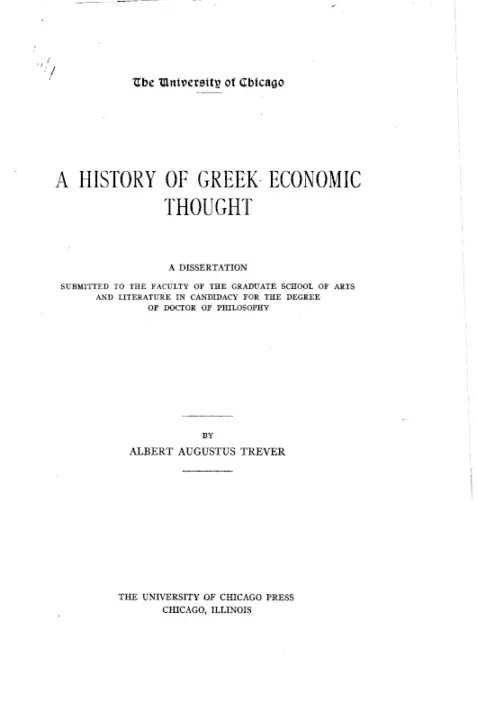
"A History of Greek Economic Thought" by Albert Augustus Trever is a scholarly dissertation composed in the early 20th century. This work explores the evolution of economic theories as conceptualized by ancient Greek philosophers, placing their ideas within the context of both their time and the present humanitarian economic discourse. The book aims to not just chronicle, but also reinterpret Greek economic thought, connecting ancient ideas with modern economic principles. The opening of the work sets forth the author's intention to fulfill a scholarly gap in the discourse of Greek economic theory. It discusses the existing literature on the subject, noting that previous works often failed to approach the topic from the perspective of a classicist infused with a modern economic view. Trever emphasizes that the Greeks, despite their simpler economic environment, fostered significant ethical and humanistic considerations in their economic theories that resonate with contemporary thought. By establishing a chronological format, he intends to analyze the ideas of prominent Greek thinkers, such as Plato and Aristotle, in relation to the economic conditions of their epoch.
Introduction adapted from the source catalogue; source summaries may be automatically generated.
Free to read · English · 58,276 words · No account needed
MAKE TIME FOR A GOOD BOOK
On by default. Untick to stop anonymous reading totals. Each page counts after 10 seconds in view. How this works.
Anonymous counting is on unless you have switched it off.
e) Perhaps the strongest reason for the comparative unimportance of Greek economic thought is usually not emphasized. It is the patent fact that almost our only extant sources are the Socratic philosophers, who represent avowedly a direct moral reaction against the commercial spirit and money-greed of their age.[67] Thus the limited development of Greek economics, so far from being an evidence of primitive economic conditions in Greece, is a direct argument for the opposite. To be sure, a man with the scientific mind of Aristotle would scarcely have failed to gain a clearer apprehension of certain fundamentals of economics than he did, had his economic environment been more complex. Yet the fact remains that he and Plato are moral prophets, protesting against that very capitalism whose existence many modern historians have sought to deny to their age.
Footnote 18:
Cf. infra for qualifications. Zimmern (op. cit., p. 227) rightly insists: “In spite of what is often said, Greece did produce economists.”
Footnote 19:
Erga 308, 314, 397 f., 311 (ἔργον δ᾽ οὐδὲν ὄνειδος, ἀεργίη δέ τ᾽ ὄνειδος), 310, 303-6, 413. Any material in Homer applies rather to a history of economic conditions. Cf., however, Il. xiii. 730-32; iii. 65; xxiii. 667 on specialization of gifts.
Footnote 20:
Cf. Erga and Theogony 969-75; cf. n. 2.
Footnote 21:
Cf. n. 2 above; a common theme of seventh- and eighth-century poets; cf. e.g., Sappho (Bergk-Hiller, Lyr. G. Vet. [1897], I, 204, fr. 79 [45]); ὁ πλοῦτος ἄνευ τὰς ἀρετὰς οὐκ ἀσίνης πάροικος. Cf. also III, 168, fr. 49 (50), Alcaeus.
Footnote 22:
Erga 25 f.
Footnote 23:
Cf. his poems, especially fr. xiii. 43 ff.; Ar. Ath. Pol. x. 1; Plut. Solon 15, 22-24; Kautz, op. cit., pp. 114 f. and note, on Solon and the other lawgivers; Gilliard, Quelque Réformes de Solon. Cornford (Thucydides Mythhistoricus, p. 66) thinks he was “on the verge” of discovering the law that exports must balance imports.
Footnote 24:
Elegies 1117 f., 227 ff., 1157 f., 181 f., 267 ff., 173 ff., 351 ff., 393 ff., 523 ff., 621 f., 199 ff., 753, 145 f., 559 f., etc.
Footnote 25:
On this error, cf. infra, on communism before Plato.
Footnote 26:
Cf. Kautz, op. cit., p. 114; Jamblichus, De Pyth. vit., chap. xii, p. 58; chap. xvi, p. 69.
Footnote 27:
Diels, Frag. d. Vorsokratiker (1912), II, 20, 69.
Footnote 28:
Ibid., p. 95, fr. 171; p. 73, fr. 40.
Footnote 29:
Ibid., p. 119, fr. 283.
Footnote 30:
Ibid., p. 77, fr. 77; cf. Stob. Flor. 94. 24; χρημάτων χρῆσις ξὺν νόῳ μὲν χρήσιμον εἰς τὸ ἐλευθέριον εἶναι καί δημοφελέα· ξὺν ἀνοίῃ δὲ χορηγίῃ ξυνή. Cf. Xenophon and Plato, infra, on value and wealth.
Footnote 31:
Ibid., p. 78, fr. 78.
Footnote 32:
Ibid., p. 105, frs. 200, 218, 221.
Footnote 33:
Ibid., fr. 219; p. 106, fr. 224. The ethical fragments of Democritus, cited above, may be spurious. Cf. Mullach, Frag. Phil. Gr., I, 138; Zeller (Gesch. d. Gr. Phil. I, 2, 925, n. 1) leaves the question open. Diels (op. cit., II, 1912) cites the above passages under the “echte fragmente,” though some are starred.
Footnote 34:
Cf. Barker, op. cit., p. 37.
Footnote 35:
Diels, op. cit., I, 83, fr. 29; οἱ δὲ πολλὸι κεκόρηται ὁκώσπερ κτήνεα.
Footnote 36:
Ibid., p. 82, fr. 22; cf. Clem. Alex. Strom. iv. 2. p. 565, and
his comment.
Footnote 37:
Diels, op. cit., I, 95, fr. 90: πυρὸς ἀνταμείβεται πάντα καὶ πῦρ ἀπάντων, ὥσπερ χρυσοῦ χρήματα καὶ χρημάτων χρυσὸς.
Footnote 38:
Pol. ii; cf. infra for details.
Footnote 39:
Your reading position is saved on this browser. Take it to another device with a library code. Reading pages adapt to text, rather than matching a printed edition.
BEHIND THE BOOK
This eBook is for the use of anyone anywhere in the United States and most other parts of the world at no cost and with almost no restrictions whatsoever. You may copy it, give it away or re-use it under the terms of the Project Gutenberg License included with this eBook or online at www.gutenberg.org. If you are not located in the United States, you will have to check the laws of the country where you are located before using this eBook. Read the source licence.
The original source file, including credits and licence, is retained by this library. Request an original-format copy at no charge. Please include the book title and Project Gutenberg identifier #58204.
KEEP YOUR CURIOSITY GOING
Cécile Tormay

Moritz Busch
John L. Ransom
Frances Wright
Cécile Tormay

Mabel Potter Daggett