
Love and liberty
Alexandre Dumas
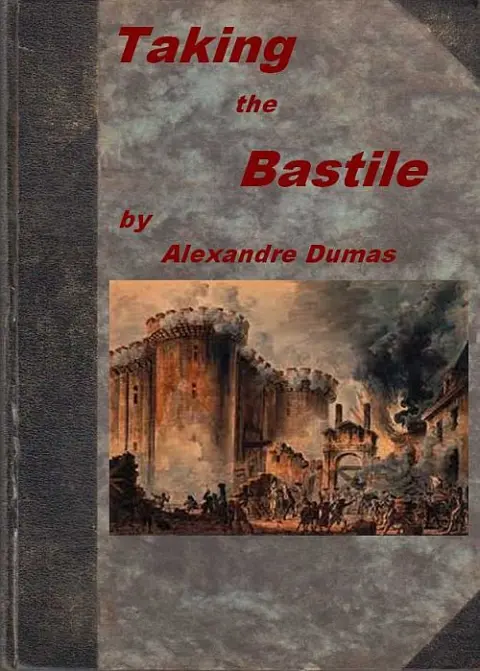
THE CLASSIC COLLECTION · 1891
"Taking the Bastile; Or, Pitou the Peasant" by Alexandre Dumas is a historical novel written in the late 19th century. The story centers around the tumultuous period of the French Revolution, focusing on the character of Ange Pitou, a peasant boy who becomes embroiled in the unfolding events and strives to find his place amidst the chaos. Dumas weaves a tale of heroism, societal change, and the quest for liberty, encapsulated in the dramatic moment of storming the Bastille. The opening portion of the novel introduces us to a young man named Gilbert, who ventures through the snow-covered countryside to find a peasant woman, Madeline Pitou. He brings with him an infant to be raised at her cottage, a child whose birth has been surrounded by tragedy as both parents have died. As Gilbert entrusts the child to Madeline, he expresses both hope and sorrow for the boy's future. Through his interactions with Madeline and her family, we see the warmth and complexities of rural life, as well as the undercurrents of change looming on the horizon. The introduction sets the stage for the emergence of the protagonist, Ange Pitou, hinting at themes of loss, parental bonds, and the significant impact of the upcoming revolution on personal and societal levels.
Introduction adapted from the source catalogue; source summaries may be automatically generated.
Free to read · English · 76,316 words · No account needed
MAKE TIME FOR A GOOD BOOK
On by default. Untick to stop anonymous reading totals. Each page counts after 10 seconds in view. How this works.
Anonymous counting is on unless you have switched it off.
"Hurrah for the Guards of the Country!" said Billet.
"Thank you," said a soldier, "we are given the right name and
christened with fire."
"I have been under fire, too," said Pitou, "and it is not as dreadful
as I imagined it."
"Now, who owns this gun?" queried Billet, examining the rifle which was
a costly one.
"My master," answered the man who had lent him it, and who wore the
Orleans livery. "He thinks you use it too handsomely to have to return
it."
"Where is your master?" demanded the farmer.
The servant pointed to a half-open blind behind which the prince was
watching what happened.
"Is he with us, then?"
"With heart and soul for the people," replied the domestic.
"In that case, three cheers again for the Duke of Orleans!" said the farmer. "Friends the Duke of Orleans is on our side--three cheers for the duke!"
He pointed upwards and the prince showed himself for an instant while he bowed three times to the shouting; short as was the appearance it lifted enthusiasm to the utmost.
"Break open the gunsmith's," shouted a voice in the turbulence.
"Let us go to the Invalid Soldiers Hospital," added some old veterans. "General Sombreuil has twenty thousand muskets there."
"And to the City Hall!" exclaimed others: "Flesselles, Provost of the Traders, has the keys for the town guards' armory and he must give them up."
"To the Hall!" bellowed a fraction of the assemblage.
All flowed away in one or the other of the three directions called out.
During this time the dragoons had rallied around Baron Bezenval and Prince Lambesq on Louis XV. Square.
Billet and Pitou were unaware of this as they followed none of the parties and were left pretty well alone on Palais Royale Square.
"Well, where are we off to, dear Master Billet?" inquired Ange Pitou.
"I should like to follow the crowd," replied the other: "not to the gunmakers', as I have a first-rate gun, but to the City Hall or the military Asylum. Still, as we came to town not to fight, but to learn Doctor Gilbert's address. I think we ought to go to Louis-the-Great's College, where his son is. When I shall have got through with the doctor, we can jump back into the chafing-dish."
His eyes flashed lightnings.
"This course seems logical to me," observed the young peasant.
"So take some weapon, gun or sword, from those beer drinkers lying there," said the farmer, pointing to half-a-dozen dragoons on the pave, "and let us go to the college."
"But these weapons are not mine, but the King's," objected Pitou.
Your reading position is saved on this browser. Take it to another device with a library code. Reading pages adapt to text, rather than matching a printed edition.
Alexandre Dumas
Alexandre Dumas & Auguste Maquet
Alexandre Dumas
Alexandre Dumas
BEHIND THE BOOK
This eBook is for the use of anyone anywhere in the United States and most other parts of the world at no cost and with almost no restrictions whatsoever. You may copy it, give it away or re-use it under the terms of the Project Gutenberg License included with this eBook or online at www.gutenberg.org. If you are not located in the United States, you will have to check the laws of the country where you are located before using this eBook. Read the source licence.
The original source file, including credits and licence, is retained by this library. Request an original-format copy at no charge. Please include the book title and Project Gutenberg identifier #45424.
KEEP YOUR CURIOSITY GOING
Cécile Tormay

Moritz Busch
Coulson Kernahan
John L. Ransom

Maurice Baring
Frances Wright