
Love and liberty
Alexandre Dumas
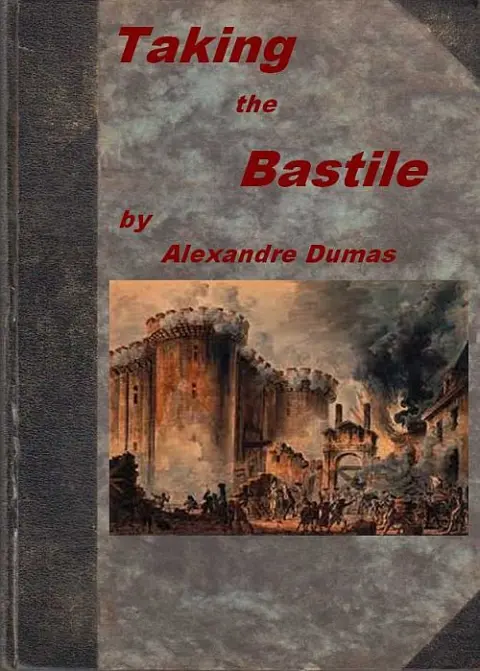
THE CLASSIC COLLECTION · 1891
"Taking the Bastile; Or, Pitou the Peasant" by Alexandre Dumas is a historical novel written in the late 19th century. The story centers around the tumultuous period of the French Revolution, focusing on the character of Ange Pitou, a peasant boy who becomes embroiled in the unfolding events and strives to find his place amidst the chaos. Dumas weaves a tale of heroism, societal change, and the quest for liberty, encapsulated in the dramatic moment of storming the Bastille. The opening portion of the novel introduces us to a young man named Gilbert, who ventures through the snow-covered countryside to find a peasant woman, Madeline Pitou. He brings with him an infant to be raised at her cottage, a child whose birth has been surrounded by tragedy as both parents have died. As Gilbert entrusts the child to Madeline, he expresses both hope and sorrow for the boy's future. Through his interactions with Madeline and her family, we see the warmth and complexities of rural life, as well as the undercurrents of change looming on the horizon. The introduction sets the stage for the emergence of the protagonist, Ange Pitou, hinting at themes of loss, parental bonds, and the significant impact of the upcoming revolution on personal and societal levels.
Introduction adapted from the source catalogue; source summaries may be automatically generated.
Free to read · English · 76,316 words · No account needed
MAKE TIME FOR A GOOD BOOK
On by default. Untick to stop anonymous reading totals. Each page counts after 10 seconds in view. How this works.
Anonymous counting is on unless you have switched it off.
It was on the morning of the fourteenth of July that Billet opened oratorical fire against the monument which had for five centuries weighed like an incubus on the breast of France--a rock of Sisyphus. Less confident than the Titan in her power, France had never thought to throw it off.
The Bastile was the seal of feudalism on the brow of Paris.
The King was accounted too good to order people to be beheaded; but he sent people into the Bastile. Once there a man was forgotten, isolated, sequestered, buried alive, annihilated. He stayed there till the monarch remembered him, and kings have so many new matters to think of that they often forget the old ones.
There were twenty other Bastiles in France, the name being general for prison, so that, to this day, the tramp on the dusty road speaks of the "Steel," without perhaps knowing that the title of ignominy referred to the great French Statesprison.
The fortress by the St. Antoine Gate was the Bastile pre-eminently. It was alone worth all the others.
Some of the prisoners were perhaps great criminals; but others like Latude had done nothing to merit thirty years' captivity.
He had fallen in love with Lady Pompadour, the King's mistress, and wrote her a note which caused his imprisonment for a life-time.
It was not for nothing that the Bastile was hated by the people.
It was hated like a living thing--a monster like the dragoons who defy a people till a champion rises, like Billet, to show them how to attack it.
Hence one may comprehend Sebastian's hopeless grief at his father being incarcerated in the Bastile.
Hence Billet's belief that he would never be liberated but by being
plucked forth.
Hence the popular transport may be felt when the shout rose of "Down
with the Bastile!"
But it was, as the soldiers said, an insane project to think of capturing the King's Prison-Castle.
The Bastile had a garrison, artillery and provisions. The walls were fifteen feet thick at the top and forty at the base.
The governor was Count Launay, who had thirty thousand pounds of gunpowder in the magazine, and had promised in case of annoyance to blow up the fort and with it all that part of Paris.
Nevertheless Billet marched forward, but he did not have to do any
shouting.
Liking his martial mien, the multitude felt he was one of their kind, and commenting on his words and bearing, it followed him, increasing like the flowing tide.
When Billet came out on St. Michel's quay, he had behind him more than three thousand men, armed with hatchets, cutlasses, pikes and guns.
Your reading position is saved on this browser. Take it to another device with a library code. Reading pages adapt to text, rather than matching a printed edition.
Alexandre Dumas
Alexandre Dumas & Auguste Maquet
Alexandre Dumas
Alexandre Dumas
BEHIND THE BOOK
This eBook is for the use of anyone anywhere in the United States and most other parts of the world at no cost and with almost no restrictions whatsoever. You may copy it, give it away or re-use it under the terms of the Project Gutenberg License included with this eBook or online at www.gutenberg.org. If you are not located in the United States, you will have to check the laws of the country where you are located before using this eBook. Read the source licence.
The original source file, including credits and licence, is retained by this library. Request an original-format copy at no charge. Please include the book title and Project Gutenberg identifier #45424.
KEEP YOUR CURIOSITY GOING
Cécile Tormay

Moritz Busch
Coulson Kernahan
John L. Ransom

Maurice Baring
Frances Wright