THE CLASSIC COLLECTION✦An outlaw’s diary: the CommuneCLASSIC FREE BOOKS
An outlaw’s diary: the Commune
Cécile Tormay
THE CLASSIC COLLECTION · 1911
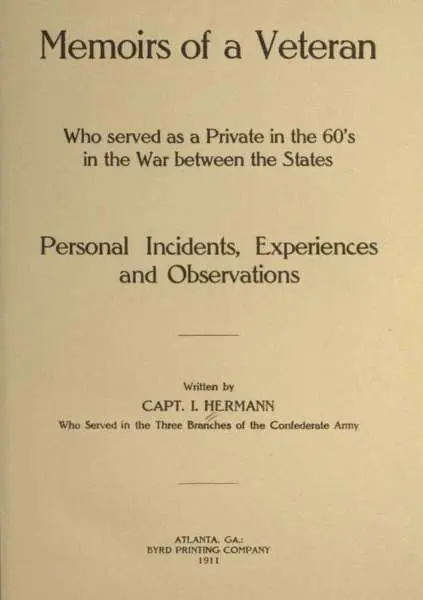
"Memoirs of a Veteran Who Served as a Private in the 60's in the War Between the States" by Capt. I. Hermann is a historical account written in the early 20th century. The book narrates the personal experiences and observations of Hermann, who enlisted in the Confederate Army during the American Civil War. Through his detailed anecdotes, the narrative explores themes of sacrifice, camaraderie, and the harsh realities of warfare from the perspective of a soldier on the front lines. The opening of the memoir introduces Capt. I. Hermann's reflections on the idealized visions of military life presented in propaganda, contrasting them with the grim realities he and his comrades faced. He recalls his enlistment in the Confederate Army in 1861 and the initial enthusiasm among fellow soldiers, driven by patriotism and duty to their homes. Hermann illustrates the early tensions that sparked the Civil War, recounting events like the defense of Fort Sumter, and shares vivid descriptions of his regiment's first encounters, including their experiences leading up to the Battle of Manassas. The early chapters set a foundation for Hermann's journey, highlighting both personal and collective struggles while providing insights into the complexities of war from an intimate viewpoint.
Introduction adapted from the source catalogue; source summaries may be automatically generated.
Free to read · English · 58,417 words · No account needed
MAKE TIME FOR A GOOD BOOK
On by default. Untick to stop anonymous reading totals. Each page counts after 10 seconds in view. How this works.
Anonymous counting is on unless you have switched it off.
I rejoined Dr. Crawford and he sent me out again. I took the train to Greenville, Alabama, and walked about eight miles to Col. Bowens', who was an uncle of Mrs. John George. Mrs. George was a niece of Mrs. Braswell, where I boarded. She came to spend many days with her Aunt while I was with the family; her home was only about three miles distant. She married Mr. George and moved to Butler County, Alabama. Mr. Bowen, her uncle, furnished me with a horse and I rode out to see them. Butler county is a sort of an out of the way place, and that country had not been overrun with soldiers, and provisions were plentiful. When I hollowed at the gate she recognized me at once and was overjoyed; she took me around the neck and kissed me. George ran out saying, "Mollie! Mollie! What are you doing." She said, "Never mind that is home folks." Poor woman, she was so overcome to see someone from home that she actually cried for joy. They were a happy family. I gave them all the news about their people, as I had just come from there. I stated my business and both of them set in the following day to assist me in my duty. Butler county, where they lived was a very hilly country, but tolerably thickly settled, and provisions came in by the quantities. I, with the assistance of my host and hostess, filled a single box of eggs six by three feet long and three feet high. We stood every one on its end with alternate layers of bran and sawdust and carried them over a very rough road to Greenville, together with a great many chickens and shipped them to the hospital, and we only lost three dozen eggs by breakage. One morning we heard the report that the enemy, in great force, was approaching. People were leaving the city. With the exception of a small garrison there was no defense. Dr. Crawford had to abandon the city, removed all that were in condition to get away, but there were about a half a dozen men who were too sick to be removed. The enemy came into the city soon after we left. Dr. Crawford remarked to me that evening, "Herman, I am going to send you back to take charge of the hospital and those poor fellows that I could not get away." I demurred, saying that I did not care to be taken prisoner. He said, "Listen; In all civilized warfare the medical department is exempt from molestation." I said, "From the way this war is waged it is not altogether civilized, but I am under your orders; I'll do what you want me to do." He said, "I'll take it as a great favor; I can't abandon those poor fellows, some one has to take care of them and administer to their wants." He said he did not know where he would locate but wherever he went I must come back to him. I was then about nine miles from Montgomery. It was late in the evening, and I took it afoot back. When passing through Macon on my way to Montgomery, I passed a night with my cousin, Mrs. Wurzbourg, whose husband was exempt from military duty on account of physical infirmity. My jacket which I wore was threadbare, and even (holy). He presented me with one of his blue flannel sack coats. I had previously been able, through Dr. Crawford, to get enough cloth for a pair of pants and vest. It was blockade goods which the Government had purchased, and it was of a coarse textile, and of a light blue cast, and thus I was fairly decently clothed. In those days the Confederate grey was very much lacking, and men, as well as women, had to wear anything, of any color they could get hold of. So after leaving Dr. Crawford, to return to the hospital at Montgomery, I stopped over at a cottage. The proprietor had a watch repair and jewelry shop in Montgomery, who owned a small plantation about six miles from the city. He had left the city for lack of business, and now lived at his country home. He was an Englishman, his wife was French. This book being written entirely from memory, after a lapse of about a half a century, I can't remember the names of those people, but they were very kind and hospitable. After supper we repaired to their little parlor. The house was well kept, and proved that the mistress of the same knew how to manage a home and make it comfortable. There was a piano, and I asked the lady, (talking French to her), if she would kindly play a little. So she asked me if I could sing some French songs; I said a few. She at once repaired to the instrument, and asked me what will you have. I of course called for the Marseillaise, which she performed to perfection. So she asked me to sing; I started the melody of
Your reading position is saved on this browser. Take it to another device with a library code. Reading pages adapt to text, rather than matching a printed edition.
BEHIND THE BOOK
This eBook is for the use of anyone anywhere in the United States and most other parts of the world at no cost and with almost no restrictions whatsoever. You may copy it, give it away or re-use it under the terms of the Project Gutenberg License included with this eBook or online at www.gutenberg.org. If you are not located in the United States, you will have to check the laws of the country where you are located before using this eBook. Read the source licence.
The original source file, including credits and licence, is retained by this library. Request an original-format copy at no charge. Please include the book title and Project Gutenberg identifier #41528.
KEEP YOUR CURIOSITY GOING
Cécile Tormay

Moritz Busch
John L. Ransom
Frances Wright
Cécile Tormay

Mabel Potter Daggett