THE CLASSIC COLLECTION✦An outlaw’s diary: the CommuneCLASSIC FREE BOOKS
An outlaw’s diary: the Commune
Cécile Tormay
THE CLASSIC COLLECTION · 1911
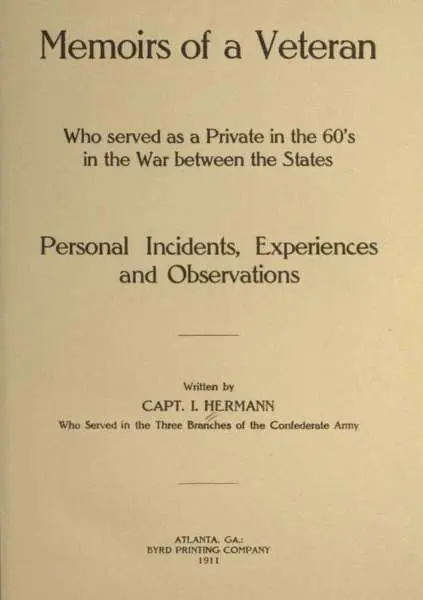
"Memoirs of a Veteran Who Served as a Private in the 60's in the War Between the States" by Capt. I. Hermann is a historical account written in the early 20th century. The book narrates the personal experiences and observations of Hermann, who enlisted in the Confederate Army during the American Civil War. Through his detailed anecdotes, the narrative explores themes of sacrifice, camaraderie, and the harsh realities of warfare from the perspective of a soldier on the front lines. The opening of the memoir introduces Capt. I. Hermann's reflections on the idealized visions of military life presented in propaganda, contrasting them with the grim realities he and his comrades faced. He recalls his enlistment in the Confederate Army in 1861 and the initial enthusiasm among fellow soldiers, driven by patriotism and duty to their homes. Hermann illustrates the early tensions that sparked the Civil War, recounting events like the defense of Fort Sumter, and shares vivid descriptions of his regiment's first encounters, including their experiences leading up to the Battle of Manassas. The early chapters set a foundation for Hermann's journey, highlighting both personal and collective struggles while providing insights into the complexities of war from an intimate viewpoint.
Introduction adapted from the source catalogue; source summaries may be automatically generated.
Free to read · English · 58,417 words · No account needed
MAKE TIME FOR A GOOD BOOK
On by default. Untick to stop anonymous reading totals. Each page counts after 10 seconds in view. How this works.
Anonymous counting is on unless you have switched it off.
The Central road was being rebuilt from Savannah and we met the trains at its terminals, thus shortening the distance of our journeys. The train had reached Guyton, thirty miles this side of Savannah and was advancing daily until completed to Macon. It was early in the spring when I met the train at station No. 6, a flat country. It had rained nearly daily for a week; the roads were slushy, I had on a heavy load; we had traveled the whole day long until dark. It was hard to find a dry knob to camp on, until finally we came to a little elevation. I said Perry we are going to stop here. He guided the team into the woods a few paces and unhitched, while I was looking for a few lightwood knots to build up a fire. Everything was wet and it was hard to kindle up a blaze. When suddenly there arrived on the scene an ambulance pulled by a team of four splendid mules and thirteen Federal soldiers alighted. They took the grounds on the opposite side of the road. I thought to myself, Now I am into it. Perry was on his knees, fanning up the damp pine straw, when one of those fellows called, Heigho, you black fellow, come here. I said to Perry in an undertone, Attend to your business. When the same fellow called again, Hello you negro, I told you to come here, did you hear me? accompanying his remarks with the coarsest words. Perry answered, My boss told me to tend to my business. D----n you and your boss, too, was his reply. As he had completed the sentence, I being close by the side of my wagon, reached up and took my Spencer in hand, bringing it from a trail to a support. I stepped to the center of the road, saying, D----n you some too. This is not the first time I have met some of you at odds, and I am ready for the fray, if it has to be. Everything was quiet, not a word was uttered. I still remained standing in the road, watching any move they might make, when one of them spoke, saying, Will you let me come to you? He spoke in a very conciliatory tone. I said, Yes, one at a time. He came to me unarmed, and said, Let us have no trouble; don't pay any attention to that fellow, he is drinking. There is plenty of room here for all of us, without any friction. I said, Well, if your friend is drunk, take care of him. I am able to take care of myself. He returned to his camp and I to mine. I heard him say to his comrades, That fellow won't do to fool with. By that time Perry had succeeded in having a rousing fire and we went to work on the culinary department. Our meals were simple, a little fried meat and corn bread and water from out of a ditch. Presently one of the Federals hollered over, "Say, Johnnie, don't you want some coffee?" I answered, "No, it has been so long since I tasted any I have forgotten how it tastes." He said, We have a plenty and you are welcome to it if you will have it. I said I have no way to make coffee if I had any. So one of them came over with some parched coffee and offered it to me. I declined it, for I had no mill to grind it, nor any vessel to stew it in. They insisted, bringing over all of the paraphernalia for the brewing of coffee and I must admit that it was enjoyed by Perry, as well as myself, it being the first that had passed my lips in four years. After our meal was completed they came over, one after another and sat around the fire. The conversation became general and I found them to be very congenial company. One brought me a whole haversack full of green coffee, saying, Have it, we have a sack of over a hundred pounds. I thanked them saying, This is quite a treat. And what seemed to be a disagreeable affair in its incipiency terminated most agreeably. It having become late I suggested that we take a night cap and retire. I passed around the jug and each returned to his respective quarters. However I slept, as the saying is, with one eye open. Early in the morning we fed the mules, rekindled the fire, drank a warm cup of coffee and ate a bite or so. We harnessed two of our mules, two of which in the lead were of small size, when one of the Federals proposed to swap mules. I said, Your mules are worth a great deal more than mine, and I have no money to pay boot. We don't want any money said another, we want you to have the best team on the road, by swapping your two lead mules for those tall black ones of ours you will have a real fine team. They then said they were on their way to Augusta to report to the quartermaster there, that they had receipted for four mules and a sack of coffee to be delivered to the quartermaster in Augusta. The mules in their possession were not branded as government mules but were picked up and a mule is a mule, so we deliver the number of heads is all that is required. To tell the truth I feared a trap, but while I was talking with one of them the others changed the lead mules for two of theirs and off they drove in a lope, singing, Old John Brown Lies Buried in the Ground, etc. We trudged along, Perry and I elated over our good luck, when Perry said, Well Marse Ike, your standing up to them made them your friends.
Your reading position is saved on this browser. Take it to another device with a library code. Reading pages adapt to text, rather than matching a printed edition.
BEHIND THE BOOK
This eBook is for the use of anyone anywhere in the United States and most other parts of the world at no cost and with almost no restrictions whatsoever. You may copy it, give it away or re-use it under the terms of the Project Gutenberg License included with this eBook or online at www.gutenberg.org. If you are not located in the United States, you will have to check the laws of the country where you are located before using this eBook. Read the source licence.
The original source file, including credits and licence, is retained by this library. Request an original-format copy at no charge. Please include the book title and Project Gutenberg identifier #41528.
KEEP YOUR CURIOSITY GOING
Cécile Tormay

Moritz Busch
John L. Ransom
Frances Wright
Cécile Tormay

Mabel Potter Daggett