THE CLASSIC COLLECTION✦An outlaw’s diary: the CommuneCLASSIC FREE BOOKS
An outlaw’s diary: the Commune
Cécile Tormay
THE CLASSIC COLLECTION · 1911
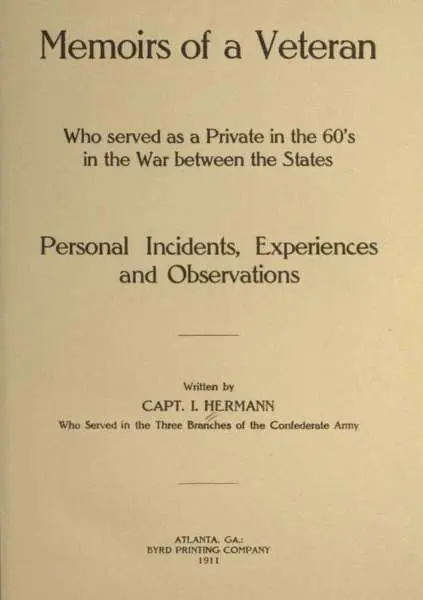
"Memoirs of a Veteran Who Served as a Private in the 60's in the War Between the States" by Capt. I. Hermann is a historical account written in the early 20th century. The book narrates the personal experiences and observations of Hermann, who enlisted in the Confederate Army during the American Civil War. Through his detailed anecdotes, the narrative explores themes of sacrifice, camaraderie, and the harsh realities of warfare from the perspective of a soldier on the front lines. The opening of the memoir introduces Capt. I. Hermann's reflections on the idealized visions of military life presented in propaganda, contrasting them with the grim realities he and his comrades faced. He recalls his enlistment in the Confederate Army in 1861 and the initial enthusiasm among fellow soldiers, driven by patriotism and duty to their homes. Hermann illustrates the early tensions that sparked the Civil War, recounting events like the defense of Fort Sumter, and shares vivid descriptions of his regiment's first encounters, including their experiences leading up to the Battle of Manassas. The early chapters set a foundation for Hermann's journey, highlighting both personal and collective struggles while providing insights into the complexities of war from an intimate viewpoint.
Introduction adapted from the source catalogue; source summaries may be automatically generated.
Free to read · English · 58,417 words · No account needed
MAKE TIME FOR A GOOD BOOK
On by default. Untick to stop anonymous reading totals. Each page counts after 10 seconds in view. How this works.
Anonymous counting is on unless you have switched it off.
The following incident caused a rupture of friendship between Lieutenant Evan P. Howell and myself, which made military service unnecessarily harder on me, owing to our respective ranks. One night, it was on a Saturday, I had occasion to get up, it was late. I passed the sentinel on post number one, and recognized William Tolson on duty. I passed the usual greeting of "Hello! Bill, how do you do," "O, Ike, I'm so sick. I've one of the hardest chills on me I ever had." "Why don't you call the Corporal of the Guard, and get relief?" He replied, he wished I would call him, so I called "Corporal of the Guard, post number one." Corporal William O'Quinn came up to see what's up. I said, "Corporal, Tolson is sick and ought to be relieved." Presently the Corporal returned from headquarters, saying the officers are all gone over to Patterson, they were having a dance at the Quartermaster's, Major Cranston, and there is no one at headquarters but Dr. Stevenson who is drunk, and I can't get any sense out of him. When I told him that one of the men were sick, he said "You see that puppy, is he not the finest you have ever seen?" having reference to a small dog he fondled. Finding out that I can't get any relief, I came back, so I told Tolson to go in and I would stand guard in his place. Tolson was a good soldier, he was a native Englishman, and when he got over his chill he was loud in his denunciation as to his treatment, so he was punished for having spoken derogatory about the officers and condemned to wear ball and chain for twenty-four hours. This was the first time that I knew there was such a thing as a ball and chain in camp for the punishment of man. The following Monday night, the writer having found out all about the particulars and the doings at the Quartermaster's, wrote up a program of intoxication at Granston Hall, Saturday night, March 1863. I treated the matter more of a burlesque than otherwise, and wound up in these words: "That's the way Confederate whiskey goes, pop goes the Government." Captain Martin was off and Lieutenant Howell was in command. Lieutenants Bland and Roberson laughed over the matter and took it good naturedly. W. N. Harmon was the only man in the Company who saw me write the article, and when finished I read it to him. He pronounced it a good joke and asked me what I was going to do with it. I said, "I am going to stick it up on the big pine where general orders are posted, so that the men can read it after reveille call," so he made some lightwood pegs, and we went together and posted it. The article was not signed, and was written in a round handwriting. The men enjoyed it and laughed a great deal over it, when Sergeant Fulford came up and tore down the paper, and carried it to the officer's tent. They inquired, what is the matter, what are the men laughing about. He presented the paper. Lieutenant Howell, after reading it, got raving mad, while Lieutenants Roberson and Bland took it good naturedly. Lieutenant Howell was determined to find out the author, so during the day he took up the men by fours and swore them on the Bible, if they knew who wrote the paper. I was at the station on that day and was absent. When I returned to my mess, they told me what was going on, and that Lieutenant Howell was trying to find out who wrote that article, so I said, "Bill," meaning William Harmon, "He took up the wrong men; if he had called on me I would have saved him that trouble". He answered, "Well, what will you do?" "Well, you don't believe that I would swear to a lie?" I got up saying, "I will satisfy his curiosity," and up to his tent I went. He was sitting in a chair smoking. "Good evening Lieutenant," says I. "I understand that you are very anxious to know who wrote that paper Sergeant Fulford submitted for your inspection. I can give you all the information you require." Lieutenant Howell at once brightened up and became all smiles. "You know--who did it?" "Your humble servant." In a twinkling his countenance changed. He became pale with rage, working himself into a passion, and very peremptorily ordered me to stand at attention. I at once planted my heels together to form a perfect angle, placed my little fingers along the seams of my pantaloons, my arms extending at full length, my body erect, facing my superior officer. I humbly remarked, "Will that do?"--"What did you do it for?"--"You had your fun, am I not entitled to have some?"--"You made false charges; you said we drank Government whiskey. I want you to understand what liquor we drank we bought and paid for it." "Well, Lieutenant, I have not accused anybody; not even mentioned a single name, but if the cap fits you, you can wear it. I have nothing to retract." By that time, Howell was surely mad. "I-I-I reduce you to ranks! I put you on double duty for thirty days and to wear ball and chain." "Is that all?" "Lieutenant, I volunteered in the Confederate army to do my full duty, as I always have done, in regard to duty; you only can put me on every other day, but when it comes to degrading me by making me wear ball and chain, I give you fair notice that I will kill any man who attempts to place the same on my limbs," and I made my exit, going to my mess-mates. "Well, how did you come out?" the boys asked me. I related what had passed between Lieutenant and I. William Harmon, then said, "Did you tell him that I helped you stick it up?" I said, "No, I shouldered the whole responsibility. What good would it do to implicate you?" "Well you shall not be the only one to do double duty," and off he went to tell Lieutenant Howell that he also had a hand in it, and consequently he was also condemned to double duty for thirty days. "Did he also tell you to wear ball and chain?" Harmon said "No."
Your reading position is saved on this browser. Take it to another device with a library code. Reading pages adapt to text, rather than matching a printed edition.
BEHIND THE BOOK
This eBook is for the use of anyone anywhere in the United States and most other parts of the world at no cost and with almost no restrictions whatsoever. You may copy it, give it away or re-use it under the terms of the Project Gutenberg License included with this eBook or online at www.gutenberg.org. If you are not located in the United States, you will have to check the laws of the country where you are located before using this eBook. Read the source licence.
The original source file, including credits and licence, is retained by this library. Request an original-format copy at no charge. Please include the book title and Project Gutenberg identifier #41528.
KEEP YOUR CURIOSITY GOING
Cécile Tormay

Moritz Busch
John L. Ransom
Frances Wright
Cécile Tormay

Mabel Potter Daggett