THE CLASSIC COLLECTION✦An outlaw’s diary: the CommuneCLASSIC FREE BOOKS
An outlaw’s diary: the Commune
Cécile Tormay
THE CLASSIC COLLECTION · 1911
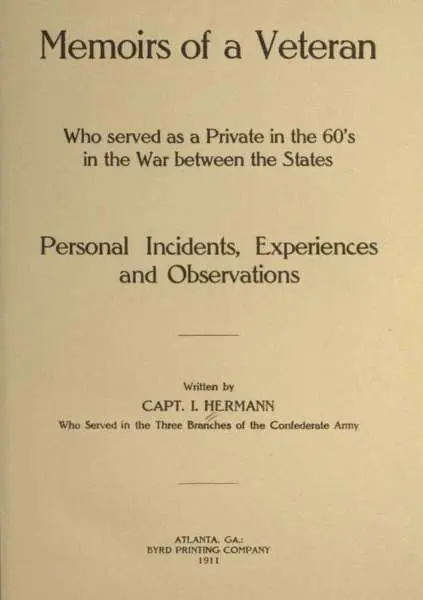
"Memoirs of a Veteran Who Served as a Private in the 60's in the War Between the States" by Capt. I. Hermann is a historical account written in the early 20th century. The book narrates the personal experiences and observations of Hermann, who enlisted in the Confederate Army during the American Civil War. Through his detailed anecdotes, the narrative explores themes of sacrifice, camaraderie, and the harsh realities of warfare from the perspective of a soldier on the front lines. The opening of the memoir introduces Capt. I. Hermann's reflections on the idealized visions of military life presented in propaganda, contrasting them with the grim realities he and his comrades faced. He recalls his enlistment in the Confederate Army in 1861 and the initial enthusiasm among fellow soldiers, driven by patriotism and duty to their homes. Hermann illustrates the early tensions that sparked the Civil War, recounting events like the defense of Fort Sumter, and shares vivid descriptions of his regiment's first encounters, including their experiences leading up to the Battle of Manassas. The early chapters set a foundation for Hermann's journey, highlighting both personal and collective struggles while providing insights into the complexities of war from an intimate viewpoint.
Introduction adapted from the source catalogue; source summaries may be automatically generated.
Free to read · English · 58,417 words · No account needed
MAKE TIME FOR A GOOD BOOK
On by default. Untick to stop anonymous reading totals. Each page counts after 10 seconds in view. How this works.
Anonymous counting is on unless you have switched it off.
Thus it will be noted that while the war was over in the East, we of the Western army didn't know it and were still fighting, all communication between the two armies being cut off. My friend Faber, who was one of the most popular citizens of Montgomery was afterwards elected Mayor of the City. The following morning I prepared to wend my way back to Georgia. My foot was inflamed and gave me pain, so I said to a Yankee Sergeant who was in waiting on some of the officers there if he could not manage to get me some piece of a horse to ride as I was a long ways from home and in a crippled condition. He said, Yes, if I would give him my watch, which was an open faced, old fashioned English lever, generally called bulls-eye. I acquiesced. We marched down one of the main thoroughfares. We halted before an establishment which was used as a guard house and previously had served as a store. In its front on the sidewalk was a cellar. The Sergeant asked them to bring out that horse, and in the meantime asked me for the watch. Thinking of him as a clever, sympathetic soul, owing to his prompt offer of assistance, I unhesitatingly handed him my watch. They having entered the cellar, they lifted out of its confines a frame of horse so poor that six men took him bodily and placed him on the sidewalk. He was actually nothing but skin and bones; I was astonished that life could have existed in such a frame. I said, Is this the best you can do for me? He said, I promised you a horse for your watch and here he is, and he left me. The men were amused at my discomfiture. I finally concluded that a bad ride is better than a good walk and I made the best of a bad bargain. I asked the men if they could get me a bridle and saddle. They answered that they had none, so I made me a halter out of the rope around his neck, pulled off my coat as padding on either side of his sharp backbone so as to serve me as a saddle and asked the man next to me to give me a lift, and there I was, mounted, representing the picture of Don Quixote to perfection. I urged the horse forward and the men hollered Whoa! which command he was only too eager to obey, I eventually got away from that place and took the Eufaula route homeward. It was four o'clock in the afternoon and I was only four miles from my starting point. The animal had neither eat nor drunk anything while in my possession and from his looks probably not in several days previous. I saw as I passed along at a snail gait, a corral by the side of the road, with all kinds of contraband. There were negroes, women and children, cattle of all description and a quantity of mules and horses, all encircled by a large rope and guarded by sentinels. I passed a soldier about a half mile from this place. I said to him, What troops are those on the right hand side up the hill? He said they were cavalry. I concluded to ride up, that probably I might induce the officer to exchange animals with me so as to enable me to get along, for I came to the conclusion to abandon my steed and take a bad walk in preference to a bad ride. As I approached the camp I noticed a man sitting on a camp stool, his back towards me, his feet propped up against a large tree, reading a newspaper and seemingly greatly preoccupied as he did not hear my approach. He was in negligee, it being a very warm day; he wore nothing but his pants and a spotted white blouse shirt and was bareheaded. I left my horse by the side of a stump and slid off, approaching within a respectful distance in his rear, I said, Good evening. He jumped like he had been shot. I said excuse me sir, I did not mean to scare you. So he peremptorily said, What will you have? I answered, Are you the commander of these troops? He said, Yes; what will you have? I answered that I was a paroled prisoner on my way home; that I was crippled and had a long ways to go. The horse I got I bought from one of the Federals for a silver watch. It took me a whole day to get from the City to where I am; that I had noted, coming along, a corral with many loose horses and mules and I ventured to see if he would not be kind enough to furnish me with a better mount than the one I possessed. He replied, What country are you from? I am from France. How long have you been in the army? Ever since the war started. Were you forced into the army or did you volunteer? I volunteered sir. And you have been fighting us for over four years and now come and ask me for a favor? You need not grant it; good bye. And off I hobbled to where I left my horse taking him by the mane I led him up to the stump and was about to mount when the officer commanded me, Come back here, said he, I like your style. You are the first one I've met but what was forced into the army. Tell the officer in charge of the corral to exchange animals with you. I remarked, Colonel, a written order from you might have a better effect. He laughed, got up and walked into his tent and when he returned he handed me a slip of paper addressed to Capt. Ledger, and read as follows: Exchange animals with the bearer; Col. York, Com'd'g 7, Indiana Cavalry. I thanked him, gave the military salute and retraced my steps towards the corral. I presented my note to the Capt. in charge; he said, Pick out the one you want. There were some excellent animals but many were galled and not serviceable for any immediate use. I spied a medium sized, plump mule. She was in excellent order, and as I was short in funds I thought I could tether her out to eat grass and thus progress without having to buy food. So I took the mule. I asked him if he would furnish me with a saddle and bridle, and he let me have nearly a new Mexican saddle and bridle and I was once more in good shape. Capt. Ledger asked me where I was going. I said, Home, in Georgia. Which way? I am on my way to Eufaula. So he said, I believe I'll ride a piece of the way with you. He had his horse caught, which was a magnificent animal. Riding along side by side I remarked, Captain that is a splendid horse you are on. He said, Yes, I have a pair, you could not tell one from the other; they are spirited animals but perfectly gentle. Their owner must have prized them highly; some of the men picked them up. That's a new name for stealing, said I. He remarked, I suppose so, but if I could find out their owner I am going to return them to him; I am making some effort towards it. I said, Well sir, it does me good to hear you say so, and to know that there are some men of feeling, and gentlemen among your army. He said, Well, war is war. It is true that many acts were committed unnecessarily harsh, but I am glad it is over and I hope we will all be friends again. He stopped, saying, Well, I have ridden far enough, and I am going back. We shook hands, he wished me a safe journey and cantered back to his camp. It was already late and I proceeded as far as Fort Browder and stopped over night with Mr. Tom Wells. His wife was also a Georgian and a kinswoman of the Braswell family.
Your reading position is saved on this browser. Take it to another device with a library code. Reading pages adapt to text, rather than matching a printed edition.
BEHIND THE BOOK
This eBook is for the use of anyone anywhere in the United States and most other parts of the world at no cost and with almost no restrictions whatsoever. You may copy it, give it away or re-use it under the terms of the Project Gutenberg License included with this eBook or online at www.gutenberg.org. If you are not located in the United States, you will have to check the laws of the country where you are located before using this eBook. Read the source licence.
The original source file, including credits and licence, is retained by this library. Request an original-format copy at no charge. Please include the book title and Project Gutenberg identifier #41528.
KEEP YOUR CURIOSITY GOING
Cécile Tormay

Moritz Busch
John L. Ransom
Frances Wright
Cécile Tormay

Mabel Potter Daggett