THE CLASSIC COLLECTION✦An outlaw’s diary: the CommuneCLASSIC FREE BOOKS
An outlaw’s diary: the Commune
Cécile Tormay
THE CLASSIC COLLECTION · 1911
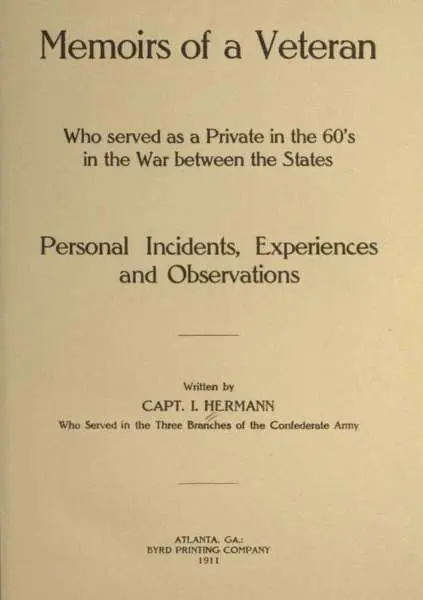
"Memoirs of a Veteran Who Served as a Private in the 60's in the War Between the States" by Capt. I. Hermann is a historical account written in the early 20th century. The book narrates the personal experiences and observations of Hermann, who enlisted in the Confederate Army during the American Civil War. Through his detailed anecdotes, the narrative explores themes of sacrifice, camaraderie, and the harsh realities of warfare from the perspective of a soldier on the front lines. The opening of the memoir introduces Capt. I. Hermann's reflections on the idealized visions of military life presented in propaganda, contrasting them with the grim realities he and his comrades faced. He recalls his enlistment in the Confederate Army in 1861 and the initial enthusiasm among fellow soldiers, driven by patriotism and duty to their homes. Hermann illustrates the early tensions that sparked the Civil War, recounting events like the defense of Fort Sumter, and shares vivid descriptions of his regiment's first encounters, including their experiences leading up to the Battle of Manassas. The early chapters set a foundation for Hermann's journey, highlighting both personal and collective struggles while providing insights into the complexities of war from an intimate viewpoint.
Introduction adapted from the source catalogue; source summaries may be automatically generated.
Free to read · English · 58,417 words · No account needed
MAKE TIME FOR A GOOD BOOK
On by default. Untick to stop anonymous reading totals. Each page counts after 10 seconds in view. How this works.
Anonymous counting is on unless you have switched it off.
The following day I entered camp with my comrades among great cheers, all having thought me dead or a prisoner. Major Martin asked me how I got through. I told him I took his advice and did the best I could. I related to him the incidents that I met with. He said, "Well, I congratulate you. I don't believe one in a thousand would have escaped." "I was glad I was the one." We were ordered to strike tents at Canton, and we retraced our steps again towards Jackson, a distance of between twenty and twenty-five miles. It was one of the hottest days of the season. The road bed being red clay. Our forces now amounted to about eight thousand men, and marching in column with artillery, wagon train and all the paraphernalia appertaining to a moving army, raised such intense dust that it was impossible to recognize one's file-leader in his immediate front. Every step of every individual raised clouds of dust, which lay ankle deep. It was actually suffocating. Men and horses would gasp for breath. The men occasionally would expectorate large lumps of clay that settled in their throats, and no water to be had. We didn't pass a single stream of any kind. It was a forced march to get in the enemy's rear and to cut off reinforcement and supplies for Grant's invading forces onto Vicksburg. The enemy was also making back to Jackson on the Clinton Road which ran nearly parallel to the Canton Road, and we could see their advance by the column of dust to our right. Just before dark a very heavy rain and thunder storm set in. It was preferable to the previous conditions of the weather, although it put us half leg deep in sticky red mud. It got so dark we could not see anything and the rain continued pouring down in all its fury. It was nip and tuck as to which army would reach Jackson first. We got there just a little ahead of the enemy in time to occupy the ditches which now were nearly knee deep in water. In that condition we passed the night, expecting to be attacked momentarily. Men were detailed long in the rear to cook rations for the men in the ditch, which were issued along the line, and consisted of corn bread cooked (a la hate) and a piece of fat bacon. A very amusing incident happened to one of my comrades, W. A. Grimes, who early on our march, and before the dust got so dense, had to step aside for some reason, and being detained while the column kept onward, threw him some distance behind his command. The State of Georgia had sent her troops some shoes; the description of my draw I have already stated, and some white wool hats. Grimes put his name on the front of his hat in large capital letters, and as he hurried to catch up with his command, someone hollowed as he passed, "How are you Bill Grimes?" Grimes stopped in surprise to see who knew him in some other command. Others took up the word all along the line of "How are you Bill Grimes?" Grimes hurried on, on his way, the perspiration running down his face, which had the appearance of being covered with a mask. He could not account for his sudden popularity until he pulled off his hat to wipe off his face. He saw his name on his hat and quickly turned it wrong side out. His name had passed all along the column faster than he could travel and passed Howell's Battery long before he caught up with it. Early in the morning the enemy made demonstrations all along our line and was repulsed. It had quit raining. The artillery kept up a desultory fire for eight days and nights. The enemy's forces were at least three to our one and therefore, could relieve each other, while we were obliged to be kept continually on duty, and consequently became exhausted, my eyes were blood shot, men loaded and fired mechanically, and when so exhausted that I couldn't stand any longer, I dropped beside one of the pieces and in a jiffy, was asleep. I couldn't even hear the report of the guns within a few feet of me. The strain was more than my physique could stand. I got sick and unconscious, and when I came to myself, I was in Yazoo City in a private house, snugly fixed, and a kindly lady by my bedside, whose name was Mrs. Lyons. She cried for joy to see me recover my senses. I asked her where I was and how long I had been there. She said just a week. I asked her what place it was and she said "Yazoo City." I shall always remember gratefully the kind treatment I received from that worthy family, and when after a week's convalescence, I took my leave with many thanks. The lady said she hoped that her brother who was in the Virginia army would in case of sickness receive the attention that she would bestow on any Confederate soldier. Such was the spirit that prevailed throughout the Confederate States.
Your reading position is saved on this browser. Take it to another device with a library code. Reading pages adapt to text, rather than matching a printed edition.
BEHIND THE BOOK
This eBook is for the use of anyone anywhere in the United States and most other parts of the world at no cost and with almost no restrictions whatsoever. You may copy it, give it away or re-use it under the terms of the Project Gutenberg License included with this eBook or online at www.gutenberg.org. If you are not located in the United States, you will have to check the laws of the country where you are located before using this eBook. Read the source licence.
The original source file, including credits and licence, is retained by this library. Request an original-format copy at no charge. Please include the book title and Project Gutenberg identifier #41528.
KEEP YOUR CURIOSITY GOING
Cécile Tormay

Moritz Busch
John L. Ransom
Frances Wright
Cécile Tormay

Mabel Potter Daggett