THE CLASSIC COLLECTION✦An outlaw’s diary: the CommuneCLASSIC FREE BOOKS
An outlaw’s diary: the Commune
Cécile Tormay
THE CLASSIC COLLECTION · 1911
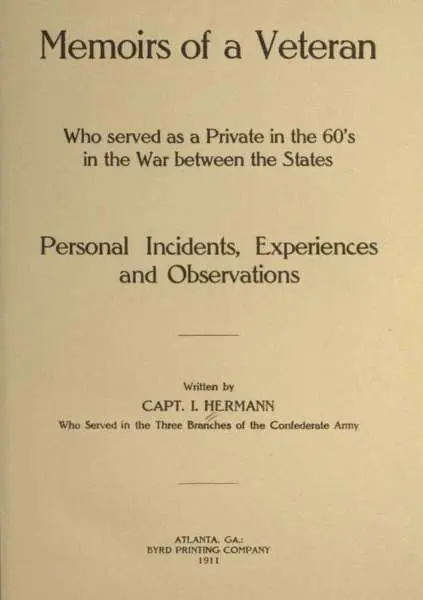
"Memoirs of a Veteran Who Served as a Private in the 60's in the War Between the States" by Capt. I. Hermann is a historical account written in the early 20th century. The book narrates the personal experiences and observations of Hermann, who enlisted in the Confederate Army during the American Civil War. Through his detailed anecdotes, the narrative explores themes of sacrifice, camaraderie, and the harsh realities of warfare from the perspective of a soldier on the front lines. The opening of the memoir introduces Capt. I. Hermann's reflections on the idealized visions of military life presented in propaganda, contrasting them with the grim realities he and his comrades faced. He recalls his enlistment in the Confederate Army in 1861 and the initial enthusiasm among fellow soldiers, driven by patriotism and duty to their homes. Hermann illustrates the early tensions that sparked the Civil War, recounting events like the defense of Fort Sumter, and shares vivid descriptions of his regiment's first encounters, including their experiences leading up to the Battle of Manassas. The early chapters set a foundation for Hermann's journey, highlighting both personal and collective struggles while providing insights into the complexities of war from an intimate viewpoint.
Introduction adapted from the source catalogue; source summaries may be automatically generated.
Free to read · English · 58,417 words · No account needed
MAKE TIME FOR A GOOD BOOK
On by default. Untick to stop anonymous reading totals. Each page counts after 10 seconds in view. How this works.
Anonymous counting is on unless you have switched it off.
When the commanding officers of the Confederate army surrendered and stacked arms the rank and file expected that the terms of the cartel promulgated and agreed upon would be carried out to the letter. The men laid down their arms in good faith, feeling as General R. E. Lee remarked in his farewell address to them, that under present unequal condition it would only be a waste of precious lives to continue the struggle. The following were the terms of the agreement entered into between General Grant and General Lee: The officers and men to return to their homes and remain there until exchanged and not to be disturbed by the United States authorities so long as they observe their paroles and the laws in force in their respective states.
But the fellows who directed the ship of state and who were invisible on the firing line became invincible, when the South lay prostrated. The first order was from Secretary Staunton, for the arrest of our commanding officers. This order, however, was resented by General Grant as contrary to the cartel and should not be executed. This caused a rupture between the two and the order was finally rescinded. The next step was to disperse all State authority and appoint a military Governor. General Wilson acted in that capacity in Georgia. The same year, 1865, negroes were proclaimed free and military garrisons established in every town, city or village throughout the South. Under the superintendence of those militaries the Freedmen's Bureau was established, forcing negroes to migrate from one place to another, thus breaking up the good relationship still existing between Masters and servants. The bureau was seemingly gotten up for the protection of the blacks, as if they needed any protection, they to whom we owed so much for their good behavior during the time when every available man able to bear arms was at the front, leaving their families in charge of the negroes. The gratitude of our people was or ought to have been sufficient guarantee in that line. Such harmonious condition did not suit the powers that be, there was venom in their heart for revenge, and punitive measures were concocted. Never were captives bound tighter than the people of the South. Is it a wonder that the men of the South became desperate and used desperate remedies to oust more desperate diseases? The carpet baggers made their exit. The negroes' mind had been prejudiced under the auspices of those vultures. They were forced into societies, one of which was the Rising Sun. Some called it The Rising Sons. God only knows what ultimate result they expected to obtain. Drums and fifes were heard in every direction at night times. The woods were full of rumors that the negroes are rising. Men in towns made ready for emergencies, every one on his own hook; no organization for defense, in case harsher measures should be needed. When the author of this sketch took up the idea of a reunion of his comrades and inserted a call in the county's weekly, calling on the members of Howell's Battery for a social reunion, their wives and children, when other veterans suggested why not make it a reunion for all the veterans of the County. I was only too glad for the suggestion and changed the call to include all veterans of the county, and on the day specified there was the greatest reunion Washington County ever had. It was estimated that eight thousand people participated. There were over one hundred carcasses besides thousands of baskets filled to overflow with eatables and delicacies. The object of the meeting was stated to form an artillery company as a nucleus or rallying head and to meet organization with organization not as a measure of aggression but as a protection. The author was elected Captain. Under his supervision he built an armory and eventually the State furnished him with two pieces of artillery. The day he received the guns he had a salute fired. The boys in the rural districts had not forgotten the sound of artillery and the town was filled with enthusiasm. Some of the negro leaders called on me to know what all that means, I told them it was to teach their misguided people that we can play at the same game and if they don't stop beating their drums and blowing fifes in the night time when honest people are at rest I would shell the woods. This admonition had a splendid effect and the people of Washington have lived in peace ever since. The author resigned his commission in the year 1881, when Honorable Alex Stephens was Governor of Georgia. And Washington County has the honor of having inaugurated the first reunion of Confederate veterans. The citizens of Washington County and Howell's Battery presented the author with a gold headed ebony cane, beautifully carved, as a memorial and their regard for him as a citizen and a soldier. Being taken by surprise I had to submit to the caning.
Your reading position is saved on this browser. Take it to another device with a library code. Reading pages adapt to text, rather than matching a printed edition.
BEHIND THE BOOK
This eBook is for the use of anyone anywhere in the United States and most other parts of the world at no cost and with almost no restrictions whatsoever. You may copy it, give it away or re-use it under the terms of the Project Gutenberg License included with this eBook or online at www.gutenberg.org. If you are not located in the United States, you will have to check the laws of the country where you are located before using this eBook. Read the source licence.
The original source file, including credits and licence, is retained by this library. Request an original-format copy at no charge. Please include the book title and Project Gutenberg identifier #41528.
KEEP YOUR CURIOSITY GOING
Cécile Tormay

Moritz Busch
John L. Ransom
Frances Wright
Cécile Tormay

Mabel Potter Daggett