THE CLASSIC COLLECTION✦An outlaw’s diary: the CommuneCLASSIC FREE BOOKS
An outlaw’s diary: the Commune
Cécile Tormay
THE CLASSIC COLLECTION · 1911
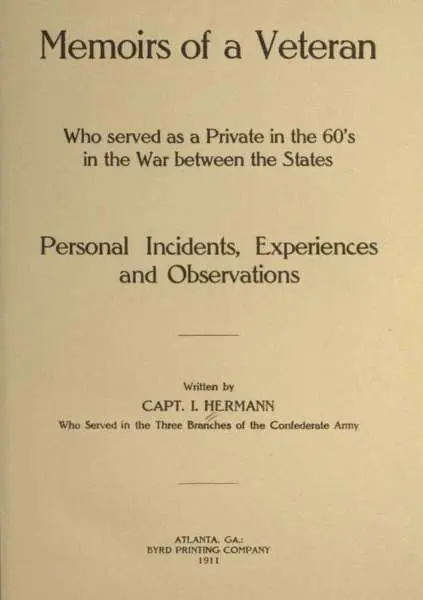
"Memoirs of a Veteran Who Served as a Private in the 60's in the War Between the States" by Capt. I. Hermann is a historical account written in the early 20th century. The book narrates the personal experiences and observations of Hermann, who enlisted in the Confederate Army during the American Civil War. Through his detailed anecdotes, the narrative explores themes of sacrifice, camaraderie, and the harsh realities of warfare from the perspective of a soldier on the front lines. The opening of the memoir introduces Capt. I. Hermann's reflections on the idealized visions of military life presented in propaganda, contrasting them with the grim realities he and his comrades faced. He recalls his enlistment in the Confederate Army in 1861 and the initial enthusiasm among fellow soldiers, driven by patriotism and duty to their homes. Hermann illustrates the early tensions that sparked the Civil War, recounting events like the defense of Fort Sumter, and shares vivid descriptions of his regiment's first encounters, including their experiences leading up to the Battle of Manassas. The early chapters set a foundation for Hermann's journey, highlighting both personal and collective struggles while providing insights into the complexities of war from an intimate viewpoint.
Introduction adapted from the source catalogue; source summaries may be automatically generated.
Free to read · English · 58,417 words · No account needed
MAKE TIME FOR A GOOD BOOK
On by default. Untick to stop anonymous reading totals. Each page counts after 10 seconds in view. How this works.
Anonymous counting is on unless you have switched it off.
My cousin in Macon gave a little social entertainment and sent me an invitation. I showed the same to the Doctor, and he said, Well go, I give you 48 hours. The following morning I hurried to the Quartermaster with my furlough for transportation by placing my permission on his desk. The train just blew the signal for departure; I picked up the transportation and in my hurry left my furlough on the desk. Between Atlanta and Griffin the guards passed through the coaches to inspect all papers of the passengers. When they came to me I found my transportation in my side pocket minus my forty-eight hours leave of absence. I explained how it might have happened, and hoped they would let me continue, but I was requested to get off at Griffin, which I did, and asked the guard to conduct me to the Provost Marshal, so that I might explain, and he could inform himself, never doubting but that he would wire and inform himself of the correctness of my statement and let me proceed. Instead, he told me he had heard such statements before and informed the guard to be especially vigilant in regard to me, so I was conducted to an old livery stable that served as a prison. This was in Dec. 1863. I spoke to my guard if there was not a way by which I could communicate with Dr. Crawford in Atlanta; he said he did not know. I said, Please tell the Provost to write to Dr. Crawford about me. Presently one of the guards brought me a broom, saying, It is a rule when a new comer comes to make him sweep out the calaboose. I said, Well this time you will have to break your rule. Do I understand that you refuse to comply? I certainly do. He went to the Sergt. of the Guard and made his report as to what passed between us. The Sergt. came at once, saying I understand you refuse to sweep out the calaboose. I certainly do; is it for this which I am arrested? He said, Do you know the penalty, sir? No, and I don't care, was my reply. He remarked, You'll be bucked and gagged for two hours. I again said, "You'll have a nice time doing it." He answered. Not so much talk; pull off your overcoat. I said, If I do I'll make you feel sorry for it. All this occurred while I was standing before the fire place, with my hands behind me. In front of me about five feet distance, stood a wooden bench. The Sergeant stood between me and it. Calling for the guard to come up, they asked him if they should bring their guns. He said no, only one bring his gun. They came up. When the Sergeant put his hand on me as if to unbutton my coat. I had moistened the knuckles of my fingers by passing them between my lips, concentrated the muscles' tension and struck the Sergeant over the bridge of his nose, sending him sprawling backward over the bench, his head hitting the pavement, and I had to dodge to avoid his heels hitting me under the chin. The man who had the musket made a lunge at me. Fortunately I had a memorandum book in my side pocket which he hit and dented the leaves of it half way through. I grabbed at the gun and caught it just at the curve of the bayonet, close to the muscle, and jerked it out of his hands. I made moulinets, holding the gun by the barrel and bayonet, and drove the whole guard, consisting of twelve men, before me. One of them stopped at the rack, close to the door, which was open, to reach for a gun, when I hit him with the butt end on the arm, just below the shoulder, and sent him to the ground, falling as he went in the middle of the street. The exit of the men out of the guard house was so hasty it attracted the attention of the populace so that in a very short space of time a crowd had assembled before the door, looking askance as to what had happened, among which was a Lieut. Colonel, judging from the ensign he wore. Advancing to me, who stood quietly at the entrance, at parade rest, he, undoubtedly thinking that I was the sentinel, asked me what was the matter, what are the casualties. I simply remarked, Nobody hurt on my side, Colonel. What is all this assemblage here doing? So I explained to him what had happened and the cause of it. He asked me where were the guards. I pointed out some of them in the crowd; they gradually approached. He asked some of them to lead him to the Provost Marshal, whose name was Capt. Willis, which gentleman (pardon the expression) he berated to the utmost, telling him that he was not fit for a hog herder much less to be in command of human beings, who ever heard of bucking and gagging in the Confederate Army. I am going to report you to the proper authorities, and he ordered him to send me back to Atlanta by the next train, so that I might prove my assertion. The train from Macon to Atlanta was due within half an hour, so I was sent back under guard of a Lieutenant and four men with loaded muskets, with orders to shoot should I make an effort to escape. Luckily in my school days, which were close to an army post, I went twice a week to the armory to take lessons in boxing and sword exercise, and while I do not profess to be an expert in those sciences, they served me tolerably well in the above stated instance, and others through which it has been my misfortune to pass. Arriving in Atlanta, I was conducted to the Provost Marshal. The Lieutenant in command of the guard handed him a letter which the Provost read, after which he looked at me, standing in the middle of the room, and said, Well Lieutenant, I'll take charge of the prisoner; you can go back by the next train. The Lieutenant saluted him and he and his guard departed. It was between four and five o'clock in the afternoon. There were two more men at the office at their desks, and they soon left the room, leaving me and the Provost by ourselves. Turning to me he said, You belong to Walker's Brigade? I said, Yes, Howell's Battery. He said, Well I thought I knew you. He said, Well you got in a h----l of a scrape. I answered that I did not know that a man losing his furlough was so criminal. He looked up at me in surprise, saying, This is not what you are charged with; you are charged with striking a superior officer; do you know the penalty? Yes, shot if found guilty. What did you do it for? About that time I had been eyeing my questioner all along, I thought I knew him but I could not place him. He was Capt. Beebee of a South Carolina Regiment. I answered him thus, "Well, Captain, I fought for the rights of the Confederacy for the last three years and thought five minutes for myself was not too much." I explained to him all of the circumstances leading to my present condition. He exclaimed, "My God, why did you not kill him?" I said I did my best, I only got one lick at him and I give him a good one. He said Go over to the quartermaster's and see if you find your papers; if not I will give you some that will carry you through. I ran across the street, asking the quartermaster if I did not leave my furlough on his desk that morning. He opened a drawer and handed me my paper. I thanked him and reported my find to Capt. Beebee, who said, I know you are alright, you can go. We shook hands and I went my way to the fair ground hospital for the night to make a new start in the morning. Dr. Crawford seeing me said, I thought you had gone to Macon. I answered that I had gone a part of the way and was brought back under guards. How was that? So I recounted to him all the circumstances and illustrated with a musket the picture of the guard getting out of my reach. Dr. Crawford laughed till he cried. Well you had a time of it, said he. I sure did, and half of my permit is out. He said, Well go and stay as long as you like it, but not too long. He wrote me another permit and I again made for the train leading to Macon. This time the guard did not come aboard inspecting papers, but the train on arriving at Griffin was entered by the guards and papers were shown. I was sitting by the window of my coach when I heard some one say "Sergt. there is the fellow, the same fellow," pointing at me. I had not noticed the Sergt. at first as I was looking above and beyond him, and I saw him standing right close beside the train, in front of the window. I put out my head to speak to him; he had a bandage around his forehead and both of his eyes were inflamed and discolored. I said to him, Sergt. are you hurt? He did not reply, so I said, I am sorry for you, the next time you want to have some fun in the bucking, gagging line you try some one else who likes that kind of sport better than I do. The train departed and nobody even looked at my papers that day. I arrived at Macon a day after the feast, but had a pleasant day anyhow.
Your reading position is saved on this browser. Take it to another device with a library code. Reading pages adapt to text, rather than matching a printed edition.
BEHIND THE BOOK
This eBook is for the use of anyone anywhere in the United States and most other parts of the world at no cost and with almost no restrictions whatsoever. You may copy it, give it away or re-use it under the terms of the Project Gutenberg License included with this eBook or online at www.gutenberg.org. If you are not located in the United States, you will have to check the laws of the country where you are located before using this eBook. Read the source licence.
The original source file, including credits and licence, is retained by this library. Request an original-format copy at no charge. Please include the book title and Project Gutenberg identifier #41528.
KEEP YOUR CURIOSITY GOING
Cécile Tormay

Moritz Busch
John L. Ransom
Frances Wright
Cécile Tormay

Mabel Potter Daggett