READ · DISCOVER · ENJOYClassic literature · Always free
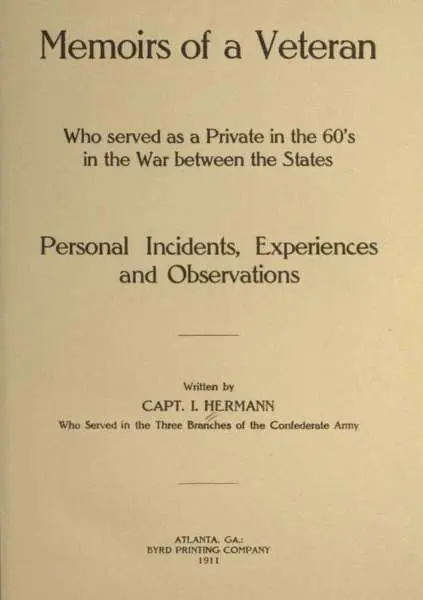
Memoirs of a Veteran Who Served as a Private in the 60’s in the War Between the States Personal Incidents, Experiences and Observations — digital edition cover

THE CLASSIC COLLECTION · 1911

Memoirs of a Veteran Who Served as a Private in the 60’s in the War Between the States Personal Incidents, Experiences and Observations

"Memoirs of a Veteran Who Served as a Private in the 60's in the War Between the States" by Capt. I. Hermann is a historical account written in the early 20th century. The book narrates the personal experiences and observations of Hermann, who enlisted in the Confederate Army during the American Civil War. Through his detailed anecdotes, the narrative explores themes of sacrifice, camaraderie, and the harsh realities of warfare from the perspective of a soldier on the front lines. The opening of the memoir introduces Capt. I. Hermann's reflections on the idealized visions of military life presented in propaganda, contrasting them with the grim realities he and his comrades faced. He recalls his enlistment in the Confederate Army in 1861 and the initial enthusiasm among fellow soldiers, driven by patriotism and duty to their homes. Hermann illustrates the early tensions that sparked the Civil War, recounting events like the defense of Fort Sumter, and shares vivid descriptions of his regiment's first encounters, including their experiences leading up to the Battle of Manassas. The early chapters set a foundation for Hermann's journey, highlighting both personal and collective struggles while providing insights into the complexities of war from an intimate viewpoint.

Introduction adapted from the source catalogue; source summaries may be automatically generated.

Start reading ↓

Free to read · English · 58,417 words · No account needed

MAKE TIME FOR A GOOD BOOK

Memoirs of a Veteran Who Served as a Private in the 60’s in the War Between the States Personal Incidents, Experiences and Observations

On by default. Untick to stop anonymous reading totals. Each page counts after 10 seconds in view. How this works.

Anonymous counting is on unless you have switched it off.

Memoirs of a Veteran Who Served as a Private in the 60’s in the War Between the States Personal Incidents, Experiences and Observations

This brings us towards the last part of December, 1864. When General Hood planned his campaign to the rear of General Sherman, instead of following General Johnston's tactics and thus leaving the balance of the State of Georgia to the tender mercies of our adversaries, who had no mercy or respect for age nor sex, but wantonly destroyed by fire and sword whatever they could lay their hands on, save the booty and relics with which they were loaded. Howell's battery, on account of their horses being exhausted, could not follow General Hood's army into Tennessee, and were ordered to Macon to recruit. This Company had seen arduous service from Chickamauga to Atlanta, including Jonesboro. After the battle of Chickamauga, one of the hardest contests of the war, in which the confederate forces were successful, Howell's battery had the honor to open the battle from the extreme right, on the 18th day of September, 1863. On the 19th, which was on Saturday, the fight was progressing furiously, with no results, both armies holding their own, but on Sunday morning our forces centered their attack on the enemy's center, charged through their lines and rolled them back in complete disorder, and the victory was ours. General Bragg rested his forces for a few days and renewed the fight around Chattanooga, Lookout Mountain and Missionary Ridge. He found the enemy well fortified and ready. The battle was a sanguinary one; Howell's battery besides losing two pieces of artillery, which were recovered in the evening and returned to us, lost in wounded, Leonidas Hines, Frank Bailey and Corporal Braswell, and captured James Mullen, John S. Kelley, John Tompkins and John Braswell. That night General Bragg withdrew as quietly as possible and went into camp at Dalton, where we spent in winter quarters. At Macon they did provost duty under direction of General Howell Cobb. The writer drifted back through Alabama expecting to rejoin Dr. Crawford as soon as he would locate, and being intercepted by Federal troops I reported to the nearest Confederate post, which proved to be General Beaufort from Kentucky, a cavalry officer at Union Springs, Alabama. General Abe Beaufort was of colossal stature and an able officer, so I reported to him for duty until I could join my proper command. He said, Have you a horse? We are cavalry. I said, No, but I expect to get one the first fight we get into. He laughed and said, Well, you can hang around here. I stayed at his quarters several days. One day he seemed to be worried more than usual; I ventured to say, "General, You seem to be worried over something." He said, "I have enough to worry about; there is General Forrest at Selma; I have sent him two couriers and neither of them have reported; I don't know what became of them, whether they have been captured, killed or run away. I want to hear from General Forrest so that we can act in concert of action." The Federals who held possession of Montgomery under General Wilson's corps d'army, who later captured President Jefferson Davis in Irwin County, Ga., during the several days of my hanging around at General Beaufort's Headquarters, he asked me how long I had been in the service. I said, "I joined the first Company that left my county and the first regiment that left my State." How long had you been in this country before the war broke out? I answered that I came to Georgia direct from France in the Fall of 1859, about sixteen months before I enlisted. I found in this country an ideal and harmonious people; they treated me as one of their own; in fact for me, it was the land of Canaan where milk and honey flowed. In the discussion of the political issues I felt, with those that I was in contact with, that they were grossly imposed upon by their Northern brethren and joined my friends in their defence, and so here I am, somewhat worsted, but still in the ring. I said, General I have an idea; I think I can carry a dispatch that will land. I have in my possession at home my French passport. I can write for it and use it by going squarely through their lines, as being an alien. I can change my clothes for some citizens clothes. After a little reflection General Beaufort said, "Hermann, you are an angel; it's the very idea." So we arranged to write at once for my pass. It came in due time. The lady of the house where the General kept his quarters furnished me with a suit of jeans cloth, but begged the General not to send me for fear I might meet with reverses. But the General said, He is all right, he can work the scheme. That night I started about ten o'clock, on horseback, with two escorts. It was a starlight night. We passed for some distance through a dense swamp. The General cautioned me to be careful and on the lookout, an admonition I thought entirely unnecessary. He said the enemy's camp was about twelve miles distant, and that they had a company of scouts out that night, and so had we, but as we journeyed along at a walk the lightning bugs were so thick as to blind a fellow and the swamp so dark that we could only designate the road by the distance and open space of the tree tops and the stars. We did not however, meet any of the scouts. On emerging from the swamp I noticed on my right a small farm cottage and a dim light through the cracks of the door. I dismounted, knocked at the door. At first no one answered. I knocked again when a lady's feeble voice answered, Who is there? A friend, was the reply. Open the door please. The door opened and there stood in front of me an old lady of about seventy, I judged, nearly scared to death, trembling from head to foot. To re-assure her I said, Madam, we are Southerners don't be frightened, we won't do you any harm. Can you tell me how far it is from here to the enemy's camp? She answered very excitedly that she had nothing to do with the war, she is only a lone woman and we can't cheat her out of many years. You all have stolen all my meat and did not leave me a mouthful of corn or meat, and I am left here to starve to death. I said, But we are Confederates; but I noticed the woman did not believe me, undoubtedly owing to my brogue, as there were thousands of foreigners in the federal army. I lit a match and scrutinized the ground and noted the doors of the outhouse wide open, houses empty and the ground churned into dust by the horses hoofs. Undoubtedly we were not far from the enemy, as they were there that day and looted the premises. I bid the lady good night and joined my escort who waited for me in the road. As I was about to mount my horse I perceived ahead of me through the limbs of the trees, a bright light. The lady was still standing in the door, and I asked her what that light was we saw ahead of us. She said they were the negro quarters about a quarter of a mile ahead, and I thanked her and we moved a little forward and held consultation as to what was best to do, whether they should return to camp leading my horse back and I to take it afoot or whether we had better go together to the quarters, probably they might get a few potatoes and some buttermilk, for be it understood that we belonged to the hungry army where rations became very scarce, for as a rule the Confederate soldier respected private property and often suffered hunger rather than appropriate property belonging to others. They concluded they might buy something to eat from the darkies. The negroes in those days, as before the war, always had a surplus of provisions. They were well fed, in fact most of them made their own provisions with the exception of meat, their owner allowing them patches and giving them time to cultivate the same for their own use or to sell with their master's permission, which was generally only a matter of form or respect.

Your reading position is saved on this browser. Take it to another device with a library code. Reading pages adapt to text, rather than matching a printed edition.

BEHIND THE WORDS

About I. (Isaac) Hermann

I. (Isaac) Hermann (1838–1917). Explore Memoirs of a Veteran Who Served as a Private in the 60’s in the War Between the States Personal Incidents, Experiences and Observations in this collection. These books span history.

Explore this author’s books →

THE READERS’ VERDICT

How did this story stay with you?

Not rated yet
Your rating for Memoirs of a Veteran Who Served as a Private in the 60’s in the War Between the States Personal Incidents, Experiences and Observations

Be the first to share your verdict.

One rating per browser, which you can change or remove. A necessary browser identifier remembers your vote. How ratings work

A GOOD STORY DESERVES COMPANY

Pass this book along.

A great read is even better when it’s shared.

SEND A LITTLE INSPIRATION

Share this book

BEHIND THE BOOK

Edition & source details.

Title
Memoirs of a Veteran Who Served as a Private in the 60’s in the War Between the States Personal Incidents, Experiences and Observations
Author
I. (Isaac) Hermann
Publication year
1911
Digital edition publisher
Project Gutenberg
Gutenberg release date
2012-12-01
Language
English
Source edition imprint
Not stated in source catalogue
Source identifier
Project Gutenberg #41528
Contributors
No additional named contributors in source metadata

Public-domain source & licence

This eBook is for the use of anyone anywhere in the United States and most other parts of the world at no cost and with almost no restrictions whatsoever. You may copy it, give it away or re-use it under the terms of the Project Gutenberg License included with this eBook or online at www.gutenberg.org. If you are not located in the United States, you will have to check the laws of the country where you are located before using this eBook. Read the source licence.

Full source licence and obtaining an original copy

The original source file, including credits and licence, is retained by this library. Request an original-format copy at no charge. Please include the book title and Project Gutenberg identifier #41528.

the full Project Gutenberg License must appear
prominently whenever any copy of a Project Gutenberg work (any work
on which the phrase “Project Gutenberg” appears, or with which the
phrase “Project Gutenberg” is associated) is accessed, displayed,
performed, viewed, copied or distributed:

This eBook is for the use of anyone anywhere in the United States and most
other parts of the world at no cost and with almost no restrictions
whatsoever. You may copy it, give it away or re-use it under the terms
of the Project Gutenberg™ License included with this eBook or online
at www.gutenberg.org. If you
are not located in the United States, you will have to check the laws
of the country where you are located before using this eBook.

1.E.2. If an individual Project Gutenberg electronic work is
derived from texts not protected by U.S. copyright law (does not
contain a notice indicating that it is posted with permission of the
copyright holder), the work can be copied and distributed to anyone in
the United States without paying any fees or charges. If you are
redistributing or providing access to a work with the phrase “Project
Gutenberg” associated with or appearing on the work, you must comply
either with the requirements of paragraphs 1.E.1 through 1.E.7 or
obtain permission for the use of the work and the Project Gutenberg
trademark as set forth in paragraphs 1.E.8 or 1.E.9.

1.E.3. If an individual Project Gutenberg electronic work is posted
with the permission of the copyright holder, your use and distribution
must comply with both paragraphs 1.E.1 through 1.E.7 and any
additional terms imposed by the copyright holder. Additional terms
will be linked to the Project Gutenberg License for all works
posted with the permission of the copyright holder found at the
beginning of this work.

1.E.4. Do not unlink or detach or remove the full Project Gutenberg
License terms from this work, or any files containing a part of this
work or any other work associated with Project Gutenberg.

1.E.5. Do not copy, display, perform, distribute or redistribute this
electronic work, or any part of this electronic work, without
prominently displaying the sentence set forth in paragraph 1.E.1 with
active links or immediate access to the full terms of the Project
Gutenberg License.

1.E.6. You may convert to and distribute this work in any binary,
compressed, marked up, nonproprietary or proprietary form, including
any word processing or hypertext form. However, if you provide access
to or distribute copies of a Project Gutenberg work in a format
other than “Plain Vanilla ASCII” or other format used in the official
version posted on the official Project Gutenberg website
(www.gutenberg.org), you must, at no additional cost, fee or expense
to the user, provide a copy, a means of exporting a copy, or a means
of obtaining a copy upon request, of the work in its original “Plain
Vanilla ASCII” or other form. Any alternate format must include the
full Project Gutenberg License as specified in paragraph 1.E.1.

1.E.7. Do not charge a fee for access to, viewing, displaying,
performing, copying or distributing any Project Gutenberg works
unless you comply with paragraph 1.E.8 or 1.E.9.

1.E.8. You may charge a reasonable fee for copies of or providing
access to or distributing Project Gutenberg electronic works
provided that:

• You pay a royalty fee of 20% of the gross profits you derive from
the use of Project Gutenberg works calculated using the method
you already use to calculate your applicable taxes. The fee is owed
to the owner of the Project Gutenberg trademark, but he has
agreed to donate royalties under this paragraph to the Project
Gutenberg Literary Archive Foundation. Royalty payments must be paid
within 60 days following each date on which you prepare (or are
legally required to prepare) your periodic tax returns. Royalty
payments should be clearly marked as such and sent to the Project
Gutenberg Literary Archive Foundation at the address specified in
Section 4, “Information about donations to the Project Gutenberg
Literary Archive Foundation.”

• You provide a full refund of any money paid by a user who notifies
you in writing (or by e-mail) within 30 days of receipt that s/he
does not agree to the terms of the full Project Gutenberg™
License. You must require such a user to return or destroy all
copies of the works possessed in a physical medium and discontinue
all use of and all access to other copies of Project Gutenberg™
works.

• You provide, in accordance with paragraph 1.F.3, a full refund of
any money paid for a work or a replacement copy, if a defect in the
electronic work is discovered and reported to you within 90 days of
receipt of the work.

• You comply with all other terms of this agreement for free
distribution of Project Gutenberg™ works.


1.E.9. If you wish to charge a fee or distribute a Project
Gutenberg™ electronic work or group of works on different terms than
are set forth in this agreement, you must obtain permission in writing
from the Project Gutenberg Literary Archive Foundation, the manager of
the Project Gutenberg™ trademark. Contact the Foundation as set
forth in Section 3 below.

1.F.

1.F.1. Project Gutenberg volunteers and employees expend considerable
effort to identify, do copyright research on, transcribe and proofread
works not protected by U.S. copyright law in creating the Project
Gutenberg™ collection. Despite these efforts, Project Gutenberg™
electronic works, and the medium on which they may be stored, may
contain “Defects,” such as, but not limited to, incomplete, inaccurate
or corrupt data, transcription errors, a copyright or other
intellectual property infringement, a defective or damaged disk or
other medium, a computer virus, or computer codes that damage or
cannot be read by your equipment.

1.F.2. LIMITED WARRANTY, DISCLAIMER OF DAMAGES - Except for the “Right
of Replacement or Refund” described in paragraph 1.F.3, the Project
Gutenberg Literary Archive Foundation, the owner of the Project
Gutenberg™ trademark, and any other party distributing a Project
Gutenberg™ electronic work under this agreement, disclaim all
liability to you for damages, costs and expenses, including legal
fees. YOU AGREE THAT YOU HAVE NO REMEDIES FOR NEGLIGENCE, STRICT
LIABILITY, BREACH OF WARRANTY OR BREACH OF CONTRACT EXCEPT THOSE
PROVIDED IN PARAGRAPH 1.F.3. YOU AGREE THAT THE FOUNDATION, THE
TRADEMARK OWNER, AND ANY DISTRIBUTOR UNDER THIS AGREEMENT WILL NOT BE
LIABLE TO YOU FOR ACTUAL, DIRECT, INDIRECT, CONSEQUENTIAL, PUNITIVE OR
INCIDENTAL DAMAGES EVEN IF YOU GIVE NOTICE OF THE POSSIBILITY OF SUCH
DAMAGE.

1.F.3. LIMITED RIGHT OF REPLACEMENT OR REFUND - If you discover a
defect in this electronic work within 90 days of receiving it, you can
receive a refund of the money (if any) you paid for it by sending a
written explanation to the person you received the work from. If you
received the work on a physical medium, you must return the medium
with your written explanation. The person or entity that provided you
with the defective work may elect to provide a replacement copy in
lieu of a refund. If you received the work electronically, the person
or entity providing it to you may choose to give you a second
opportunity to receive the work electronically in lieu of a refund. If
the second copy is also defective, you may demand a refund in writing
without further opportunities to fix the problem.

1.F.4. Except for the limited right of replacement or refund set forth
in paragraph 1.F.3, this work is provided to you ‘AS-IS’, WITH NO
OTHER WARRANTIES OF ANY KIND, EXPRESS OR IMPLIED, INCLUDING BUT NOT
LIMITED TO WARRANTIES OF MERCHANTABILITY OR FITNESS FOR ANY PURPOSE.

1.F.5. Some states do not allow disclaimers of certain implied
warranties or the exclusion or limitation of certain types of
damages. If any disclaimer or limitation set forth in this agreement
violates the law of the state applicable to this agreement, the
agreement shall be interpreted to make the maximum disclaimer or
limitation permitted by the applicable state law. The invalidity or
unenforceability of any provision of this agreement shall not void the
remaining provisions.

1.F.6. INDEMNITY - You agree to indemnify and hold the Foundation, the
trademark owner, any agent or employee of the Foundation, anyone
providing copies of Project Gutenberg™ electronic works in
accordance with this agreement, and any volunteers associated with the
production, promotion and distribution of Project Gutenberg™
electronic works, harmless from all liability, costs and expenses,
including legal fees, that arise directly or indirectly from any of
the following which you do or cause to occur: (a) distribution of this
or any Project Gutenberg work, (b) alteration, modification, or
additions or deletions to any Project Gutenberg work, and (c) any
Defect you cause.

Section 2. Information about the Mission of Project Gutenberg

Project Gutenberg is synonymous with the free distribution of
electronic works in formats readable by the widest variety of
computers including obsolete, old, middle-aged and new computers. It
exists because of the efforts of hundreds of volunteers and donations
from people in all walks of life.

Volunteers and financial support to provide volunteers with the
assistance they need are critical to reaching Project Gutenberg’s
goals and ensuring that the Project Gutenberg collection will
remain freely available for generations to come. In 2001, the Project
Gutenberg Literary Archive Foundation was created to provide a secure
and permanent future for Project Gutenberg and future
generations. To learn more about the Project Gutenberg Literary
Archive Foundation and how your efforts and donations can help, see
Sections 3 and 4 and the Foundation information page at www.gutenberg.org.

Section 3. Information about the Project Gutenberg Literary Archive Foundation

The Project Gutenberg Literary Archive Foundation is a non-profit
501(c)(3) educational corporation organized under the laws of the
state of Mississippi and granted tax exempt status by the Internal
Revenue Service. The Foundation’s EIN or federal tax identification
number is 64-6221541. Contributions to the Project Gutenberg Literary
Archive Foundation are tax deductible to the full extent permitted by
U.S. federal laws and your state’s laws.

The Foundation’s business office is located at 41 Watchung Plaza #516,
Montclair NJ 07042, USA, +1 (862) 621-9288. Email contact links and up
to date contact information can be found at the Foundation’s website
and official page at www.gutenberg.org/contact

Section 4. Information about Donations to the Project Gutenberg
Literary Archive Foundation

Project Gutenberg™ depends upon and cannot survive without widespread
public support and donations to carry out its mission of
increasing the number of public domain and licensed works that can be
freely distributed in machine-readable form accessible by the widest
array of equipment including outdated equipment. Many small donations
($1 to $5,000) are particularly important to maintaining tax exempt
status with the IRS.

The Foundation is committed to complying with the laws regulating
charities and charitable donations in all 50 states of the United
States. Compliance requirements are not uniform and it takes a
considerable effort, much paperwork and many fees to meet and keep up
with these requirements. We do not solicit donations in locations
where we have not received written confirmation of compliance. To SEND
DONATIONS or determine the status of compliance for any particular state
visit www.gutenberg.org/donate.

While we cannot and do not solicit contributions from states where we
have not met the solicitation requirements, we know of no prohibition
against accepting unsolicited donations from donors in such states who
approach us with offers to donate.

International donations are gratefully accepted, but we cannot make
any statements concerning tax treatment of donations received from
outside the United States. U.S. laws alone swamp our small staff.

Please check the Project Gutenberg web pages for current donation
methods and addresses. Donations are accepted in a number of other
ways including checks, online payments and credit card donations. To
donate, please visit: www.gutenberg.org/donate.

Section 5. General Information About Project Gutenberg electronic works

Professor Michael S. Hart was the originator of the Project
Gutenberg concept of a library of electronic works that could be
freely shared with anyone. For forty years, he produced and
distributed Project Gutenberg eBooks with only a loose network of
volunteer support.

Project Gutenberg eBooks are often created from several printed
editions, all of which are confirmed as not protected by copyright in
the U.S. unless a copyright notice is included. Thus, we do not
necessarily keep eBooks in compliance with any particular paper
edition.

Most people start at our website which has the main PG search
facility: www.gutenberg.org.

This website includes information about Project Gutenberg,
including how to make donations to the Project Gutenberg Literary
Archive Foundation, how to help produce our new eBooks, and how to
subscribe to our email newsletter to hear about new eBooks.


KEEP YOUR CURIOSITY GOING

Your next chapter awaits.

Your privacy choices

Reading is always free. You can change these settings at any time.

Book banners link to our books on simonward.net. They do not use advertising cookies or tracking.

Privacy & cookie policy · Reading data and privacy controls