THE CLASSIC COLLECTION✦An outlaw’s diary: the CommuneCLASSIC FREE BOOKS
An outlaw’s diary: the Commune
Cécile Tormay
THE CLASSIC COLLECTION · 1911
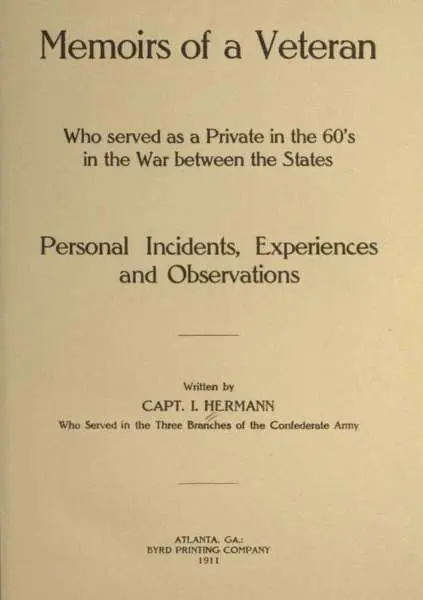
"Memoirs of a Veteran Who Served as a Private in the 60's in the War Between the States" by Capt. I. Hermann is a historical account written in the early 20th century. The book narrates the personal experiences and observations of Hermann, who enlisted in the Confederate Army during the American Civil War. Through his detailed anecdotes, the narrative explores themes of sacrifice, camaraderie, and the harsh realities of warfare from the perspective of a soldier on the front lines. The opening of the memoir introduces Capt. I. Hermann's reflections on the idealized visions of military life presented in propaganda, contrasting them with the grim realities he and his comrades faced. He recalls his enlistment in the Confederate Army in 1861 and the initial enthusiasm among fellow soldiers, driven by patriotism and duty to their homes. Hermann illustrates the early tensions that sparked the Civil War, recounting events like the defense of Fort Sumter, and shares vivid descriptions of his regiment's first encounters, including their experiences leading up to the Battle of Manassas. The early chapters set a foundation for Hermann's journey, highlighting both personal and collective struggles while providing insights into the complexities of war from an intimate viewpoint.
Introduction adapted from the source catalogue; source summaries may be automatically generated.
Free to read · English · 58,417 words · No account needed
MAKE TIME FOR A GOOD BOOK
On by default. Untick to stop anonymous reading totals. Each page counts after 10 seconds in view. How this works.
Anonymous counting is on unless you have switched it off.
Adieu Patrie
France Cherie
Ou Chaque jour
Coulait si pure
Mon helvretie
Douce et jolie
Pays d'Amour
O ciel d azure
Adieu, Adieu!
Having finished that stanza I noticed she had quit playing and was crying; so I remarked, "Madam, had I known that my singing would have had such an effect I surely would not have sung." By way of explanation she remarked that her first husband was a composer and that the song I sang was his first effort and he received a prize on it. Oh those were happy days she said! Her husband talked very kindly to her and the general conversation turned on France and of days gone by. She had lived in Paris and knew many business houses that I knew and I passed a most pleasant night. The following morning I sat down to a substantial country breakfast. We had hardly finished when the negro servant ran in, saying, "Master the Yankees are coming. They are here." Looking up the road, sure enough, a few hundred yards beyond where the road turned, they were in view. I at once, on the first impulse, jumped into a closet. Hardly was I in, closing the door, when I thought of this being the first place they would examine. I opened the door, and not knowing where to go I went into the back yard, between the house and the smoke house. Hardly had I done so when a dozen or more Yankees left their column entered the house very boisterously. Being dressed somewhat like they were, in blue, lacking but the brass buttons, I entered the back door, unconcernedly, mixing among them without being detected or noticed. Some of the men had placed their guns in the corner of the room; when of a sudden my hostess run in by the back door, crying, "My God! They are taking all of my meat." I don't know what impelled me but I seized a gun from the corner, ran out of the back door, brought my weapon from a trail to a support, and ordered the two men to throw back the hams each of them had in their grasp, one of which acted at my command, and the other said, What in the h----l you got to do with it. Before I could reply his comrade said to him, "Throw it down, don't you see he is a safe guard;" he threw down the hams. I took the cue from what the Yankee said, although it was the first time I had heard of a safe-guard. The door of the dwelling wide open, those in the house saw me walk the post back and forth, made their exit and left the house, and as long as I was guarding, no more Yankees tarried on the premises; they came, looked about and left the premises as soon as they saw me standing guard, until the whole column had passed. My host came to me saying, Well, they are all gone, thank God, I said no, the rear guard has not passed. The dwelling house was constructed close to the ground, leaving only about a foot space in front while the rear end was about two and a half feet from the ground. I took my gun and crawled under the house. Presently there came what I thought to be about a regiment, and several stragglers. Finally I came from under the house. I gave my hostess the gun I'd taken, telling her, If I do not call for it it shall be yours. My host took my hands, shook them heartily, saying, "You are a hero;" I laughed, saying, Well, I saved your bacon; Good bye; I am much obliged to you for your kind hospitality, and if it had not been for those fellows we would have had a good time. I started on my philanthropic errand, not knowing if I would find the sick men dead or alive. I had gone but a few hundred yards when I met a Federal soldier marching hastily to catch up. He said, Are they far ahead; I said, No, about five hundred yards or a quarter of a mile. You are going the wrong way, said he. I answered, I am not going far, I lost something. Further on I met two more, who like the first, took me for a Federal. One said, Comrade you are going the wrong way. I said, I am not going far. How far behind are we? I said, Not far, a few hundred yards. And so within about one and a half mile I met a dozen stragglers, walking to catch up, all comparatively asking the same questions, and to which I replied alike. When about four hundred yards in front of me, and about alike in the rear of the last straggler I saw four horsemen, riding abreast, holding their carbines by the barrel and resting the butt on their thighs. I recognized them as Confederates. I walked up to them, asking, What troops do you belong to? Harvey's Scouts of Forrests' Cavalry, was their reply. Are there any others behind? Yes. How far? The rear of the enemy's column is about two miles ahead of you, said I, and there are about a dozen stragglers, some with guns, and some have none; they are separated several hundred yards apart, some single and some in pairs; if you spur up you can catch the whole gang; I'll tell those men ahead of me to hurry up. Where is Capt. Harvey? You'll find him in the Exchange Hotel, in town. They at once put spurs to their horses and galloped on, and I followed my course towards the city. I met the reinforcements some little distance ahead of me, and reported what I had seen and told their advance scouts. They all went at full speed, and later, I saw the whole gang of stragglers brought in. I asked Capt. Harvey what had become of the inmates at the hospital. He said he did not know for he had just arrived that morning. I went to the hospital, found things in rather bad shape and the inmates gone. After careful investigation I heard that the Ladies Relief Association had taken care of the sick and that they were well provided for.
Your reading position is saved on this browser. Take it to another device with a library code. Reading pages adapt to text, rather than matching a printed edition.
BEHIND THE BOOK
This eBook is for the use of anyone anywhere in the United States and most other parts of the world at no cost and with almost no restrictions whatsoever. You may copy it, give it away or re-use it under the terms of the Project Gutenberg License included with this eBook or online at www.gutenberg.org. If you are not located in the United States, you will have to check the laws of the country where you are located before using this eBook. Read the source licence.
The original source file, including credits and licence, is retained by this library. Request an original-format copy at no charge. Please include the book title and Project Gutenberg identifier #41528.
KEEP YOUR CURIOSITY GOING
Cécile Tormay

Moritz Busch
John L. Ransom
Frances Wright
Cécile Tormay

Mabel Potter Daggett