THE CLASSIC COLLECTION✦An outlaw’s diary: the CommuneCLASSIC FREE BOOKS
An outlaw’s diary: the Commune
Cécile Tormay
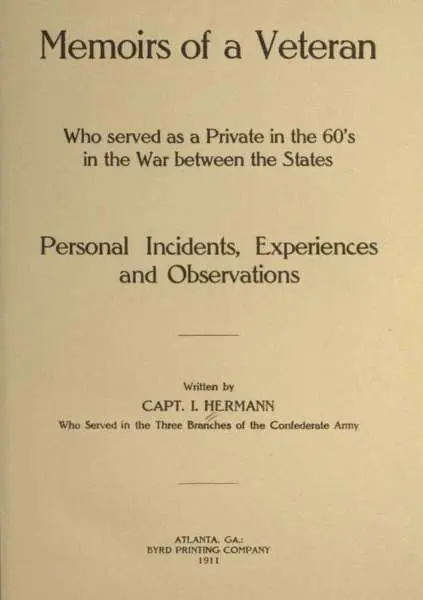
THE CLASSIC COLLECTION · 1911
"Memoirs of a Veteran Who Served as a Private in the 60's in the War Between the States" by Capt. I. Hermann is a historical account written in the early 20th century. The book narrates the personal experiences and observations of Hermann, who enlisted in the Confederate Army during the American Civil War. Through his detailed anecdotes, the narrative explores themes of sacrifice, camaraderie, and the harsh realities of warfare from the perspective of a soldier on the front lines. The opening of the memoir introduces Capt. I. Hermann's reflections on the idealized visions of military life presented in propaganda, contrasting them with the grim realities he and his comrades faced. He recalls his enlistment in the Confederate Army in 1861 and the initial enthusiasm among fellow soldiers, driven by patriotism and duty to their homes. Hermann illustrates the early tensions that sparked the Civil War, recounting events like the defense of Fort Sumter, and shares vivid descriptions of his regiment's first encounters, including their experiences leading up to the Battle of Manassas. The early chapters set a foundation for Hermann's journey, highlighting both personal and collective struggles while providing insights into the complexities of war from an intimate viewpoint.
Introduction adapted from the source catalogue; source summaries may be automatically generated.
Free to read · English · 58,417 words · No account needed
MAKE TIME FOR A GOOD BOOK
On by default. Untick to stop anonymous reading totals. Each page counts after 10 seconds in view. How this works.
Anonymous counting is on unless you have switched it off.
The fall of Vicksburg ended the Mississippi Campaign, and our troops were ordered to join the Army of Tennessee. All had left with the exception of the Mississippi Regiment and our battery who were awaiting transportation. Our commissary had also gone ahead of us and so we were left to "root hog or die." We had to eat once in awhile any how. Quinton Dudley and myself took a stroll to the commissary of the Mississippi Regiment. I learned that his name was Coleman. Passing through the building which was an old wooden railroad warehouse about a hundred feet long and forty wide, Quinton picked up a piece of rock salt from a large pile. Captain Coleman saw him put something in his haversack. In a brisk manner, said, "What is that you have taken?" He showed him a piece of salt the size of a hen egg. "Put it back," he hollowed at him. Quinton threw it back on the pile very much humiliated. On our leaving the building, I spied on the platform at the other end of the warehouse a large hogshead full of smoked meat of all descriptions, there were sides, shoulders and hams. They looked very enticing for hungry men like we were. We went to camp and reported how that Captain had caught Quinton who was very timid and did not like to be caught in the act. Others felt different about such. We were entitled to a living while in the field on duty. Some suggested that we go and charge the commissary and get some rations. I said, "That would bring on some trouble. Maybe we might get some of that meat by strategy," so we planned that W. N. Harmon should take ten men around and about the warehouse, while I would engage the Captain in conversation, during which time Harmon and his men would help themselves to rations. I awaited an opportune moment when Captain Coleman was at the other end of the building from where the hogshead of meat stood. Entering by that end, I walked squarely up to the Captain, extending my hand. "How do you do, Captain Coleman? I'm very glad to meet you, it is an unexpected pleasure. How long since you have heard from home?" He looked at me in surprise, holding onto my hand. I heard some meat drop on the ground. I knew the meat was flying campwards. "Well," said Capt. Coleman, "you have the advantage of me." "Don't you know me?" says I? He replied, "Well, your face is familiar to me, but I can't place you. Are you not from Emanuel county, Georgia?" "No, but I have some kinfolks in Georgia with my name." "Well, then I am mistaken and beg your pardon." "We have a lake on the Ogeechee River called Coleman's Lake. I went there often for fishing, and was sure you were one of the Colemans that lived there when at home. You favor them very much." "Well, said he, they may be some kin to me." By that time, between thirty and forty pieces of meat had changed hands. The next morning transportation came, and we loaded the cars which carried us to the Tennessee Army, then under the command of General Bragg, who was then retreating, leaving Tennessee to the tender care of the Federals, under command of General Rosencrantz. Our forces took a stand around and about Lookout Mountain and Chickamauga. We struck camp some distance from the main forces after unloading the train and watering and feeding the horses. The boys took a swim in the river, a luxury not realized for many days past. I was detailed to cut underbrush in the woods to assist stretching ropes to corral our horses. I was not quite as green in handling an axe by this time as I was in Virginia, when I was detailed to cut wood for the blacksmith shop. I was again taken sick with risings in my ear. I suffered as only those who ever suffered with such affliction knew how to extend their sympathy. The pains were simply excruciating and threw me into hot fever. We were ordered to strike camps. We marched that forenoon until eleven o'clock. The sun was shining in full force. I could no longer keep up. I stopped by the roadside and lay down, waiting for the Company's baggage wagon to come along. Lorenzo Stephens was the driver. After awhile he appeared on foot. One of the rear axles of his wagon having broken, he therefore hurried forward to get some assistance. In the meantime, the ambulance came along in charge of the Company surgeon. He had me picked up and placed in it. He said I had high fever and gave me some medicine, and as we passed the station of a railroad, the name of which I did not know, I was put on the train with others and sent to the Atlanta Hospital, in charge of Dr. Paul Eve, of Augusta, Dr. Rosser being in charge of my ward. I was suffering terribly, both of my ears were discharging corruption. Through suffering and hardship, my general health was giving away. I needed rest and time to recuperate. Medicines were hard to get, and I was slow in recovering my strength. One day Dr. Rosser asked me if I would like to have a furlough. He thought it would help me. I said, "Yes, the best in the world, as soon as I can gain a little strength," so he and Dr. Eve came to my cot the following morning, and after examining my condition, departed. Dr. Rosser came again in the afternoon and handed me a thirty days furlough. I was very grateful to him. He was a perfect gentleman, hard working and sympathetic. I came home to my foster mother, Mrs. Jas. L. Braswell, under whose care I soon gained strength.
Your reading position is saved on this browser. Take it to another device with a library code. Reading pages adapt to text, rather than matching a printed edition.
BEHIND THE BOOK
This eBook is for the use of anyone anywhere in the United States and most other parts of the world at no cost and with almost no restrictions whatsoever. You may copy it, give it away or re-use it under the terms of the Project Gutenberg License included with this eBook or online at www.gutenberg.org. If you are not located in the United States, you will have to check the laws of the country where you are located before using this eBook. Read the source licence.
The original source file, including credits and licence, is retained by this library. Request an original-format copy at no charge. Please include the book title and Project Gutenberg identifier #41528.
KEEP YOUR CURIOSITY GOING
Cécile Tormay

Moritz Busch
John L. Ransom
Frances Wright
Cécile Tormay

Mabel Potter Daggett