THE CLASSIC COLLECTION✦An outlaw’s diary: the CommuneCLASSIC FREE BOOKS
An outlaw’s diary: the Commune
Cécile Tormay
THE CLASSIC COLLECTION · 1911
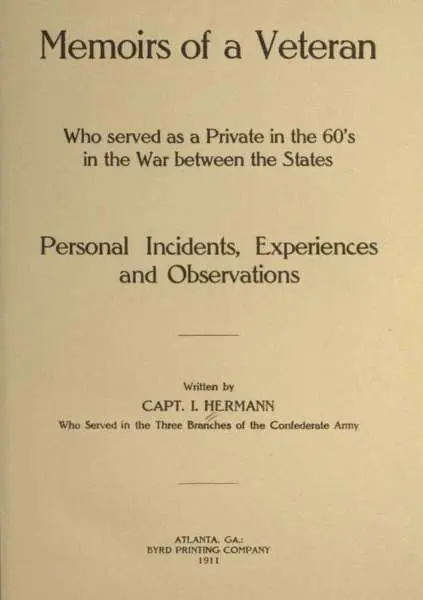
"Memoirs of a Veteran Who Served as a Private in the 60's in the War Between the States" by Capt. I. Hermann is a historical account written in the early 20th century. The book narrates the personal experiences and observations of Hermann, who enlisted in the Confederate Army during the American Civil War. Through his detailed anecdotes, the narrative explores themes of sacrifice, camaraderie, and the harsh realities of warfare from the perspective of a soldier on the front lines. The opening of the memoir introduces Capt. I. Hermann's reflections on the idealized visions of military life presented in propaganda, contrasting them with the grim realities he and his comrades faced. He recalls his enlistment in the Confederate Army in 1861 and the initial enthusiasm among fellow soldiers, driven by patriotism and duty to their homes. Hermann illustrates the early tensions that sparked the Civil War, recounting events like the defense of Fort Sumter, and shares vivid descriptions of his regiment's first encounters, including their experiences leading up to the Battle of Manassas. The early chapters set a foundation for Hermann's journey, highlighting both personal and collective struggles while providing insights into the complexities of war from an intimate viewpoint.
Introduction adapted from the source catalogue; source summaries may be automatically generated.
Free to read · English · 58,417 words · No account needed
MAKE TIME FOR A GOOD BOOK
On by default. Untick to stop anonymous reading totals. Each page counts after 10 seconds in view. How this works.
Anonymous counting is on unless you have switched it off.
Mr. James F. Brooks acted as my No. 1. I asked him if he had made his will, if not, he had better, as we were there to stay. We watched with all our eyes, we saw no enemies. Just about dark, we were ordered to limber up, and double quick to the rear, for about a mile, the enemy having taken another route and we were in danger of being cut off. Weary and footsore, having marched about ten miles that afternoon, we retraced our steps within about three miles of Jackson, hungry and thirsty, we marched on, large oaks bordered the road at places and the roots protruded above the surface of the ground; having on a pair of shoes, left foot number six for a number 8 foot, while my right shoe was a number 10 brogan, I crammed cotton in shoe number 10 to prevent too much friction and cut off the end of number 6 to avoid the painful sensation of being cramped, but misfortunes never come single--the night became dark and it threatened to rain. I stumbled over one of those protruding roots and tore off half of my unprotected toe nail on my left foot, a most excruciating and painful sensation. I did not swear, because I was speechless. I mounted the caisson, our horses were jaded, had had no food nor water that day, but managed to get into camp. Dr. Stewart, our surgeon was left at Jackson, with a few of our command who were sick. W. J. Bell was our ambulance driver. He drove me to Dr. Stewart's camp to dress my wound that night. I was all O. K. next morning, when the ball opened after day break. Our pickets announced the enemy's advance. The skirmishes then came into play and kept the advance at some bay for some time, our forces placing themselves in position to receive them in due form. We were five thousand strong, while the enemy numbered twenty-five thousand. At about eleven A. M. orders came from our right to left to fall back, and we gradually withdrew, putting on our prolongs, and firing occasionally as we retraced our steps. When the fight first opened I was in the rear, as stated, on account of my foot, but after being dressed and hearing the firing, I made for the front, and reported to Captain Howell for duty, while he was in line of battle on the extreme left. He said his detachment was complete, to report to the next. Having only four pieces of artillery in action, two under charge of Lieutenant Robson not having yet arrived, they were placed along the front about two hundred yards apart, all had full working force. I retraced my steps and so reported to the Captain, saying, "Well, Captain, there being no use for me here, I shall go to the rear to protect myself and watch the progress of the fight, should there be any casualties in the Company I'll take their place--no use for me to be here unless I can be of some service." Up to that time the skirmish line was still contending for every inch of the ground. Captain Howell says to me, "You stay here, and act as my orderly. I'm hoarse anyhow, and you have a good voice and can repeat my orders and commands," so I was installed by the side of the Captain. The ground on which we stood was a gradual incline, while that of the enemy was about on a level with us, leaving a sort of a basin or valley between both lines. It was a novel sight to see our skirmishers contending every inch of the ground before an overwhelming force, to see them load and fire, and gradually falling back, facing the advancing foe. When suddenly they emerged from the woods, where they were concealed, and advanced in platoon form, sending their deadly missiles into our thin skirmishers ranks. I said, "This is more than our men can stand, let me throw a shell over their heads, into their ranks." He answered, "Do so, but don't shoot our men." "No danger," said I. I depressed the bridge of my piece, raising the muzzle about four fingers. No. four pulled the laniard. It had a good effect, and resulted in stopping their advance, and thus enabled our skirmishers to come in. My fire also gave them our position and distance. They at once formed a battery in front of us. I aimed a second shot at a white horse. Captain Howell watching its effect. I being behind the gun, the smoke prevented me from so doing, when he said, "You got him." I soon found out that I had done some damage and that my range was accurate, for they centered their fire of several pieces against my own. One of their shots passed over my gun and knocked off its sight, passed between the detachment, striking the caisson lid in the rear and staving it in, and thus preventing us for a few minutes in replying. We had to break it open with the hand spikes to get ammunition. They undoubtedly thought that we were irreparably silenced, and paid their respects to some other part of our line, but we resumed business again, and they came back at us. I saw a ball rolling on the ground, about six feet to my right. It seemed to be about the same caliber as ours. It rolled up a stump, bouncing about fifteen feet in the air. I thought it was a solid shot and wanting to send it back to them through the muzzle of our gun, I ran after it. It proved to be a shell, as it exploded, and a piece of it struck my arm. It was a painful wound, but not serious. Another ball struck a tree about eight inches in diameter, knocked out a chip, which struck my face and caused me to see the seven stars in plain day light and very near got a scalp of Captain Howell, who stood behind that tree. Orders came for Captain Howell to fall back. He asked me to inform Major Martin, who was in command of the piece at the extreme right, that he was falling back. I had to traverse the whole front of our line. I took the color bearers' horse, a fine animal. We named him Stonewall. The enemy's fire was rather high, as they came up the incline and the balls rattled through the tree tops like hail. It commenced raining very hard. I dismounted and took it afoot. On my way passing the third section, Sim Bland, who acted as number 6, and whose duty it was to carry the ammunition from the caisson and to hand it to No. 2 who inserts it in the muzzle of the gun, while No. 1 rammed it home. As I crossed him at a trot, I remarked, "Sim, this is hot time." Before he could reply, a solid cannon ball had struck him. Poor fellow, he did not know what hit him, for he was dead. His whole left side entirely torn to pieces.
Your reading position is saved on this browser. Take it to another device with a library code. Reading pages adapt to text, rather than matching a printed edition.
BEHIND THE BOOK
This eBook is for the use of anyone anywhere in the United States and most other parts of the world at no cost and with almost no restrictions whatsoever. You may copy it, give it away or re-use it under the terms of the Project Gutenberg License included with this eBook or online at www.gutenberg.org. If you are not located in the United States, you will have to check the laws of the country where you are located before using this eBook. Read the source licence.
The original source file, including credits and licence, is retained by this library. Request an original-format copy at no charge. Please include the book title and Project Gutenberg identifier #41528.
KEEP YOUR CURIOSITY GOING
Cécile Tormay

Moritz Busch
John L. Ransom
Frances Wright
Cécile Tormay

Mabel Potter Daggett