THE CLASSIC COLLECTION✦An outlaw’s diary: the CommuneCLASSIC FREE BOOKS
An outlaw’s diary: the Commune
Cécile Tormay
THE CLASSIC COLLECTION · 1911
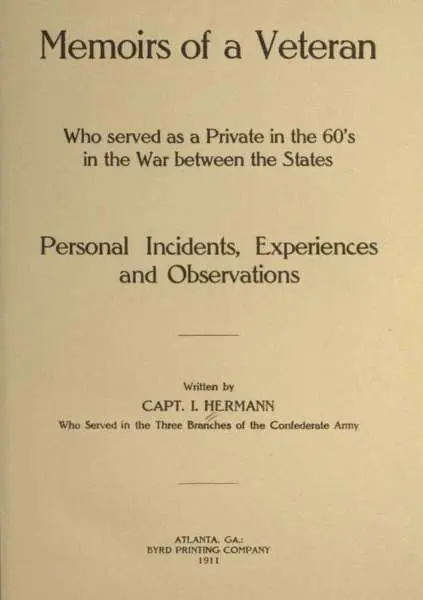
"Memoirs of a Veteran Who Served as a Private in the 60's in the War Between the States" by Capt. I. Hermann is a historical account written in the early 20th century. The book narrates the personal experiences and observations of Hermann, who enlisted in the Confederate Army during the American Civil War. Through his detailed anecdotes, the narrative explores themes of sacrifice, camaraderie, and the harsh realities of warfare from the perspective of a soldier on the front lines. The opening of the memoir introduces Capt. I. Hermann's reflections on the idealized visions of military life presented in propaganda, contrasting them with the grim realities he and his comrades faced. He recalls his enlistment in the Confederate Army in 1861 and the initial enthusiasm among fellow soldiers, driven by patriotism and duty to their homes. Hermann illustrates the early tensions that sparked the Civil War, recounting events like the defense of Fort Sumter, and shares vivid descriptions of his regiment's first encounters, including their experiences leading up to the Battle of Manassas. The early chapters set a foundation for Hermann's journey, highlighting both personal and collective struggles while providing insights into the complexities of war from an intimate viewpoint.
Introduction adapted from the source catalogue; source summaries may be automatically generated.
Free to read · English · 58,417 words · No account needed
MAKE TIME FOR A GOOD BOOK
On by default. Untick to stop anonymous reading totals. Each page counts after 10 seconds in view. How this works.
Anonymous counting is on unless you have switched it off.
On the eighth of May we were ordered to Mississippi. We went by the way of Columbus, Ga., arriving there about three o'clock P. M. The ladies had prepared a fine spread for us at the depot. The men were hungry. Capt. F. G. Wilkins being mayor of the City, Mayor Wilkins was Captain of the Columbus Guards, Company B, First Regiment, Georgia Volunteers, and on his return home, after his severe experience of one year's military service, he preferred civil service as more congenial to his feelings. He was a brave and fearless soldier. At Carricks Ford, he and twelve of his men got mixed in with the Yankees, who at that time wore also grey uniforms. They were Ohio troops. Captain Wilkins on seeing his dilemma, formed his men into line, then into column making them go through evolutions, and manual of arms, and marched them to the rear, and out of the Yankee columns without being suspicioned or receiving a scratch. Such coolness is not often exhibited on a danger line, and Captain Wilkins reached Monterey long before any of the Regiment did, and saved himself and his men a great deal of hardship.
When alighting from the train and seeing all those good things prepared for us, I at once took my position. A lady remarked, "Help yourself." I took hold of a piece of fowl, and as I was about to take a bite, someone struck me on the arm with such force that the piece of fowl dropped out of my hand, and someone said, "Those things are not for you." It was Mayor Wilkins. He was glad to see me, and said, "I have something better for you, boys. How many of the First Georgia are here? Get them all together and follow me." We were about a dozen of the old Washington Rifles. He conducted us to a room where we met a committee of gentlemen. After the usual shaking hands and introductions, we passed into another chamber. I never beheld a more bountiful and artistically prepared spread. Provisions arranged on a revolving table, shelved to a pyramid, and loaded with delicious wines. In a corner of the room was a table covered with case liquors of every description, and some fine cigars. I was astonished, I had no idea such delicacies could have been gotten in the whole Confederacy. We surely did enjoy the hospitality of that Committee. Mayor Wilkins introduced me to a Mr. Rothschild, saying, "I want you to take good care of him, he is a splendid fellow." Turning to me he said, "Hermann, I want you to stay all night with this gentleman, he will treat you all right." I said, "Captain Wilkins, I can't leave camps without a permit, and myself and Captain Howell are not on such terms as for me to ask him for any favors." "Well, I'll arrange that, you come along." Captain Wilkins said to Howell, "I want Ike to go home with my friend here," designating Mr. Rothschild. Captain Howell said, "You'll have to be here by seven o'clock, A. M. The train will leave at that time." Mr. Rothschild spoke up, saying, "I'll have him here on time." I was royally treated; the lady of the house and daughter played on the piano and sang. I joined in the chorus 'till late in the night, when I was shown to my room, nicely furnished, a nice clean feather bed and all the requisites for comfort, but I could not sleep, I did not lay comfortable. The two years service I had seen, made a feather bed rather an impediment to my repose, having become accustomed to sleep out doors on the hard ground, with my knapsack as a pillow, so I got up, put my knapsack under my head and lay by the side of the bed on the carpet, and slept like a log the balance of the night; so soundly, that I did not hear the negro boy who was sent to my room to blacken my boots, open the door, but I heard a noise like someone slamming the door and I heard someone running down stairs. I heard many voices talking, and someone coming up stairs, opening the door very unceremoniously, I looked--there was Mr. Rothschild,--greatly astonished and laughing, he could hardly talk. Finally he said, "What in the world made you lay on the floor." I explained to him that being no longer used to sleeping on a bed, I could not rest until I got on the hard floor. Then he told me he had sent up a boy to blacken my boots, who had scared them all by telling them that the man up stairs had fallen off of the bed and lay dead on the floor. I took my ablution, and went down to breakfast, all enjoying that I was still able to do justice to the meal that my kind host and hostess set before me. After many thanks and good byes to Mr. and Mrs. Rothschild and the family, Mr. Rothschild and myself went down to the train, which was in waiting. Everything was soon ready and we departed for Mobile, Ala. At Greenville, Ala., I met General W. H. T. Walker for the first time. Martin's battery was assigned to his brigade. Captain Martin was promoted to Major, and Chief of Staff of General Walker's brigade, and Lieutenant Evan P. Howell, by right of seniority, took his place as Captain. From Mobile, we went to Jackson, Miss., one section of two cannons were left behind under charge of Lieutenant Robson. The balance arrived at destination at about three o'clock P. M., May 12th, 1863. We unloaded the pieces at once, and all the accoutrements, all the horses and harnessed them up without the loss of any time, took up the line of march towards Raymond Springs. The weather was very warm and the road of red clay was very dusty for men marching in columns. The dust would rise like clouds of ashes at every step. It must be remembered that it was ration day, but we had no time to draw any. As we advanced, we met General Gists' Brigade just out of a fight with General Grant's forces, who landed at Port Gibson, on his forward move to Vicksburg. General Gist had several prisoners. Among them was a Captain. I spoke to him and asked him about the strength of Grant's army. Of course, I did not expect a truthful answer. He replied, "If you'll keep on in the direction you are going, you will meet him. He is not so very far, ahead of you, and when you do meet him, you will think he has more than enough to eat you all up." Well, he did tell the truth, and it has been our misfortune all through the war to fight against many odds. We kept advancing, when of a sudden the command was ordered to halt. We formed ourselves into battery, and I was placed in charge of a detachment. General Walker ordered me to follow him. About two hundred yards ahead the road took a sudden turn around the bluff, which commanded a straight stretch of about a mile. General Walker ordered me to unlimber my gun and place it in position, so as to command that road, and ordered me to fire into any cavalry that might appear. At the further end of my view was a water mill. I remarked, "General, had I not better let them advance somewhat, so as not to waste too much ammunition?" "You must use your own judgment," said he. Looking about me, I saw no infantry in close proximity, so I ventured to ask him where my support was. He answered, "Support Hell!--If they charge you, fight them with the hand spikes, don't you never leave this post," and left.
Your reading position is saved on this browser. Take it to another device with a library code. Reading pages adapt to text, rather than matching a printed edition.
BEHIND THE BOOK
This eBook is for the use of anyone anywhere in the United States and most other parts of the world at no cost and with almost no restrictions whatsoever. You may copy it, give it away or re-use it under the terms of the Project Gutenberg License included with this eBook or online at www.gutenberg.org. If you are not located in the United States, you will have to check the laws of the country where you are located before using this eBook. Read the source licence.
The original source file, including credits and licence, is retained by this library. Request an original-format copy at no charge. Please include the book title and Project Gutenberg identifier #41528.
KEEP YOUR CURIOSITY GOING
Cécile Tormay

Moritz Busch
John L. Ransom
Frances Wright
Cécile Tormay

Mabel Potter Daggett