THE CLASSIC COLLECTION✦An outlaw’s diary: the CommuneCLASSIC FREE BOOKS
An outlaw’s diary: the Commune
Cécile Tormay
THE CLASSIC COLLECTION · 1916
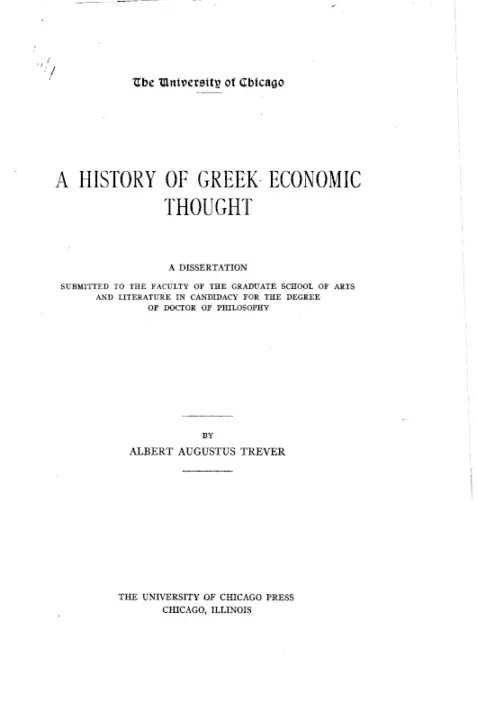
"A History of Greek Economic Thought" by Albert Augustus Trever is a scholarly dissertation composed in the early 20th century. This work explores the evolution of economic theories as conceptualized by ancient Greek philosophers, placing their ideas within the context of both their time and the present humanitarian economic discourse. The book aims to not just chronicle, but also reinterpret Greek economic thought, connecting ancient ideas with modern economic principles. The opening of the work sets forth the author's intention to fulfill a scholarly gap in the discourse of Greek economic theory. It discusses the existing literature on the subject, noting that previous works often failed to approach the topic from the perspective of a classicist infused with a modern economic view. Trever emphasizes that the Greeks, despite their simpler economic environment, fostered significant ethical and humanistic considerations in their economic theories that resonate with contemporary thought. By establishing a chronological format, he intends to analyze the ideas of prominent Greek thinkers, such as Plato and Aristotle, in relation to the economic conditions of their epoch.
Introduction adapted from the source catalogue; source summaries may be automatically generated.
Free to read · English · 58,276 words · No account needed
MAKE TIME FOR A GOOD BOOK
On by default. Untick to stop anonymous reading totals. Each page counts after 10 seconds in view. How this works.
Anonymous counting is on unless you have switched it off.
F. Wilhelm (Rhein. Mus., XVII, No. 2 [1915], 163, n. 2) says: “Eine Geschichte der theoretischen Behandlung der Oekonomik bei den Griechen ist noch zu schreiben.” The present work was undertaken in the year 1911.
Footnote 2:
Cf. Zimmern, Greek Commonwealth, pp. 211 ff.; but the statement on p. 222 is extreme: “where competition and unemployment are unknown terms, where hardly anyone is working precariously for money wages or salary.”
Footnote 3:
Cf. Roscher, Ansichten der Volkswirtschaft (1878), I, chap. i, p. 7; Ar. Pol. 1259b18-21.
Footnote 4:
Cf. Plato Rep. 498A; Xen. Econ., a treatise on household management; Ar. Pol. i. p. 3, on the divisions of οἰκονομία; chap. 8, on whether finance (χρηματιστική) is a part of οἰκονομική; pseudo-Ar. Economica; cf. infra, p. 63, nn. 5 and 6; p. 82, n. 1; p. 128, for fuller discussion.
Footnote 5:
Xen. Mem. iii. 4. 6 ff., especially 12; Econ. xx; Plato Pol. 259 B-C; cf., on this passage, Espinas, Revue des Etudes Grecques, XXVII (1914), 105; cf. Ruskin: “Economy no more means saving money than it means spending money. It means the administration of a house” (A Joy Forever, I, 8, Allen ed., London, 1912, Vol. XVI, 19). We shall frequently quote from this monumental edition of Ruskin.
Footnote 6:
Pol. i. 1. 2: ὅσοι μὲν οὖν οἵονται πολιτικὸν καὶ βασιλικὸν καὶ οἰκονομικὸν καὶ δεσποτικὸν εἶναι τὸν αὐτόν, οὐ καλῶς λέγουσιν.
Footnote 7:
Political Thought of Plato and Aristotle, p. 357; cf. Zmavc, Zeitschr. f. d. gesammt. Staatswissenschaft, 1902, pp. 59 f., and his references to Boeckh, Meyer, and Beloch; Kautz, Die Gesch. d. Entwickelung der National Ökonomik, p. 133, n. 5; for note on the authorship of the Revenues, cf. infra, p. 63, n. 2.
Footnote 8:
Ingram, History of Political Economy, p. 12; cf. Souchon, Les Théories économiques dans la Grèce antique, p. 34.
Footnote 9:
Cf. Souchon, op. cit., pp. 31 ff.
Footnote 10:
Cf. V. Brants, Xenophon Economiste, reprint from Revue Catholique de Louvain, 1881, pp. 4 ff.
Footnote 11:
Ely, Studies in Historical and Political Science, 2d series, pp. 48 ff., especially p. 64, where he states that it is a return to the Greek view.
Footnote 12:
Ely, Outlines of Economics, 1908, pp. 4 ff.; cf. Seligman, Principles of Economy, (1905), pp. 4 ff., especially p. 14, where he even quotes the sentences of Ruskin with approval: “There is no wealth but life”; “Nor can anything be wealth except to a noble person” (Unto This Last, IV, 77 [Vol. XVII, 105]). All citations will be from the Allen library edition unless otherwise stated.
Footnote 13:
Schoenberg, Handbuch der polit. Econ. (1890), I, 56.
Footnote 14:
Haney, History of Economic Thought, p. 52; cf. Ely, op. cit., p. 48, n. 1, cited in n. 1, above, for a similar definition based on Plato.
Footnote 15:
Kautz (op. cit., p. 57) goes to the extreme of saying that antiquity represents “die Negation der ökonomischen Interessen und der wirtschaftlichen Arbeit.”
Footnote 16:
Your reading position is saved on this browser. Take it to another device with a library code. Reading pages adapt to text, rather than matching a printed edition.
BEHIND THE BOOK
This eBook is for the use of anyone anywhere in the United States and most other parts of the world at no cost and with almost no restrictions whatsoever. You may copy it, give it away or re-use it under the terms of the Project Gutenberg License included with this eBook or online at www.gutenberg.org. If you are not located in the United States, you will have to check the laws of the country where you are located before using this eBook. Read the source licence.
The original source file, including credits and licence, is retained by this library. Request an original-format copy at no charge. Please include the book title and Project Gutenberg identifier #58204.
KEEP YOUR CURIOSITY GOING
Cécile Tormay

Moritz Busch
John L. Ransom
Frances Wright
Cécile Tormay

Mabel Potter Daggett