THE CLASSIC COLLECTION✦An outlaw’s diary: the CommuneCLASSIC FREE BOOKS
An outlaw’s diary: the Commune
Cécile Tormay
THE CLASSIC COLLECTION · 1916
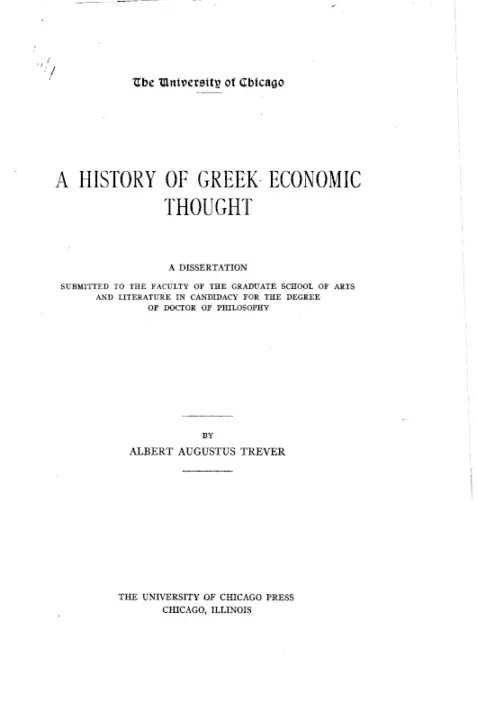
"A History of Greek Economic Thought" by Albert Augustus Trever is a scholarly dissertation composed in the early 20th century. This work explores the evolution of economic theories as conceptualized by ancient Greek philosophers, placing their ideas within the context of both their time and the present humanitarian economic discourse. The book aims to not just chronicle, but also reinterpret Greek economic thought, connecting ancient ideas with modern economic principles. The opening of the work sets forth the author's intention to fulfill a scholarly gap in the discourse of Greek economic theory. It discusses the existing literature on the subject, noting that previous works often failed to approach the topic from the perspective of a classicist infused with a modern economic view. Trever emphasizes that the Greeks, despite their simpler economic environment, fostered significant ethical and humanistic considerations in their economic theories that resonate with contemporary thought. By establishing a chronological format, he intends to analyze the ideas of prominent Greek thinkers, such as Plato and Aristotle, in relation to the economic conditions of their epoch.
Introduction adapted from the source catalogue; source summaries may be automatically generated.
Free to read · English · 58,276 words · No account needed
MAKE TIME FOR A GOOD BOOK
On by default. Untick to stop anonymous reading totals. Each page counts after 10 seconds in view. How this works.
Anonymous counting is on unless you have switched it off.
Hildebrand, B. Xenophontis et Aristot. de oeconomia publico doctrinae illustrantur (dissertation, Marburg, 1845). Part on Aristotle not published.
Hoderman, M. “Quaestionum oeconomicarum specimen,” (dissertation, Berlin, 1896), Berlin Studien für class. Philol. und Arch., XVI, No. 4. On the so-called Economica.
Ingram, J. K. History of Political Economy (1907), pp. 7-26.*
Jowett and Campbell. Republic of Plato (3 vols., 1894).
Kaulla, R. Die geschichtliche Entwickelung der modernen Werttheorien (1906), pp. 3 f. On Aristotle.
Kautsky, K. Die Geschichte des Socialismus in Einzeldarstellungen
(1897), I, 1.
Kautz. Theorie und Geschichte der national Oekonomie (Wien, 2d ed.,
1860), pp. 102-43.*
Knies, Karl. Die politische Economie vom geschichtlichen Standpunkt (1883). Of but slight interest for ancient theory.
Loos, I. A. “Studies in the Politics of Aristotle and the Republic of Plato,” Bull. of the University of Iowa, 1899.
Mabille. “Le communisme et le féminisme à Athènes.” Mémoires de l’académie de Dijon, 4 série, t. 7, pp. 317 ff. (Paris, 1900).
Martiis, S. de. Cognetti (Socialismo antico, Turin, 1899).*
Menger, Karl. Art. “Geld,” Handwörterbuch der Staatswissenschaft (2d
ed.), IV, 82 ff.
Newman. The Politics of Aristotle (Oxford, 1877, 4 vols.).*
Oncken, A. Geschichte der Nationalökonomie (1902), I, 27-49.
Palgrave’s Dictionary. Art. “Aristotle.” This and the above-named article on “Geld” will serve as sufficient notice of the several Dictionaries of Political Economy, to which other references might be made.
Platon, G. “Le socialisme en Grèce,” Devenir Social., January, 1897
ff.
Poehlmann, R. Geschichte des antiken Socialismus und Kommunismus (München, 1893-1901, 2 vols.; 2d ed., 1912, Geschichte der sozialen Frage und des Socialismus in der antiken Welt). A thorough treatment of Greek socialistic tendencies both in theory and in practice, though it exaggerates the development of capitalism in Greece, and draws analogies too freely between ancient and modern socialism. Our citations are from the second edition.*
——. “Die Anfänge des Sozialismus in Europa,” Sybel’s Hist. Zeitschrift, Bd. 79, H. 3, pp. 385-451.
Rambaud, J. Histoire des Doctrines économiques (Paris, 1902).
Regnier, M. L’économie politique et rurale des Grecs.
Robin, L. “Platon et la science sociale,” Revue de metaphysique et de morale, March, 1913 (reprint by Armand Colin, Paris).*
Roscher. “Ueber das Verhältniss der national Oekonomik[** Nationalökonomie] zum klassischen Alterthume,” Ansichten der Volkswirtschaft, I (1878), 1-50.*
Roscher. De doctrinae oeconomico politicae apud Graecos primordiis
(Leipzig, 1866).
Salvio, G. Salomo. Il concetto della schiavitu secundo Aristotile
(Rome, 1881).
——. Communismo nella Grecia antiqua (Padua, 1883).
Schneider. Die staatswirtschaftlichen Lehren des Aristotles
(dissertation, Neu Puppin, 1873).
Schrohl, O. De Eryxias qui fertur Platonis (dissertation, 1901). Chiefly on the authorship of the Eryxias.
Schulte, J. Quomodo Plato in legibus publico Atheniensium instituta respexerit (dissertation, 1907).
Sewall, H. “Theory of Value before Adam Smith,” Publication of American Economic Association, II, Part 3. Four pages on Aristotle.
Shorey, Paul (“Plato’s Laws,” Classical Philology, October, 1914).
Your reading position is saved on this browser. Take it to another device with a library code. Reading pages adapt to text, rather than matching a printed edition.
BEHIND THE BOOK
This eBook is for the use of anyone anywhere in the United States and most other parts of the world at no cost and with almost no restrictions whatsoever. You may copy it, give it away or re-use it under the terms of the Project Gutenberg License included with this eBook or online at www.gutenberg.org. If you are not located in the United States, you will have to check the laws of the country where you are located before using this eBook. Read the source licence.
The original source file, including credits and licence, is retained by this library. Request an original-format copy at no charge. Please include the book title and Project Gutenberg identifier #58204.
KEEP YOUR CURIOSITY GOING
Cécile Tormay

Moritz Busch
John L. Ransom
Frances Wright
Cécile Tormay

Mabel Potter Daggett