THE CLASSIC COLLECTION✦An outlaw’s diary: the CommuneCLASSIC FREE BOOKS
An outlaw’s diary: the Commune
Cécile Tormay
THE CLASSIC COLLECTION · 1916
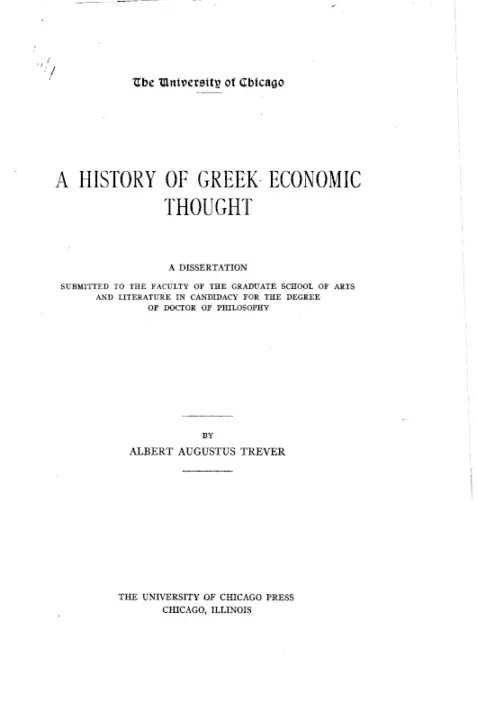
"A History of Greek Economic Thought" by Albert Augustus Trever is a scholarly dissertation composed in the early 20th century. This work explores the evolution of economic theories as conceptualized by ancient Greek philosophers, placing their ideas within the context of both their time and the present humanitarian economic discourse. The book aims to not just chronicle, but also reinterpret Greek economic thought, connecting ancient ideas with modern economic principles. The opening of the work sets forth the author's intention to fulfill a scholarly gap in the discourse of Greek economic theory. It discusses the existing literature on the subject, noting that previous works often failed to approach the topic from the perspective of a classicist infused with a modern economic view. Trever emphasizes that the Greeks, despite their simpler economic environment, fostered significant ethical and humanistic considerations in their economic theories that resonate with contemporary thought. By establishing a chronological format, he intends to analyze the ideas of prominent Greek thinkers, such as Plato and Aristotle, in relation to the economic conditions of their epoch.
Introduction adapted from the source catalogue; source summaries may be automatically generated.
Free to read · English · 58,276 words · No account needed
MAKE TIME FOR A GOOD BOOK
On by default. Untick to stop anonymous reading totals. Each page counts after 10 seconds in view. How this works.
Anonymous counting is on unless you have switched it off.
Footnote 517:
Cf. infra for the Economica, which is generally recognised to be from a later member of the Peripatetic school, about 250-200 B.C.; cf. Susemihl, Economica, Intro. to the ed.; Croiset, op. cit., IV, 710; Zeller, op. cit., II, 2, 944 ff. Moreover, it deals chiefly with the practical phase of economics. On the other hand, we shall cite Eud. Eth. and Mag. mor. under Aristotle, since, though later than him, they merely imitate his thought, in so far as they touch economics. For the numerous and diverse writings ascribed to Aristotle, cf. Christ, op. cit., IV [1905], 684 ff.
Footnote 518:
B. St. Hilaire (preface to his French translation of the Politics, pp. 4-11) calls him “le créateur de l’économie politique.” Zmavc (Archiv f. d. Gesch. d. Philos. [1899], pp. 407 ff.) also tends to overestimate him.
Footnote 519:
Zmavc (ibid, and also Zeitschr. f. d. gesammt. Staatswiss. [1902], pp. 48 ff.) emphasizes this fact.
Footnote 520:
Pol. i. 1. 1252a7-13, cited on p. 9, n. 5, a criticism of Plato’s Politics 258E-259C; on the truth in this confusion, cf. p. 10. Even Adam Smith said: “What is wise with a family can hardly be foolish with a great kingdom.”
Footnote 521:
Besides St. Hilaire and Zmavc, cited above, among those favorable are Cossa, Hist. des doctrines economiques, p. 149; Blanqui, op. cit., I, 49, 86. More reserved are Souchon, op. cit., p. 127; DuBois, op. cit., p. 50; Haney, op. cit., pp. 47 f.; unfair interpretation, Dühring, op. cit., pp. 20 f.
Footnote 522:
i. 9. 1257a6-9: ἑκάστου γὰρ κτήματος διττὴ ἡ χρῆσίς ἐστιν ἀμφότεραι δὲ καθ᾽ αὑτὸ μὲν ἀλλ᾽ οὐχ ὁμοίως καθ᾽ αὑτό, ἀλλ᾽ ἡ μὲν οἰκεία ἡ δ᾽ οὐκ οἰκεία τοῦ πράγματος οἱον ὑποδήματος ἥ τε ὑπόδεσις καὶ ἡ μεταβλητική.
Footnote 523:
Wealth of Nations, I, chap. iv.
Footnote 524:
Cf. Souchon, op. cit., p. 127; Haney, op. cit., p. 47.
Footnote 525:
Unless this is implied in κτήματος, 1257a6, as ἔστι γὰρ ἡ μεταβλητικὴ πάντων (14 f.) might seem to indicate. Zmavc (Archiv., etc., p. 410) points to 1253b33-39, on the automatic tripods of Hephaestus, as implying it, but if so it was unintended by Aristotle. But cf. infra, pp. 84 and 86, n. 4, where it is recognized.
Footnote 526:
1257a11; 5-19, but not specifically stated, and the term χρεία does
not occur here.
Footnote 527:
i. 7. 14: καὶ τὸ σπανιώτερον τοῦ ἀφθόνου, οἷον χρυσὸς σιδήρου ἀχρηστότερος ὤν· ἄλλον δὲ τρόπον τε ἄφθονον τοῦ σπανίου, ὅτι ἡ χρῆσις ὑπερέχει· τὸ γὰρ πολλάκις τοῦ ὀλιγάκις ὑπερέχει· ὅθεν λέγεται ἄριστον μὲν ὕδωρ. Cf. Pind. Ol. i. 1 and Cope-Sandys ed. of Ar. Rhet. (I, pp. 130 f., 1877).
Footnote 528:
Ibid.
Footnote 529:
V, v. 8-14. 1133a5-1133b10 ff.
Footnote 530:
E.g., Stewart.
Footnote 531:
1133a5-12; 15 f.; 18; cf. Eud. Eth. vii. 10. 1243b28-38.
Footnote 532:
N. Eth. 1133a5-12, etc., 12 f.: οὐθὲν γὰρ κωλύει κρεῖττον εἶναι το θατέρου ἔργον ἢ τὸ θατέρου. The emphasis seems to be on quality of labor, as suggested by κρεῖττον. Cf. both ὅσον and οἷον (15) and p. 84 n. 3.
Footnote 533:
Ibid. 7-10; by joining means and extremes together, the proportionate exchange is effected. Cf. also 1133b4 ff.; 1133a32 f. As observed by Ritchie (Palgrave’s Dictionary, art. “Aristotle”) and H. Sewall (op. cit., p. 3, n. 2), the proportion is clearer to moderns if we make our standard one hour of labor of each workman instead of the men themselves.
Footnote 534:
Your reading position is saved on this browser. Take it to another device with a library code. Reading pages adapt to text, rather than matching a printed edition.
BEHIND THE BOOK
This eBook is for the use of anyone anywhere in the United States and most other parts of the world at no cost and with almost no restrictions whatsoever. You may copy it, give it away or re-use it under the terms of the Project Gutenberg License included with this eBook or online at www.gutenberg.org. If you are not located in the United States, you will have to check the laws of the country where you are located before using this eBook. Read the source licence.
The original source file, including credits and licence, is retained by this library. Request an original-format copy at no charge. Please include the book title and Project Gutenberg identifier #58204.
KEEP YOUR CURIOSITY GOING
Cécile Tormay

Moritz Busch
John L. Ransom
Frances Wright
Cécile Tormay

Mabel Potter Daggett