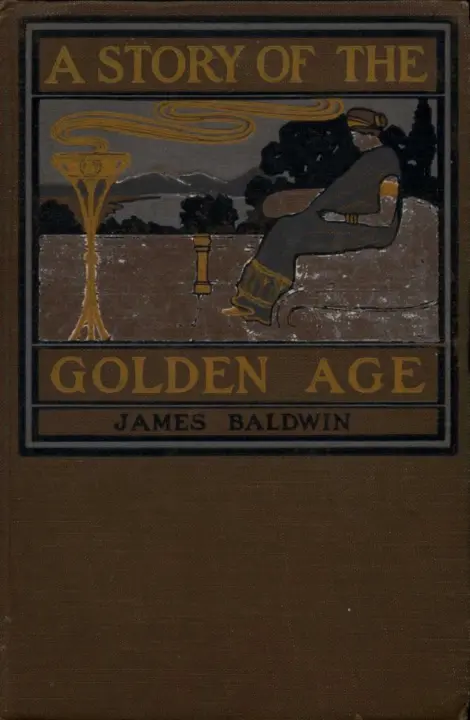
A Story of the Golden Age
James Baldwin
THE CLASSIC COLLECTION · 1892
"Six Centuries of English Poetry: Tennyson to Chaucer" by James Baldwin is a comprehensive anthology of Classic English poetry spanning from the 14th to the 19th century. Written in the late 19th century, this work is part of a series aimed at education, designed for students and teachers to explore notable English literary pieces alongside critical annotations and historical context. The book features selections from renowned poets like Tennyson, Wordsworth, and Chaucer, offering readers an insight into the evolution of English poetic expression through various eras. At the start of the anthology, Baldwin introduces the reader to the historical development of English poetry, suggesting that its roots trace back hundreds of years before Chaucer. He elaborates on the influence of earlier poets and the transition of language, connecting these historical elements to the richness found in later works. Baldwin points out the significance of understanding poetry not just as a literary form but as a reflection of cultural and historical shifts, emphasizing the importance of familiarizing oneself with poetic creations to appreciate their beauty fully. The opening sets a scholarly tone while making an engaging argument for the study of poetry as a vital component of English literature.
Introduction adapted from the source catalogue; source summaries may be automatically generated.
Free to read · English · 75,364 words · No account needed
MAKE TIME FOR A GOOD BOOK
On by default. Untick to stop anonymous reading totals. Each page counts after 10 seconds in view. How this works.
Anonymous counting is on unless you have switched it off.
=Charles Churchill= (1731-1764). "The Prophecy of Famine"; "The Rosciad."
=James Beattie= (1735-1803). "The Minstrel."
=Robert Fergusson= (1750-1774). Short Scottish poems.
=Thomas Chatterton= (1752-1770). "Poems of Thomas Rowlie"; short poems.
=George Crabbe= (1754-1832). "Tales of the Hall"; "The Village"; "The Parish Register"; "Tales in Verse."
=William Blake= (1757-1827). "Songs of Innocence"; "Songs of Experience";
"Poetical Sketches."
=Robert Burns= (1759-1796). See biographical note, page 111.
Robert Burns.
Let not Ambition mock their useful toil, Their homely joys, and destiny obscure; Nor Grandeur hear, with a disdainful smile, The short but simple annals of the Poor.{3}--Gray.
My loved, my honored, much respected friend! No mercenary bard his homage pays; With honest pride, I scorn each selfish end, My dearest meed, a friend's esteem and praise: To you I sing, in simple Scottish lays,{4} The lowly train{5} in life's sequestered scene; The native feelings strong, the guileless ways; What Aiken in a cottage would have been; Ah! though his worth unknown, far happier there I ween.
November chill blaws loud wi' angry sugh;{6} The short'ning winter-day is near a close; The miry beasts retreating frae the pleugh; The black'ning trains o' craws to their repose; The toil-worn Cotter frae his labor goes,-- This night his weekly moil is at an end,-- Collects his spades, his mattocks, and his hoes, Hoping the morn in ease and rest to spend, And weary, o'er the moor, his course does hameward bend.{7}
At length his lonely cot appears in view, Beneath the shelter of an aged tree; Th' expectant wee things toddlin', stacher thro' To meet their dad, wi' flichterin noise an' glee. His wee bit ingle, blinkin' bonnily, His clean hearth-stane, his thriftie wine's smile, The lisping infant prattling on his knee, Does a' his weary carking cares beguile, An' makes him quite forget his labor an' his toil.{8}
Belyve, the elder bairns{9} come drapping in, At service out, amang the farmers roun'; Some ca'{10} the pleugh, some herd, some tentie rin A cannie errand to a neibor{11} town: Their eldest hope, their Jenny, woman grown, In youthfu' bloom, love sparkling in her e'e, Comes hame, perhaps, to shew a braw new gown, Or deposit{12} her sair-won penny-fee,{13} To help her parents dear, if they in hardship be.
Wi' joy unfeigned, brothers and sisters meet, An' each for other's welfare kindly spiers: The social hours, swift-winged, unnoticed fleet; Each tells the uncos that he sees or hears; The parents, partial, eye their hopeful years, Anticipation forward points the view. The mother wi' her needle an' her shears, Gars auld claes look amaist as weel's the new; The father mixes a' wi' admonition due.
Your reading position is saved on this browser. Take it to another device with a library code. Reading pages adapt to text, rather than matching a printed edition.
James Baldwin
James Baldwin
James Baldwin
James Baldwin
BEHIND THE BOOK
This eBook is for the use of anyone anywhere in the United States and most other parts of the world at no cost and with almost no restrictions whatsoever. You may copy it, give it away or re-use it under the terms of the Project Gutenberg License included with this eBook or online at www.gutenberg.org. If you are not located in the United States, you will have to check the laws of the country where you are located before using this eBook. Read the source licence.
The original source file, including credits and licence, is retained by this library. Request an original-format copy at no charge. Please include the book title and Project Gutenberg identifier #30235.
KEEP YOUR CURIOSITY GOING

Eric Mackay
Edmund Gosse
Sophia Margaretta Hensley
Gilbert Parker
George MacDonald

Elizabeth Bibesco