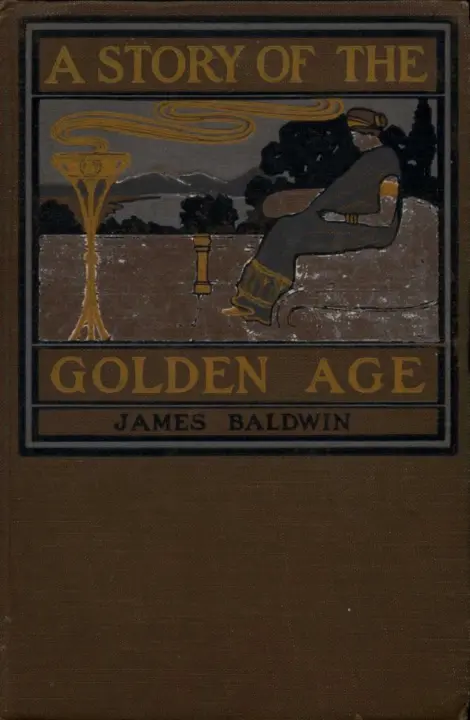
A Story of the Golden Age
James Baldwin
THE CLASSIC COLLECTION · 1892
"Six Centuries of English Poetry: Tennyson to Chaucer" by James Baldwin is a comprehensive anthology of Classic English poetry spanning from the 14th to the 19th century. Written in the late 19th century, this work is part of a series aimed at education, designed for students and teachers to explore notable English literary pieces alongside critical annotations and historical context. The book features selections from renowned poets like Tennyson, Wordsworth, and Chaucer, offering readers an insight into the evolution of English poetic expression through various eras. At the start of the anthology, Baldwin introduces the reader to the historical development of English poetry, suggesting that its roots trace back hundreds of years before Chaucer. He elaborates on the influence of earlier poets and the transition of language, connecting these historical elements to the richness found in later works. Baldwin points out the significance of understanding poetry not just as a literary form but as a reflection of cultural and historical shifts, emphasizing the importance of familiarizing oneself with poetic creations to appreciate their beauty fully. The opening sets a scholarly tone while making an engaging argument for the study of poetry as a vital component of English literature.
Introduction adapted from the source catalogue; source summaries may be automatically generated.
Free to read · English · 75,364 words · No account needed
MAKE TIME FOR A GOOD BOOK
On by default. Untick to stop anonymous reading totals. Each page counts after 10 seconds in view. How this works.
Anonymous counting is on unless you have switched it off.
Here lies, whom hound did ne'er pursue,
Nor swifter greyhound follow,
Whose foot ne'er tainted morning dew,
Nor ear heard huntsman's halloo;
Old Tiney, surliest of his kind,
Who, nursed with tender care,
And to domestic bounds confined,
Was still a wild Jack hare.
Though duly from my hand he took
His pittance every night,
He did it with a jealous look,
And, when he could, would bite.
His diet was of wheaten bread,
And milk, and oats, and straw;
Thistles, or lettuces instead,
With sand to scour his maw.
On twigs of hawthorn he regaled,
On pippins' russet peel,
And, when his juicy salads failed,
Sliced carrot pleased him well.
A Turkey carpet was his lawn,
Whereon he loved to bound,
To skip and gambol like a fawn,
And swing his rump around.
His frisking was at evening hours,
For then he lost his fear,
But most before approaching showers,
Or when a storm drew near.
Eight years and five round-rolling moons
He thus saw steal away,
Dozing out all his idle noons,
And every night at play.
I kept him for his humor's sake,
For he would oft beguile
My heart of thoughts that made it ache,
And force me to a smile.
But now beneath this walnut shade
He finds his long last home,
And waits, in snug concealment laid,
Till gentler Puss shall come.
He, still more agèd, feels the shocks
From which no care can save,
And, partner once of Tiney's box,
Must soon partake his grave.
WILLIAM COWPER was born at Great Berkhamstead, November 26, 1731. His father was the rector of the parish, and his mother was Ann Donne of the family of the famous John Donne. Cowper was educated at a private school and afterwards at Westminster. It was intended that he should follow the profession of law, and, after the completion of his studies at Westminster, he entered the Middle Temple and was articled to a solicitor. At the age of twenty-two, through the influence of his uncle, Major Cowper, he was appointed to two clerkships in the House of Lords. The excitement brought on by this occurrence, together with an unhappy love affair, induced an attack of insanity, from which he suffered for more than a year. In 1773 he suffered from a second attack of insanity, which continued for sixteen months. It was not until 1780, when in his fiftieth year, that he began really to write poetry. His first volume was published in 1782, and comprised, besides several shorter pieces, the three poems, "Conversation," "Retirement," and "Table Talk." His second volume appeared in 1785, and contained "The Task," "Tirocinium," and the ballad of "John Gilpin," which had already become famous through the recitations of one Henderson, an actor. Cowper's translation of Homer was completed and published in 1791. From that time until his death in 1800 he suffered from hopeless dejection, regarding himself as an object of divine wrath, a condemned and forsaken outcast.
Your reading position is saved on this browser. Take it to another device with a library code. Reading pages adapt to text, rather than matching a printed edition.
James Baldwin
James Baldwin

James Baldwin
James Baldwin
BEHIND THE BOOK
This eBook is for the use of anyone anywhere in the United States and most other parts of the world at no cost and with almost no restrictions whatsoever. You may copy it, give it away or re-use it under the terms of the Project Gutenberg License included with this eBook or online at www.gutenberg.org. If you are not located in the United States, you will have to check the laws of the country where you are located before using this eBook. Read the source licence.
The original source file, including credits and licence, is retained by this library. Request an original-format copy at no charge. Please include the book title and Project Gutenberg identifier #30235.
KEEP YOUR CURIOSITY GOING

Eric Mackay
Edmund Gosse
Sophia Margaretta Hensley
Gilbert Parker
George MacDonald

Elizabeth Bibesco