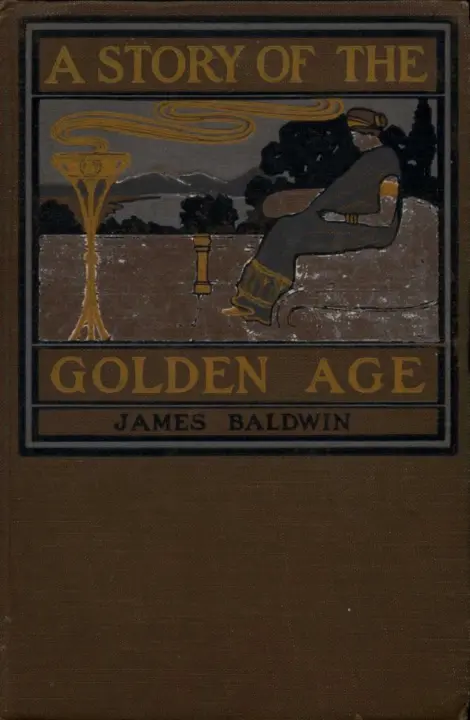
A Story of the Golden Age
James Baldwin
THE CLASSIC COLLECTION · 1892
"Six Centuries of English Poetry: Tennyson to Chaucer" by James Baldwin is a comprehensive anthology of Classic English poetry spanning from the 14th to the 19th century. Written in the late 19th century, this work is part of a series aimed at education, designed for students and teachers to explore notable English literary pieces alongside critical annotations and historical context. The book features selections from renowned poets like Tennyson, Wordsworth, and Chaucer, offering readers an insight into the evolution of English poetic expression through various eras. At the start of the anthology, Baldwin introduces the reader to the historical development of English poetry, suggesting that its roots trace back hundreds of years before Chaucer. He elaborates on the influence of earlier poets and the transition of language, connecting these historical elements to the richness found in later works. Baldwin points out the significance of understanding poetry not just as a literary form but as a reflection of cultural and historical shifts, emphasizing the importance of familiarizing oneself with poetic creations to appreciate their beauty fully. The opening sets a scholarly tone while making an engaging argument for the study of poetry as a vital component of English literature.
Introduction adapted from the source catalogue; source summaries may be automatically generated.
Free to read · English · 75,364 words · No account needed
MAKE TIME FOR A GOOD BOOK
On by default. Untick to stop anonymous reading totals. Each page counts after 10 seconds in view. How this works.
Anonymous counting is on unless you have switched it off.
"Moreover, something is or seems,
That touches me with mystic gleams,
Like glimpses of forgotten dreams;
"Of something felt, like something here;
Of something done, I know not where;
Such as no language may declare."
19. =The clouds that gather.= Compare these lines with the following from Wordsworth's "Excursion":
"Ah! why in age
Do we revert so fondly to the walks
Of childhood, but that there the soul discerns
The dear memorial footsteps unimpair'd
Of her own native vigor, thence can hear
Reverberations and a choral song,
Commingling with the incense that ascends
Undaunted toward the imperishable heavens,
From her own lonely altar?"
[44:A] The first stanza of We are Seven, said to have been written by
Coleridge.
We walked along, while bright and red
Uprose the morning sun;
And Matthew{1} stopped, he looked, and said,
'The will of God be done!'
A village schoolmaster was he,
With hair of glittering gray;
As blithe a man as you could see
On a spring holiday.
And on that morning, through the grass,
And by the steaming rills,
We travelled merrily, to pass
A day among the hills.
'Our work,' said I, 'was well begun:
Then, from thy breast what thought,
Beneath so beautiful a sun,
So sad a sigh has brought?'
A second time did Matthew stop,
And fixing still his eye
Upon the eastern mountain-top,
To me he made reply:
'Yon cloud with that long purple cleft
Brings fresh into my mind
A day like this which I have left
Full thirty years behind.
And just above yon slope of corn
Such colors, and no other,
Were in the sky, that April morn,
Of this the very brother.
With rod and line I sued the sport
Which that sweet season gave,
And, to the church-yard come, stopped short
Beside my daughter's grave.
Nine summers had she scarcely seen,
The pride of all the vale:
And then she sang;--she would have been
A very nightingale.
Six feet in earth my Emma lay;
And yet I loved her more,
For so it seemed, than till that day
I e'er had loved before.
And, turning from her grave, I met,
Beside the churchyard yew,
A blooming girl, whose hair was wet
With points of morning dew.
A basket on her head she bare;
Her brow was smooth and white:
To see a child so very fair,
It was a pure delight!
No fountain from its rocky cave
E'er tripped with foot so free;
She seemed as happy as a wave
That dances on the sea.
Your reading position is saved on this browser. Take it to another device with a library code. Reading pages adapt to text, rather than matching a printed edition.
James Baldwin
James Baldwin
James Baldwin
James Baldwin
BEHIND THE BOOK
This eBook is for the use of anyone anywhere in the United States and most other parts of the world at no cost and with almost no restrictions whatsoever. You may copy it, give it away or re-use it under the terms of the Project Gutenberg License included with this eBook or online at www.gutenberg.org. If you are not located in the United States, you will have to check the laws of the country where you are located before using this eBook. Read the source licence.
The original source file, including credits and licence, is retained by this library. Request an original-format copy at no charge. Please include the book title and Project Gutenberg identifier #30235.
KEEP YOUR CURIOSITY GOING

Eric Mackay
Edmund Gosse
Sophia Margaretta Hensley
Gilbert Parker
George MacDonald

Elizabeth Bibesco